Simple question regarding weight flow rate and specific gravity

Click For Summary
SUMMARY

This discussion clarifies the use of specific gravity (SG) in calculating weight flow rate in hydraulics. The weight flow rate is determined using the formula: weight flow rate = unit weight (SG) x Q, where Q is the volumetric flow rate. The unit weight of water is 9810 N/m³, derived from the density of water (1000 kg/m³) multiplied by the acceleration due to gravity (9.81 m/s²). Understanding this relationship is crucial for accurately solving problems involving different fluids, particularly when specific gravity is provided.

PREREQUISITES
  • Understanding of specific gravity and its definition
  • Familiarity with unit weight and its calculation
  • Knowledge of flow rate concepts in hydraulics
  • Basic principles of fluid mechanics
NEXT STEPS
  • Study the derivation of unit weight from density and gravity
  • Learn about the implications of using different units in fluid dynamics
  • Explore the effects of temperature and pressure on fluid density
  • Investigate common hydraulic formulas and their applications
USEFUL FOR

This discussion is beneficial for students studying hydraulics, engineers working with fluid dynamics, and professionals involved in applications requiring precise calculations of weight flow rates in various fluids.

drdyke
Messages
3
Reaction score
0
Homework Statement
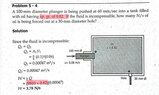
A 100 mm diameter plunger is being pushed at 60 mm/sec into a tank filled with oil having sp.gr. of 0.82. If the fluid is incompressible, how many N/s of oil is being forced out a 30-mm diameter hole?
Relevant Equations
weight flow rate = unit weight x Q

Q1 = Q2
i’m studying my textbook in hydraulics and i’d like to know the reason why specific gravity is used in one of the problems. it’s a pretty simple problem and i understood it mostly except why specific gravity is multiplied to 9810 (the unit weight of water). if the SG is given in the problem, is it always multiplied to the unit weight?

Thanks
 

Attachments

  • 9D16A092-0839-4E2E-A6EA-CC113B2A5A55.jpeg
    9D16A092-0839-4E2E-A6EA-CC113B2A5A55.jpeg
    57.9 KB · Views: 154
Physics news on Phys.org
Have you looked up what "specific gravity" means?

Ideally you would do that in the textbook, but failing that google will probably have the answer.
 
pasmith said:
Have you looked up what "specific gravity" means?

Ideally you would do that in the textbook, but failing that google will probably have the answer.
i do know that specific gravity is the ratio of density of fluid over density of water. what i am confused tho is why it is multiplied to the unit weight 9810 when it isn’t stated in the formula? i just want that part cleared up so i won’t be confused on future problems anymore

thanks
 
drdyke said:
when it isn’t stated in the formula?
What formula?

(I have to say, Newtons is a peculiar way to express a quantity of oil being exuded. Far more reasonable to express it as a mass.)
 
  • Like
Likes   Reactions: hutchphd
drdyke said:
i do know that specific gravity is the ratio of density of fluid over density of water. what i am confused tho is why it is multiplied to the unit weight 9810 when it isn’t stated in the formula? i just want that part cleared up so i won’t be confused on future problems anymore

thanks

Ideally your textbook should tell you what value to use if the question does not explicitly state a value. Remember that density depends on pressure and temperature, neither of which are given in the question.
 
haruspex said:
What formula?

(I have to say, Newtons is a peculiar way to express a quantity of oil being exuded. Far more reasonable to express it as a mass.)
weight flow rate = unit weight x Q

here the process became

weight flow rate = unit weight (SG) x Q
 
drdyke said:
what i am confused tho is why it is multiplied to the unit weight 9810 when it isn’t stated in the formula? i just want that part cleared up so i won’t be confused on future problems anymore
You are expected to be able to adapt a formula if necessary. Don’t expect a different formula for every possible slightly different variation of a problem.

The question asks for the flow-rate in N/s, so you know that you are being asked to calculate the weight of oil coming out per second. (As already noted, this is a rather unusual way to express flow-rate.)

You should be given the nominal value for the density of water (1000kg/m³) and for the acceleration due to gravity (9.81m/s² = 9.81 N/kg). You are expected to sort out for yourself that:

a) the density of water can be expressed as 1000*9.81 = 9810 N/m³

b) the density of oil can be expressed as 9810 x 0.82 N/m³

c) multiplying ##Q_2## (outgoing flow rate in m³/s) by 9810 x 0.82 N/m³ will give you the flow- rate in N/s as required.

Also, note that the model answer has some faults with rounding and use of significant figures. You may want to see if you can spot the faults!
 
drdyke said:
weight flow rate = unit weight x Q
… where Q is the volume per unit time, and unit weight means weight per unit volume.
(volume/time)x(weight/volume)=(weight/time).
drdyke said:
…here the process became weight flow rate = unit weight (SG) x Q
SG is defined as the mass of a given volume of the substance divided by the mass of an equal volume of water.
weight of volume V of substance = (mass of volume V of substance) x g
= (mass of volume V of water) x SG x g = (weight of volume V of water) x SG
Dividing through by the volume:
weight per unit volume V of substance = (weight per unit volume V of water) x SG
i.e.
unit weight of substance = (unit weight of water) x SG
 
drdyke said:
weight flow rate = unit weight (SG) x Q
What if this oil tank happens to be located on the ISS, on the moon or in the engine compartment of a formula 1 race car in the middle of turn 1 using a convention that ##g## is measured relative to the race car frame.
 
  • #10
jbriggs444 said:
What if this oil tank happens to be located on the ISS, on the moon or in the engine compartment of a formula 1 race car in the middle of turn 1 using a convention that ##g## is measured relative to the race car frame.
Agreed, but this bizarre use of weight per unit time as a measure of flow rate seems to come from the problem setter. We can but sigh.
 
  • #11
haruspex said:
Agreed, but this bizarre use of weight per unit time as a measure of flow rate seems to come from the problem setter. We can but sigh.
I have occasionally encountered questions of this kind where the author expects an answer in outré units apparently for no other reason than to be irritating. The end result is detraction from the underlying physical principle that is showcased. Sigh indeed.
 
  • Like
Likes   Reactions: hutchphd
  • #12
kuruman said:
I have occasionally encountered questions of this kind where the author expects an answer in outré units apparently for no other reason than to be irritating. The end result is detraction from the underlying physical principle that is showcased. Sigh indeed.
Judging from 8.18 at , it may have arisen as a translation from pounds/s.
 

Similar threads

  • · Replies 1 ·
Replies
1
Views
2K
  • · Replies 22 ·
Replies
22
Views
994
Replies
17
Views
10K
  • · Replies 29 ·
Replies
29
Views
7K
  • · Replies 2 ·
Replies
2
Views
16K
  • · Replies 2 ·
Replies
2
Views
11K
  • · Replies 21 ·
Replies
21
Views
9K
  • · Replies 5 ·
Replies
5
Views
3K
  • · Replies 5 ·
Replies
5
Views
3K
Replies
3
Views
2K