Simple Thevenin equivalent resistance problem

Click For Summary

Homework Help Overview

The discussion revolves around calculating the Thevenin equivalent resistance in a circuit. Participants are examining the configuration of resistors and the methods for determining equivalent resistance, particularly in the context of series and parallel arrangements.

Discussion Character

  • Exploratory, Assumption checking, Problem interpretation

Approaches and Questions Raised

  • Participants discuss the original poster's calculation attempts and question the configuration of resistors, particularly the relationships between R1, R2, and R3. There are inquiries about the use of a multi-meter in a live circuit and suggestions for alternative methods to analyze the circuit, including redrawing the circuit and applying Y-Delta transformations.

Discussion Status

The discussion includes various interpretations of the circuit setup and the challenges faced in identifying series and parallel connections. Some participants have offered guidance on potential methods to approach the problem, while others are reflecting on their understanding and considering new strategies.

Contextual Notes

Participants express uncertainty about recognizing resistor configurations and the implications of measuring resistance in a live circuit. There is mention of previous coursework on Y-Delta transformations, indicating a gap in practical application.

DrOnline
Messages
73
Reaction score
0
Gentlemen.

Homework Statement


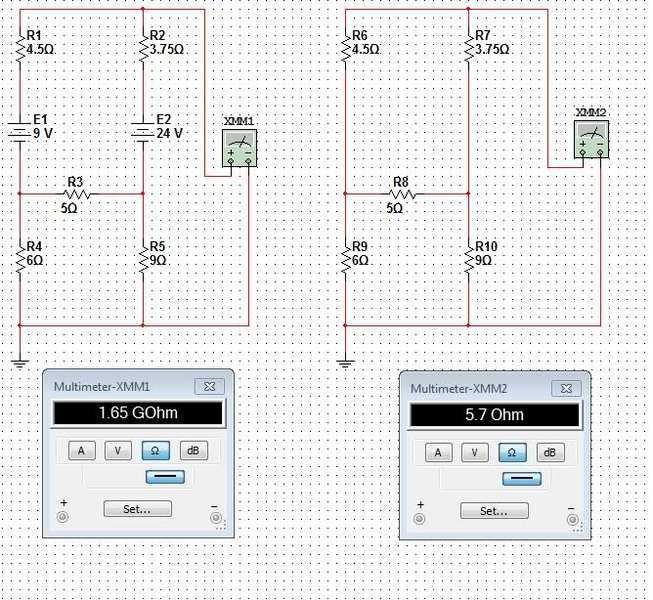
21e5aa8.jpg


Calculate the Thevenin equivalent resistance.

Homework Equations


Rseries - Rtot = R1 + R2 + ... + Rn

Rparallel - Rtot = 1/(R1^-1 + R2^-1 ... + Rn^-1)


The Attempt at a Solution


As the picture shows, The second ohm-meter tells me 5.7 Ohms is the correct answer. I also have this answer given to me in the task.

But I must be inept at calculating resistances, because I read it this way:

Rth = (R1||R2) + R3 + (R4||R5)

Rth = 2.045 + 5 + 3.6

Rth = 10,645

Obviously wrong. Even if I disregard R3, I get 5.6045 != 5.7.
 
Physics news on Phys.org
R1 is not in parallel with R2. R3 is in the way! In order to be in parallel they'd have to share exactly two nodes.
 
I don't understand the left side of your diagram. What are you doing with a multi-meter set to measure ohms and hooked up to a live circuit?
 
gneill said:
R1 is not in parallel with R2. R3 is in the way! In order to be in parallel they'd have to share exactly two nodes.

Thanks! I'm new to this, and unfortunately terrible at recognizing what's parallel and what's serial. I'll review it again today.


phinds said:
I don't understand the left side of your diagram. What are you doing with a multi-meter set to measure ohms and hooked up to a live circuit?

This picture is just something I threw up real quick for illustration. The left side is largely irrelevant. I just didn't know how to draw terminals, so I felt I had to hook it up to the ohmmeter to illustrate.
 
So what's your new plan of attack for finding the equivalent resistance?
 
DrOnline said:
... I felt I had to hook it up to the ohmmeter to illustrate.

OK, understood, but I'd avise you not to ever do that in a real situation unless you don't care if you burn out the ohmmeter.
 
gneill said:
So what's your new plan of attack for finding the equivalent resistance?

I'm trying to find another way of look at the circuit, perhaps redrawing it to make it more intuitive. I'm also going to try just brute forcing it and then from that make a new drawing and see if I can understand it.
 
You may not be able to "redraw away" the inherent difficulty of not having any series or parallel opportunities to exploit for simplification. When brute force falters, try a little finesse :smile:

Two suggestions:
1) Investigate what are called Y-Delta and Delta-Y transformations.
2) Place a voltage source V where your Ohm meter is and use circuit analysis methods to find the current that this voltage would push into the circuit. Then R = V/I.
 
214cwgo.jpg


Alright, so this circuit redrawing is not equivalent to the original, then.

Yeah we covered Y-Delta and Delta-Y in lectures, I've just never done it myself. I'm looking into it.

Thanks a lot by the way.
 
  • #10
I left this work for a while to focus on some other papers I had to hand in.

But I picked it up today, and I worked it out, by R3, R4 and R5 from a PI into a T, and got the 5.7 Ohm correct.

Thanks for the help lads!
 

Similar threads

  • · Replies 7 ·
Replies
7
Views
1K
  • · Replies 11 ·
Replies
11
Views
2K
  • · Replies 6 ·
Replies
6
Views
3K
  • · Replies 7 ·
Replies
7
Views
2K
Replies
5
Views
2K
  • · Replies 2 ·
Replies
2
Views
3K
  • · Replies 3 ·
Replies
3
Views
2K
  • · Replies 4 ·
Replies
4
Views
2K
  • · Replies 4 ·
Replies
4
Views
2K
Replies
4
Views
1K