Simple Unitial Rings .... centre is a field .... ? ....

  • Context: Undergrad 
  • Thread starter Thread starter Math Amateur
  • Start date Start date
  • Tags Tags
    Field Rings
Click For Summary
SUMMARY

The discussion centers on Example 1.21 from Matej Bresar's "Introduction to Noncommutative Algebra," specifically regarding simple unital rings and the implications of a nonzero central element. It is established that if a nonzero central element ##c## satisfies ##cA = A##, then ##c## must be invertible. This conclusion is drawn from the fact that the presence of ##1 \in A## allows for the expression of unity as ##1 = c \cdot a## for some element ##a \in A##, thereby defining ##a## as ##c^{-1}##.

PREREQUISITES
  • Understanding of simple unital rings
  • Familiarity with central elements in ring theory
  • Knowledge of ideals in algebraic structures
  • Basic concepts of invertibility in rings
NEXT STEPS
  • Study the properties of simple unital rings in detail
  • Explore central elements and their roles in ring theory
  • Investigate the concept of ideals and their implications in algebra
  • Learn about invertible elements in various algebraic structures
USEFUL FOR

Mathematicians, algebraists, and students studying noncommutative algebra, particularly those focusing on finite dimensional division algebras and the properties of simple unital rings.

Math Amateur
Gold Member
MHB
Messages
3,920
Reaction score
48
I am reading Matej Bresar's book, "Introduction to Noncommutative Algebra" and am currently focussed on Chapter 1: Finite Dimensional Division Algebras ... ...

I need help with some remarks of Bresar in Example 1.21 on simple unital rings ...

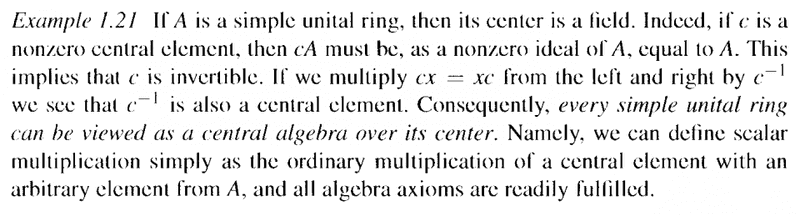
Example 1.21 reads as follows:
?temp_hash=ff70c267b1aa1206a42f97293969b974.png

In the above text from Bresar, we read the following:

" ... ... Indeed, if ##c## is a nonzero central element, then ##cA## must be, as a nonzero idea of ##A##, equal to ##A##. This implies that ##c## is invertible. ... ... "Can someone please show me exactly why it is the case that ##cA## being equal to ##A## implies that ##c## is invertible ...Help will be appreciated ...

Peter
 

Attachments

  • Bresar - Example 1.21 on Simple Unital Rings ... ....png
    Bresar - Example 1.21 on Simple Unital Rings ... ....png
    23.7 KB · Views: 761
Physics news on Phys.org
We have ##1 \in A##. Therefore ##0 \neq c = c\cdot 1 \in cA## is a non-trivial ideal of ##A##. Since ##A## is simple, it has to be the entire ring, i.e. ##cA=A##. Now ##1 \in A = cA## means ##1## can be written as ##1=c \cdot a## for some ##a \in A##. We denote this ##a## by ##c^{-1}##.
 
  • Like
Likes   Reactions: Math Amateur
Thanks ... appreciate your help ...

Peter
 

Similar threads

  • · Replies 2 ·
Replies
2
Views
1K
  • · Replies 17 ·
Replies
17
Views
3K
  • · Replies 7 ·
Replies
7
Views
2K
  • · Replies 2 ·
Replies
2
Views
2K
  • · Replies 4 ·
Replies
4
Views
2K
  • · Replies 2 ·
Replies
2
Views
1K
Replies
3
Views
2K
  • · Replies 1 ·
Replies
1
Views
2K
Replies
1
Views
1K
  • · Replies 6 ·
Replies
6
Views
2K