Simplification of the Proca Lagrangian

Click For Summary

Homework Help Overview

The discussion revolves around the simplification of the Proca Lagrangian, specifically focusing on the derivation of a term within the Euler-Lagrange equation related to a vector field Lagrangian. Participants are attempting to clarify the origin of certain terms and their manipulations in the context of tensor calculus.

Discussion Character

  • Exploratory, Conceptual clarification, Mathematical reasoning

Approaches and Questions Raised

  • Participants are examining the derivation of the term -1/(4π) and its relation to the Lagrangian. They discuss the application of the Euler-Lagrange equation and the implications of the product rule in tensor calculus. Some express uncertainty about their understanding of tensor calculus and its application in this context.

Discussion Status

There is an ongoing exploration of the mathematical steps involved in deriving the term in question. Some participants have provided hints and partial derivations, while others are seeking confirmation of their understanding and whether any steps are missing. The discussion remains open without a definitive consensus on the resolution of the problem.

Contextual Notes

Some participants indicate a lack of background in tensor calculus, which may affect their ability to follow the discussion fully. There is also mention of specific equations and terms from a textbook that are not fully explained, leading to questions about their derivation.

fabstr1
Messages
4
Reaction score
1
Homework Statement
How do I simplify the Proca lagrangian for a spin-1 field
Relevant Equations
L = -(1/16*pi) * ( ∂^(μ)A^(ν) - ∂^(ν)A^(μ))(∂_(μ)A_(ν) - ∂_(ν)A_(μ)) + 1/(8*pi) * (mc/hbar)^2* A^ν A_ν
Hello,
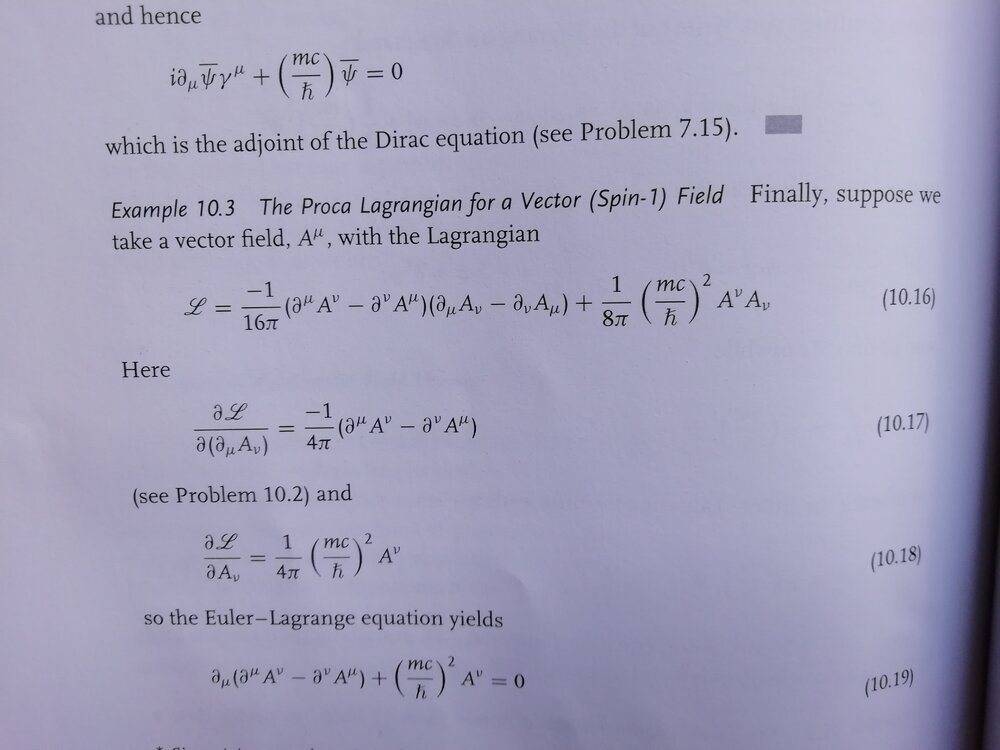
I'm trying to figure out where the term (3) came from. This is from a textbook which doesn't explain how they do it.

∂_μ(∂L/(∂(∂_μA_ν)) = ∂L/∂A_ν (1)

L = -(1/16*pi) * ( ∂^(μ)A^(ν) - ∂^(ν)A^(μ))(∂_(μ)A_(ν) - ∂_(ν)A_(μ)) + 1/(8*pi) * (mc/hbar)^2* A^ν A_ν (2)

Here is Eq (1) the Euler-Lagrange equation and Eq (2) is the lagrangian for a vector field. In the textbook they just state the term

∂_μ(∂L/(∂(∂_μA_ν)) = -1/(4*pi)*(∂^(μ)A^(ν) - ∂^(ν)A^(μ)) (3)

Where does the term -1/(4*pi) come from, and how do I cancel out the rest of the term so that the equation becomes

∂_μ(∂^(μ)A^(ν) - ∂^(ν)A^(μ)) + (mc/hbar)^2* A^ν (4)
qft.jpg
 
  • Like
Likes   Reactions: JD_PM
Physics news on Phys.org
Hints:

##\mathcal{L}= -\frac{1}{16\pi}F^{\mu\nu}F_{\mu\nu} ##

Now:
##F^{\mu\nu}= \eta^{\mu n}\eta^{\nu m}F_{nm}##

Now use this in above equation and:

##F_{nm}=\partial_n A_m- \partial_m A_n##
And
##F_{nm}= -F_{mn}##
 
  • Like
Likes   Reactions: JD_PM
But what happends to the rest of the term in Eq (10.17), where is the -1/(4*pi) term coming from.

L = - (1/(16*pi)) * η^(μν)η^(νμ)*F_(μν)
 
Last edited:
fabstr1 said:
But what happends to the rest of the term in Eq (10.17), where is the -1/(4*pi) term coming from.

L = - (1/(16*pi)) * η^(μν)η^(νμ)*F_(μν)
Ok. I will do one more step for you.

##\mathcal{L}= \frac{-1}{16\pi} \eta^{\mu n}\eta^{\nu m} F_{nm}F_{\mu\nu}##

Now, taking the differential and applying product rule to above term throws a factor of 2(Due to symmetry of product) so this becomes (Dropping the metric tensors for brevity):

##\partial\mathcal{L}= \frac{-1}{8\pi} F_{nm}\partial F_{\mu\nu}##

Now, use the defination of ##F_{nm}##
 
I haven't taken any tensor calculus before, so I'm not sure if I'm doing it right.

∂L/∂F_{ μν } = - 1/(16*pi) * η^(μν)η^(νμ)*F_(μν)* F_(μν) = - 1/(16*pi)*η^(μν)η^(νμ)* F_(μν)^2 = -1/(8*pi)*η^(μν)η^(νμ)* F_(μν) = - 1/(8*pi)*η^(μν)η^(νμ)*(∂^(μ)A^(ν) - ∂^(ν)A^(μ))
 
I have updated my solution shown below. Is it ok, or is there something that are missing ?


Similar threads

  • · Replies 4 ·
Replies
4
Views
5K
  • · Replies 1 ·
Replies
1
Views
3K
  • · Replies 4 ·
Replies
4
Views
2K
  • · Replies 3 ·
Replies
3
Views
2K
  • · Replies 3 ·
Replies
3
Views
1K
  • · Replies 2 ·
Replies
2
Views
4K
  • · Replies 7 ·
Replies
7
Views
1K
  • · Replies 12 ·
Replies
12
Views
1K
  • · Replies 7 ·
Replies
7
Views
2K
  • · Replies 4 ·
Replies
4
Views
2K