Simplifying Trigonometric Antiderivative using Right Triangles?

OmniNewton
Messages
105
Reaction score
5
Mod note: Moved from a homework section
1. Homework Statement

Hello my question more has to do with theory that perhaps deals with algebra.

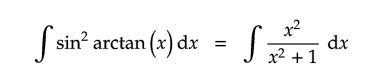
Why is the following true?
7b9324fbb148a9401897d88800b7d547.png


Homework Equations


N/A

The Attempt at a Solution


N/A[/B]
 
Last edited by a moderator:
Physics news on Phys.org
Have you tried to apply the formulas ##cos^2x + sin^2x = 1## and ##tan (x)=\frac{sin (x)}{cos (x)}##?
 
fresh_42 said:
Have you tried to apply the formulas ##cos^2x + sin^2x = 1## and ##tan (x)=\frac{sin (x)}{cos (x)}##?
Hello, fresh_42

Thank you for the reply I have attempted to apply the identity cos^2x + sin^2x = 1 and could not figure out an algebraic means to have this work out. As for the reciprocal identity tanx = sinx/cosx. I do not see how this identity applies to arctanx since arctanx does not equal arcsinx/arccosx

Regards,

OmniNewton
 
Because you have integrals on both sides, you can instead show that the two integrands are equal (plus possibly a constant). IOW, just show that ##\sin^2(\arctan(x)) = \frac{x^2}{x^2 + 1} + C##

The best way to do this, IMO, is to draw a right triangle, and label an acute angle ##\theta##, with the opposite as x and the adjacent side as 1. The ##\tan(\theta) = \frac x 1##. Now find ##sin(\theta)##.
 

Similar threads

  • · Replies 6 ·
Replies
6
Views
3K
  • · Replies 2 ·
Replies
2
Views
1K
  • · Replies 4 ·
Replies
4
Views
1K
  • · Replies 8 ·
Replies
8
Views
2K
  • · Replies 2 ·
Replies
2
Views
2K
  • · Replies 1 ·
Replies
1
Views
1K
Replies
8
Views
2K
  • · Replies 3 ·
Replies
3
Views
2K
  • · Replies 8 ·
Replies
8
Views
2K
  • · Replies 7 ·
Replies
7
Views
2K