Sinusoidal steady state circuit

Click For Summary

Discussion Overview

The discussion revolves around calculating the currents in a sinusoidal steady state circuit given a specific voltage source. Participants explore various methods to approach the problem, including matrix calculations and assumptions about the circuit's resistive nature.

Discussion Character

  • Technical explanation
  • Mathematical reasoning
  • Debate/contested

Main Points Raised

  • One participant presents a method to solve for currents using a matrix, expressing uncertainty about the format of the final solution.
  • Another participant suggests treating the circuit as if it were powered by a DC source, implying that the phase of the current will not be affected due to the purely resistive nature of the circuit.
  • Several participants report different magnitudes for the currents, with one stating a magnitude of √2/2 and others stating a magnitude of 1.
  • One participant notes a discrepancy between currents Ia and Ib, prompting a request for verification of matrix calculations.
  • Another participant provides specific values for currents I1, I2, and I3, clarifying their definitions and relationships.

Areas of Agreement / Disagreement

There is no consensus on the final values of the currents, as participants report different magnitudes and relationships between the currents. Discrepancies in calculations and interpretations of the circuit's behavior are evident.

Contextual Notes

Participants express uncertainty regarding the correct format for the final solution and the implications of treating the circuit as a DC source. There are unresolved calculations and assumptions about the circuit's configuration.

magnifik
Messages
350
Reaction score
0
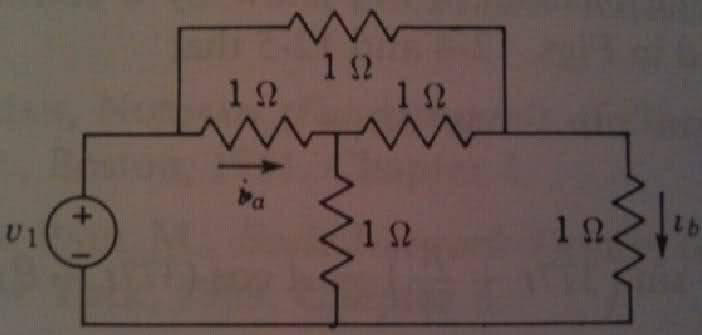
I am trying to find the indicated currents for the following circuit, given v1 = 2sin(2t + 45):
m80hkz.jpg


I attempted to solve it in the following way:
v1 = 2sin(2t+45) // given
= 2[sin(2t)cos(45) + cos(2t)sin(45)]
= √2[sin(2t) + cos(2t)]

I use a matrix for the loops:
A =
[2 -1 -1
-1 3 -1
-1 -1 3]

b =
[√2
0
0]

I'm wondering what format the final solution should be in. Should it be Isin(2t+45) or I[sin(2t) + cos(2t)]?

Btw, I got √2/2 for the magnitude of both the currents.
Any input is appreciated. Thanks in advance.
 
Physics news on Phys.org
Since the network is purely resistive it won't muck about with the current phase anywhere in the circuit. So I'd solve for the currents as though it were a DC source of 2V. Tack the sin(2t+45) back onto the results you get and call it a day!
 
gneill said:
Since the network is purely resistive it won't muck about with the current phase anywhere in the circuit. So I'd solve for the currents as though it were a DC source of 2V. Tack the sin(2t+45) back onto the results you get and call it a day!

ok. thank you.
 
I got 1 as the magnitude for both of the currents so i = sin(2t + 45)
 
magnifik said:
I got 1 as the magnitude for both of the currents so i = sin(2t + 45)

I find that Ia is not the same as Ib. Perhaps you can check your matrix calculation?
 
I got I1 = 2, I2 = 1, I3 = 1
where I1 is the current in the loop on the left part of the circuit, I2 is the current in the top part of the circuit, and I3 is the current in the loop of the right part of the circuit.

Ia = I1-I2 = 1
Ib = I3 = 1
 
magnifik said:
I got I1 = 2, I2 = 1, I3 = 1
where I1 is the current in the loop on the left part of the circuit, I2 is the current in the top part of the circuit, and I3 is the current in the loop of the right part of the circuit.

Ia = I1-I2 = 1
Ib = I3 = 1

Yes, you're right! I was thinking that Ia was the current from the supply. I must be getting tired :rolleyes:
 

Similar threads

  • · Replies 3 ·
Replies
3
Views
3K
  • · Replies 9 ·
Replies
9
Views
4K
  • · Replies 4 ·
Replies
4
Views
2K
  • · Replies 1 ·
Replies
1
Views
2K
  • · Replies 8 ·
Replies
8
Views
2K
  • · Replies 6 ·
Replies
6
Views
3K
  • · Replies 3 ·
Replies
3
Views
2K
  • · Replies 5 ·
Replies
5
Views
4K
  • · Replies 2 ·
Replies
2
Views
2K
  • · Replies 2 ·
Replies
2
Views
3K