SUMMARY
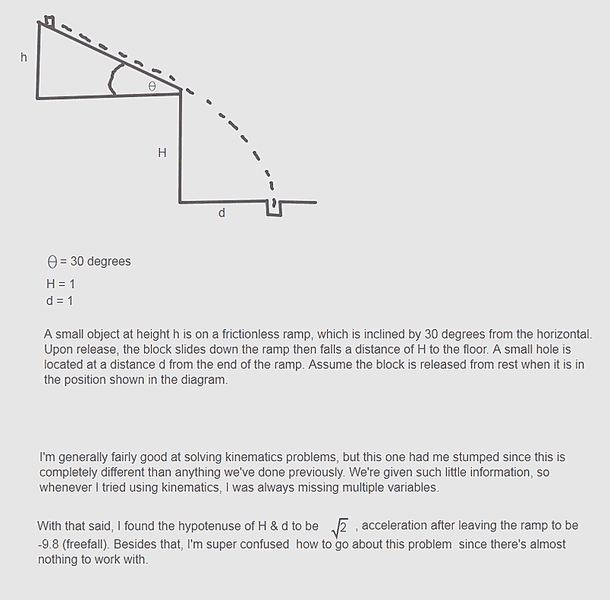
The discussion focuses on solving the Sliding Ramp and Freefall problem, specifically determining the height (h) of a frictionless ramp given the angle of 30 degrees. Participants analyze the components of velocity at the end of the ramp, utilizing gravitational acceleration (g) to derive expressions for vertical and horizontal velocities. Key equations discussed include Δh = (49/20)t² for height and Vfy = 4.9t for final vertical velocity. The conversation highlights the importance of correctly interpreting kinematic equations and the relationship between height and ramp length.
PREREQUISITES
- Understanding of kinematic equations, specifically Δs = vi*t + (1/2)at²
- Knowledge of gravitational acceleration (g) and its application in physics problems
- Familiarity with trigonometric functions, particularly sin and cos for angle calculations
- Ability to manipulate algebraic expressions to solve for unknown variables
NEXT STEPS
- Explore the concept of conservation of energy in physics problems
- Learn how to derive velocity components from acceleration on an inclined plane
- Study the relationship between angles and distances in right triangles
- Practice solving similar problems involving ramps and freefall to reinforce understanding
USEFUL FOR
Students studying physics, particularly those focusing on mechanics and kinematics, as well as educators looking for examples of problem-solving techniques in motion analysis.