Understanding Forces and Acceleration on a Sliding Object on an Incline

  • Thread starter Thread starter Murilo T
  • Start date Start date
  • Tags Tags
    Plane Sliding
Click For Summary
SUMMARY

This discussion focuses on the forces and acceleration of a sliding object on an incline, specifically referencing problem 3.7 from David Morin's "Classical Mechanics." Key equations include the tangential acceleration equation, m(ds²/dt²) = mg sinθ (sinϕ − 1), and the normal acceleration equation, m(ds/dt)(dϕ/dt) = mg sinθcosϕ. The conversation clarifies that the normal acceleration is represented as (ds/dt)(dϕ/dt) and explains the relationship between the y-axis acceleration and the tangential acceleration, emphasizing that forces perpendicular to the incline cancel out over time.

PREREQUISITES
  • Understanding of classical mechanics principles
  • Familiarity with Newton's laws of motion
  • Knowledge of vector calculus and derivatives
  • Ability to interpret and analyze physical diagrams
NEXT STEPS
  • Study the derivation of acceleration components in inclined planes
  • Learn about the role of friction in motion on inclines
  • Explore the concept of normal and tangential acceleration in detail
  • Investigate the application of forces in non-linear motion
USEFUL FOR

Students of physics, educators teaching classical mechanics, and anyone interested in understanding the dynamics of objects on inclined planes.

Murilo T
Messages
12
Reaction score
7
Homework Statement
A block is placed on a plane inclined at an angle θ. The coefficient of friction between the block and the plane is µ = tan θ. The block initially moves horizontally along the plane at a speed V . In the long-time limit, what is the speed of the block?
Relevant Equations
ms˙ϕ˙ = mg sin θ cos ϕ
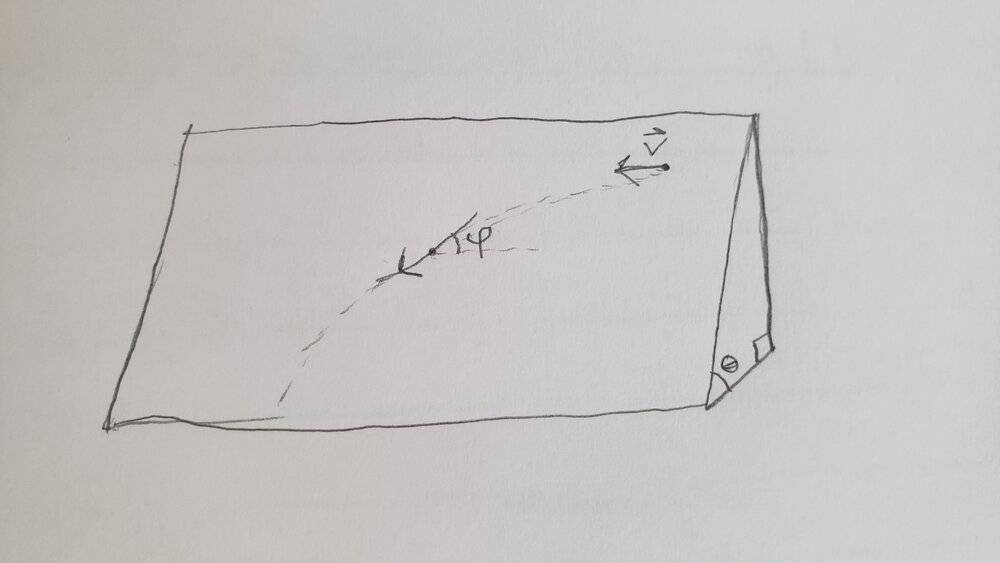
This question is from the David Morin ( Classical Mechanics ) - problem 3.7. I spent some time trying to figure it out the solution by myself, but since I couldn't, I looked into the solution in the book, but I got even more lost. So I searched for an online solution that could help me at least visualize the problem, and I found two solutions here, one here, and some one that already asked the same question here. There isn't any pictures of the problem anywhere, so this is my interpretation:
20210330_121306.jpg


I get that the forces down the plane cancels out, and the equation for the acceleration in the tangential direction: m(ds^2/dt^2) = mg sinθ (sinϕ − 1).
But in the equation for the acceleration in the normal direction: m(ds/dt)(dϕ/dt) = mg sinθcosϕ, why the normal acceleration is (ds/dt)(dϕ/dt)?
And why the acceleration in the y-axis equals the negative acceleration in the tangetial direction?
 

Attachments

  • 20210330_121306.jpg
    20210330_121306.jpg
    23.9 KB · Views: 172
Physics news on Phys.org
Murilo T said:
I get that the forces down the plane cancels out
Remember that this occurs only in the large-##t## regime; at the beginning, the ##y##-components of the two forces do not cancel out, otherwise, ##a_y## would always be zero!

Or perhaps you mean the forces perpendicular to the plane? Those do indeed always cancel out.
Murilo T said:
But in the equation for the acceleration in the normal direction: m(ds/dt)(dϕ/dt) = mg sinθcosϕ, why the normal acceleration is (ds/dt)(dϕ/dt)?
Notice that$$\frac{d\mathbf{x}}{dt} = \frac{ds}{dt} \frac{d\mathbf{x}}{ds} = \dot{s} \frac{d\mathbf{x}}{ds}$$and hence that$$\frac{d^2 \mathbf{x}}{dt^2} = \frac{d^2 s}{dt^2} \frac{d\mathbf{x}}{ds} + \frac{ds}{dt} \frac{d^2 \mathbf{x}}{ds^2} \frac{ds}{dt} = \ddot{s} \frac{d\mathbf{x}}{ds} + \dot{s}^2 \frac{d^2 \mathbf{x}}{ds^2}$$but since the tangential unit vector is ##\mathbf{e}_t = \frac{d\mathbf{x}}{ds}## and the normal unit vector satisfies ## \kappa \mathbf{e}_n = \frac{d\mathbf{e}_t}{ds} = \frac{d^2 \mathbf{x}}{ds^2}##, it follows from the chain rule that, since ##\kappa := d\varphi / ds##,$$\frac{d^2 \mathbf{x}}{dt^2} = \frac{d^2 s}{dt^2} \mathbf{e}_t + \left(\frac{ds}{dt}\right)^2 \frac{d\varphi}{ds} \mathbf{e}_n = \ddot{s} \mathbf{e}_t + \dot{s} \dot{\varphi} \mathbf{e}_n$$which tells you that the tangential component of acceleration is ##\ddot{s}## and the normal component is ##\dot{s} \dot{\varphi}##.
Murilo T said:
And why the acceleration in the y-axis equals the negative acceleration in the tangetial direction?
Since the components of force perpendicular to the plane cancel for all time [i.e. the motion is strictly rectilinear], you've essentially just got a particle acted upon by a component of weight ##mg\sin{(\theta)} \mathbf{e}_y## acting parallel to and down the plane, and a friction force ##-mg\sin{(\theta)} \mathbf{e}_t## acting in the negative tangential direction.

If you draw a diagram of this, looking directly down on the plane [i.e. in the direction of the plane normal], can you see why ##a_y = -a_t## when you draw the forces?
 
Last edited by a moderator:
  • Informative
Likes   Reactions: Murilo T
etotheipi said:
Remember that this occurs only in the large-##t## regime; at the beginning, the ##y##-components of the two forces do not cancel out, otherwise, ##a_y## would always be zero!

Or perhaps you mean the forces perpendicular to the plane? Those do indeed always cancel out.

Notice that$$\frac{d\mathbf{x}}{dt} = \frac{ds}{dt} \frac{d\mathbf{x}}{ds} = \dot{s} \frac{d\mathbf{x}}{ds}$$and hence that$$\frac{d^2 \mathbf{x}}{dt^2} = \frac{d^2 s}{dt^2} \frac{d\mathbf{x}}{ds} + \frac{ds}{dt} \frac{d^2 \mathbf{x}}{ds^2} \frac{ds}{dt} = \ddot{s} \frac{d\mathbf{x}}{ds} + \dot{s}^2 \frac{d^2 \mathbf{x}}{ds^2}$$but since the tangential unit vector is ##\mathbf{e}_t = \frac{d\mathbf{x}}{ds}## and the normal unit vector satisfies ## \kappa \mathbf{e}_n = \frac{d\mathbf{e}_t}{ds} = \frac{d^2 \mathbf{x}}{ds^2}##, it follows from the chain rule that, since ##\kappa := d\varphi / ds##,$$\frac{d^2 \mathbf{x}}{dt^2} = \frac{d^2 s}{dt^2} \mathbf{e}_t + \left(\frac{ds}{dt}\right)^2 \frac{d\varphi}{ds} \mathbf{e}_n = \ddot{s} \mathbf{e}_t + \dot{s} \dot{\varphi} \mathbf{e}_n$$which tells you that the tangential component of acceleration is ##\ddot{s}## and the normal component is ##\dot{s} \dot{\varphi}##.

Since the components of force perpendicular to the plane cancel for all time [i.e. the motion is strictly rectilinear], you've essentially just got a particle acted upon by a component of weight ##mg\sin{(\theta)} \mathbf{e}_y## acting parallel to and down the plane, and a friction force ##-mg\sin{(\theta)} \mathbf{e}_t## acting in the negative tangential direction.

If you draw a diagram of this, looking directly down on the plane [i.e. in the direction of the plane normal], can you see why ##a_y = -a_t## when you draw the forces?
Aaaah, yeees. I see it now! Thank you very very much :)
 
  • Love
Likes   Reactions: etotheipi
Murilo T said:
Aaaah, yeees. I see it now! Thank you very very much :)

No problem! :smile:
 

Similar threads

  • · Replies 11 ·
Replies
11
Views
1K
Replies
46
Views
5K
Replies
3
Views
3K
Replies
11
Views
1K
Replies
16
Views
3K
Replies
2
Views
2K
  • · Replies 13 ·
Replies
13
Views
2K
Replies
4
Views
3K
Replies
5
Views
3K