So the statement sin(n+1)pi/2 = cos(n)pi/2 is true by this property.

Click For Summary

Homework Help Overview

The discussion revolves around finding the Fourier series for the function f(x) = |cos(x)| over the interval (-π, π). The original poster expresses difficulty with integration and the implications of their calculations on the Fourier coefficients.

Discussion Character

  • Exploratory, Mathematical reasoning, Problem interpretation

Approaches and Questions Raised

  • The original poster attempts to compute the Fourier coefficients, noting that f(x) is an even function, which leads to the sine terms being zero. They question their results regarding the coefficients a0 and an, particularly why an is computed as zero.

Discussion Status

Some participants have provided hints regarding the integration limits and potential pitfalls, such as division by zero. The original poster has acknowledged these hints and indicated a realization of their earlier mistakes in the integration process. However, they are still seeking clarification on a specific property related to sine and cosine functions mentioned in a reference book.

Contextual Notes

The original poster refers to a property involving sin(n+1)pi/2 and cos(n)pi/2, which they find confusing. They have also noted the need to break the integration intervals at pi/2 due to the nature of |cos(x)|.

SVXX
Messages
35
Reaction score
0
Question - Find the Fourier series for f(x) = |cos(x)| in the interval (-π, π).
Right, I attempted the question and the integration that followed. I'm having trouble in the integration itself..
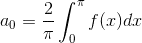
Firstly I found that f(x) is an even function, so the sine term(bn) of the Fourier expansion would be zero and that I can use a property of integration to write
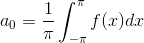
gif.latex?a_0%20=%20\frac{1}{\pi}%20\int_{-\pi}^{\pi}f(x)dx.gif
as
gif.latex?a_0%20=%20\frac{2}{\pi}%20\int_{0}^{\pi}f(x)dx.gif
and similarly so for an.

%20=%20\frac{1}{\pi}%20\int_{0}^{\pi}[cos(n-1)x%20\hspace{1mm}%20+%20\hspace{1mm}%20cos(n+1)x]dx.gif


frac{1}{\pi}[\frac{sin(n-1)x}{n-1}]_0%20^\pi%20+%20\frac{1}{\pi}[\frac{sin(n+1)x}{n+1}]_0%20^\pi.gif


I computed a0 to be zero, but the trouble is, I'm getting an to be zero too, and if that is so, there will be no Fourier series! Could someone please point out my mistake?
 
Last edited by a moderator:
Physics news on Phys.org
Hints :

1. One period of |cos(x)| extends from -pi/2 to pi/2. Check your limits.

2. Beware divide by zero.
 
Thanks for the hints...I figured out what I was doing wrong in the integration. I had to break the intervals at pi/2 as |cos(x)| = cos(x) for 0 < x < pi/2 and = - cos(x) for pi/2 < x < pi.
I referred a popular book from the college library today which proved me correct. But what I don't understand is the last part of the solution that was given in that book...it stated that sin(n+1)pi/2 = cos(n)pi/2...how is this so?
 
SVXX said:
Thanks for the hints...I figured out what I was doing wrong in the integration. I had to break the intervals at pi/2 as |cos(x)| = cos(x) for 0 < x < pi/2 and = - cos(x) for pi/2 < x < pi.
I referred a popular book from the college library today which proved me correct. But what I don't understand is the last part of the solution that was given in that book...it stated that sin(n+1)pi/2 = cos(n)pi/2...how is this so?

The complementary relation between sin and cos tells us that sin x = cos (pi/2 - x) and visa versa.

So sin (n+1)pi/2 = cos (pi/2 -(n+1)pi/2) = cos (-n pi/2).

Now since cos is an even function then cos (-n pi/2) = cos (n pi/2).
 

Similar threads

  • · Replies 3 ·
Replies
3
Views
2K
  • · Replies 1 ·
Replies
1
Views
2K
  • · Replies 6 ·
Replies
6
Views
2K
  • · Replies 5 ·
Replies
5
Views
2K
Replies
3
Views
2K
  • · Replies 14 ·
Replies
14
Views
2K
  • · Replies 1 ·
Replies
1
Views
2K
  • · Replies 6 ·
Replies
6
Views
2K
  • · Replies 1 ·
Replies
1
Views
2K
Replies
3
Views
3K