Solve 2 Loop RC Circuit: Find Q(topen)

Click For Summary
SUMMARY

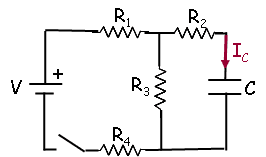
The forum discussion focuses on solving a two-loop RC circuit to find the charge on a capacitor, Q(topen), at a specific time after the switch is opened. The circuit consists of four resistors (R1 = R2 = 30 Ω, R3 = 66 Ω, R4 = 113 Ω), a capacitor (C = 64 μF), and a battery (V = 12 V). The maximum charge on the capacitor, Q0, is calculated to be approximately 243 μC. The time constant τ is determined using the formula τ = R_total * C, where R_total is the equivalent resistance during discharge.

PREREQUISITES
  • Understanding of Kirchhoff's Loop and Node Rules
  • Familiarity with RC circuit charging and discharging equations
  • Knowledge of calculating time constants in electrical circuits
  • Ability to manipulate exponential decay equations
NEXT STEPS
  • Learn how to calculate the time constant τ for RC circuits
  • Study the implications of resistor combinations in parallel and series
  • Explore capacitor discharge equations in detail
  • Investigate practical applications of RC circuits in electronics
USEFUL FOR

Electrical engineering students, hobbyists working with RC circuits, and anyone interested in understanding capacitor behavior in discharging scenarios.

acrimius
Messages
6
Reaction score
0
1. Situation and Variables:
A circuit is constructed with four resistors, one capacitor, one battery and a switch as shown. The values for the resistors are: R1 = R2 = 30 Ω, R3 = 66 Ω and R4 = 113 Ω. The capacitance is C = 64 μF and the battery voltage is V = 12 V. The positive terminal of the battery is indicated with a + sign.
phpAv88Ty.png


2. Sub-question:
After the switch has been closed for a very long time, it is then opened. What is Q(topen), the charge on the capacitor at a time topen = 786 μs after the switch was opened?

3. Relevant Equations:
Kirchhoff's Loop Rule: \Sigma V_l = 0

Kirchhoff's Node Rule: I_i = I_o

V_C = \frac {q} {C}

For a discharging circuit:
q(t) = q_o e^\frac {-t} {\tau}

4. Attempt:
When the switch is closed initially and time goes to infinity, the capacitor charges up and reaches it's capacitance, which I found the max charge, qo to be about 243μC.
Then for a discharging circuit, we have the equation I gave above q(t). I believe my issue is finding tau, which is RC. I have been using R = R_1+R_2 but that hasn't been correct. I've tried different combinations of resistors but I'm not quite getting it.
 
Last edited by a moderator:
Physics news on Phys.org
Show your working for the capacitor charging voltage.

How to determine the capacitor's discharging path when the switch is an open circuit?
 
NascentOxygen said:
Show your working for the capacitor charging voltage.

How to determine the capacitor's discharging path when the switch is an open circuit?
Q(∞)?
IC = 0 ∴ I1 = I2
Knowing this:
Loop for right hand side (I):
\frac {q} {C} = I_2R_3

Loop for left hand side (II):
V_b = I_2(R_1+R_3+R_4)
Therefore,
I_2 = \frac {V_b} {R_1+R_3+R_4}

plugging this into (I):
\frac {q} {C} = \frac {V_bR_3} {R_1+R_3+R_4}

then solve for q, which is just multiplying both sides by C.
The exactly answer they have for Q is 242.526315789474μC, which is what I got, and I have this number stored so I used it for my text calculation of find Q(786μs) from the equation q(t) = q_oe^\frac{-t} {\tau}
 
Also I figured the current go across the switch, so I assumed it would only traverse the right hand side, which is why I use R=R_2+R_3 the equation I originally posted is not what I had written, it was a typo on my part.
 
acrimius said:
which is why I use R=R_2+R_3
That's the discharge path. So you need to be able to write by inspection the exponential time equation for the capacitor voltage as it discharges. I see you almost have.

Are you able to calculate τ and finish this now?
 
NascentOxygen said:
That's the discharge path. So can you write by inspection the exponential time equation for the capacitor voltage as it discharges?
Right. So I have this equation:
q(t) = q_oe^\frac {-t} {R_2+R_3}
but because R2+R3 is so large in comparison to t=786μs, the e part is approximately 1, and so my calculator outputs nearly the same answer as I had before, which the website counts as incorrect
 
The time constant is the product of R and C. It needs to have units of seconds, or it wouldn't be a time.
 
  • Like
Likes   Reactions: acrimius
NascentOxygen said:
The time constant is the producut of R and C.
Wow, that was a really dumb mistake on my part. Thanks for helping me though, I probably would have never realized that.
 
I thought you had it right in your first post ...
acrimius said:
I believe my issue is finding tau, which is RC.
 

Similar threads

  • · Replies 10 ·
Replies
10
Views
3K
  • · Replies 17 ·
Replies
17
Views
6K
  • · Replies 7 ·
Replies
7
Views
5K
  • · Replies 1 ·
Replies
1
Views
2K
  • · Replies 7 ·
Replies
7
Views
3K
Replies
36
Views
12K
  • · Replies 10 ·
Replies
10
Views
4K
  • · Replies 3 ·
Replies
3
Views
2K
  • · Replies 10 ·
Replies
10
Views
4K
  • · Replies 7 ·
Replies
7
Views
2K