Grounding a circuit through a capacitor/parallel RC circuit

Click For Summary

Discussion Overview

The discussion revolves around understanding the behavior of a circuit involving a capacitor and a resistor in parallel, particularly focusing on the initial conditions and voltage measurements at time t = 0s. Participants explore the implications of connecting a capacitor to a circuit and how its previous state affects voltage readings.

Discussion Character

  • Exploratory
  • Technical explanation
  • Conceptual clarification
  • Debate/contested

Main Points Raised

  • One participant describes a parallel RC circuit where the capacitor charges to 12V over time, leading to a voltage across the resistor.
  • Another participant asserts that in the unclear circuit, the voltage across the resistor will be 12V, but the voltage across the capacitor is uncertain and depends on its past state.
  • A participant requests clarification on how the past history of the circuit influences the voltage across the capacitor.
  • One participant explains that discharging the capacitor results in 0V across it, affecting the voltage readings when connected to a battery and resistor.
  • Another participant emphasizes the importance of having a complete circuit with sufficient connections for clarity in understanding the circuit behavior.
  • Some participants reiterate that the unclear nature of the circuit stems from insufficient connecting wires rather than a lack of knowledge from the original poster.
  • A participant concludes that the voltage across the capacitor remains constant when connected in the unclear configuration, indicating a lack of charging or discharging.

Areas of Agreement / Disagreement

Participants express differing views on the clarity of the circuit and the implications of the capacitor's previous state on voltage measurements. There is no consensus on the best way to clarify the unclear circuit, and multiple perspectives on the role of circuit connections are presented.

Contextual Notes

The discussion highlights limitations in understanding due to the circuit's configuration and the assumptions about the capacitor's state prior to connection. There are unresolved aspects regarding the ideal versus real behavior of capacitors in circuits.

jozefmak
Messages
3
Reaction score
1
Hi,
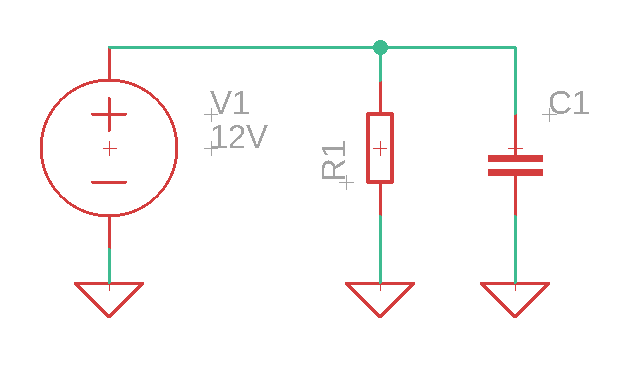
I have two similar circuits. One of them is clear for me but I am not sure how the second one works.

Let's start with the clear one:
1598446695058.png

a parallel RC circuit, which is explained here:

At time t = 0s there are zero volts across the resistor because the capacitor is fully uncharged. After some time, the capacitor will get charged to 12V so we will measure 12V across the resistor.

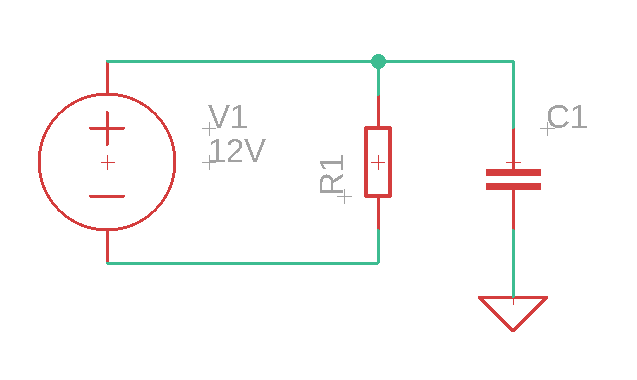
This is the unclear circuit for me:
1598447266491.png

Will the capacitor get charged? (What voltage?)
What voltage are we going to measure at t = 0s across the resistor?


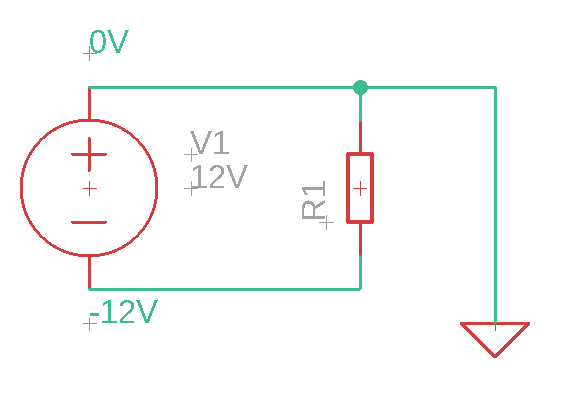
I know that when I remove the capacitor:
1598447822903.png

there will be 12V across the resistor at time t = 0s because a positive terminal of battery will have 0V and negative terminal of battery will have -12V (with respect to those 0V). The problem, which makes this circuit unclear for me is the capacitor.
 
Physics news on Phys.org
In your second circuit, there will be 12V across the resistor. But the voltage at the top of the capacitor is unknown, and could be anything (within limits set by the breakdown voltage of the capacitor). So the voltages at the resistor terminals could be +10V and -2V, or +100V and +88V, or -10V and -22V, or anything you like. The voltage that actually appears depends on the past history of the circuit.
 
  • Like
Likes   Reactions: jozefmak
I see, thanks for reply!

I am just wondering for better understanding what exactly this sentence means:
"The voltage that actually appears depends on the past history of the circuit."
Can you give some example, please?
 
Last edited:
Where are you connecting the 9V battery?
 
Suppose you take the capacitor and connect a wire to both sides and discharge it. Then there is no voltage across it. So when you connect the bottom side to 0V, the top is at 0V as well. So when you connect the battery and resistor to it, the top of the resistor will be at 0V and the bottom will be at -12V. On the other hand, suppose you connect the capacitor to a power supply and charge it up to 100V. Then when you connect the bottom of the capacitor to 0V, the top will be at +100V. So when you connect the battery and resistor to it, the top of the resistor will be at +100V and the bottom will be at +88V. All of this assumes an ideal capacitor, and that the capacitance of the capacitor is large compared to the capacitance of the battery and resistor. In a real circuit, there will be charge sharing and it gets more complicated.
 
  • Like
Likes   Reactions: jozefmak
It's a sort of hackneyed phrase but you really need a CIRCUIT with a path between the connections of any component. The 'Unclear' circuit is unclear because there are not enough connecting wires.
 
sophiecentaur said:
The 'Unclear' circuit is unclear because there are not enough connecting wires.
Good point. The deficiency is not in the OP’s knowledge. It is a deficiency in the circuit.
 
phyzguy said:
Suppose you take the capacitor and connect a wire to both sides and discharge it. Then there is no voltage across it. So when you connect the bottom side to 0V, the top is at 0V as well. So when you connect the battery and resistor to it, the top of the resistor will be at 0V and the bottom will be at -12V. On the other hand, suppose you connect the capacitor to a power supply and charge it up to 100V. Then when you connect the bottom of the capacitor to 0V, the top will be at +100V. So when you connect the battery and resistor to it, the top of the resistor will be at +100V and the bottom will be at +88V.
OK, now I understand. Voltage across the capacitor will be invariable (no charging, no discharging) when connected in the "unclear" scheme. Thank you!
 
  • Like
Likes   Reactions: phyzguy

Similar threads

  • · Replies 9 ·
Replies
9
Views
1K
  • · Replies 16 ·
Replies
16
Views
3K
  • · Replies 13 ·
Replies
13
Views
3K
  • · Replies 11 ·
Replies
11
Views
2K
  • · Replies 19 ·
Replies
19
Views
5K
  • · Replies 4 ·
Replies
4
Views
3K
  • · Replies 7 ·
Replies
7
Views
3K
  • · Replies 16 ·
Replies
16
Views
4K
  • · Replies 9 ·
Replies
9
Views
4K
  • · Replies 1 ·
Replies
1
Views
2K