Solve Acceleration of Hinges Problem on Brilliant.org

  • Context: Graduate 
  • Thread starter Thread starter Abhijeet Verma
  • Start date Start date
  • Tags Tags
    Acceleration Hinges
Click For Summary

Discussion Overview

The discussion revolves around a problem involving the acceleration of a square frame made of rods connected by frictionless hinges, as posed on Brilliant.org. Participants explore various methods to determine the relationship between the accelerations of two vertices of the frame when a force is applied to one vertex.

Discussion Character

  • Exploratory
  • Technical explanation
  • Mathematical reasoning

Main Points Raised

  • One participant mentions a lengthy solution they found and seeks alternative approaches to the problem.
  • Another participant inquires if the result from the lengthy solution is simple, suggesting that simpler methods might exist.
  • A participant describes using the work-energy theorem to analyze the system, noting that while the process is lengthy, the results yield simple expressions for the accelerations.
  • Another participant proposes using the center of mass frame for analysis, highlighting its symmetrical properties and the absence of torque due to uniform inertial forces.
  • One participant suggests deriving differential equations of motion for the system over time, indicating that the square will deform into a rhombus and discussing the degrees of freedom involved.
  • A participant mentions their experience giving this problem to students and references a previous discussion on the topic.
  • Another participant expresses difficulty understanding the Lagrangian mechanics approach presented, indicating a gap in knowledge regarding that method.

Areas of Agreement / Disagreement

Participants present multiple competing approaches to the problem, and there is no consensus on a single method or solution. The discussion remains unresolved with various perspectives on how to tackle the problem.

Contextual Notes

Some participants note the complexity of the problem and the need for differential equations, while others highlight the potential for simpler solutions. There are references to specific methods like the work-energy theorem and Lagrangian mechanics, but not all participants are familiar with these techniques.

Abhijeet Verma
Messages
8
Reaction score
0
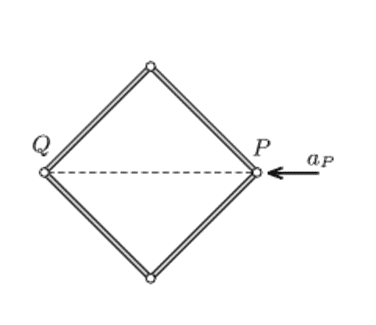
This is a problem posted by a member on Brilliant.org (https://brilliant.org/problems/acceleration-of-hinges/). I found one way to solve the problem, but it is really long, and i am looking for some different solutions. The problem is-
e172ee5a667b68a172bf57e4c88e60af6462f29d.png
Four similar rods of uniform density are connected with frictionless hinges. This frame is placed on a horizontal smooth tabletop, such that its shape is a square. Vertex P is acted upon by a horizontal force in the direction of the diagonal, and due to this force it begins to move at an acceleration of ##a_P##.

If the initial acceleration of the opposite vertex Q is ##a_Q= k.a_P## then find k.

k is positive if Q moves away from P and k is negative if Q moves closer to P.

Please post any solution or approach that can be applied in it.
Thanks.
 
Physics news on Phys.org
Abhijeet Verma said:
I found one way to solve the problem, but it is really long
Is at least the result you get from the long solution something simple? Then there is a chance for a simpler way to solve it.
 
A.T. said:
Is at least the result you get from the long solution something simple? Then there is a chance for a simpler way to solve it.
I solved it using the work-energy theorem, by finding the energy of the system after displacing by a small amount, and the work done by the force applied at point P, somewhat similar to what someone posted there. Finding the energy is pretty long, but yes the results are simple expressions in ##a_P## and ##a_Q##.
 
Abhijeet Verma said:
I solved it using the work-energy theorem, by finding the energy of the system after displacing by a small amount, and the work done by the force applied at point P, somewhat similar to what someone posted there. Finding the energy is pretty long, but yes the results are simple expressions in ##a_P## and ##a_Q##.

I would try to use the center of mass frame, where the kinematics is nicely symmetrical. The center of mass frame is non-inertial, but has a known acceleration, and thus a known inertial force field. Since the inertial force field is uniform, it doesn't create any torques at the bars, around their centers of mass.
 
First you must obtain differential equations of motion not at the single moment but for all ##t##. For ##t>0## the square will deform to a rhombus. So this is a system with two degrees of freedom

0c508385e751.png


Let ##X## be the axis of inertial frame and ##x## be the coordinate of the center of the rhombus. The generalized coordinates are ##\alpha,x##.

We shall assume that the force ##\boldsymbol F## does not depend on time. It does not matter since we will consider the differential equations at initial moment only. Then find the kinetic energy to this system ##T=T(\dot\alpha,\dot x,\alpha,x)## You will see that actually ##T## does not depend on ##x,\alpha##. And write the Lagrange equations
$$\frac{d}{dt}\frac{\partial T}{\partial \dot x}-\frac{\partial T}{\partial x}=Q_x,\quad \frac{d}{dt}\frac{\partial T}{\partial \dot \alpha}-\frac{\partial T}{\partial \alpha}=Q_\alpha.$$
The first equation will be ##4m\ddot x=F## (##m## is the mass of the rod), but the second one is not so evident, you have to calculate for it.
 
wrobel said:
First you must obtain differential equations of motion not at the single moment but for all ##t##. For ##t>0## the square will deform to a rhombus. So this is a system with two degrees of freedom

0c508385e751.png


Let ##X## be the axis of inertial frame and ##x## be the coordinate of the center of the rhombus. The generalized coordinates are ##\alpha,x##.

We shall assume that the force ##\boldsymbol F## does not depend on time. It does not matter since we will consider the differential equations at initial moment only. Then find the kinetic energy to this system ##T=T(\dot\alpha,\dot x,\alpha,x)## You will see that actually ##T## does not depend on ##x,\alpha##. And write the Lagrange equations
$$\frac{d}{dt}\frac{\partial T}{\partial \dot x}-\frac{\partial T}{\partial x}=Q_x,\quad \frac{d}{dt}\frac{\partial T}{\partial \dot \alpha}-\frac{\partial T}{\partial \alpha}=Q_\alpha.$$
The first equation will be ##4m\ddot x=F## (##m## is the mass of the rod), but the second one is not so evident, you have to calculate for it.

Sorry, but i don't know Lagrangian Mechanics and hence don't understand the solution.
 

Similar threads

  • · Replies 20 ·
Replies
20
Views
2K
  • · Replies 62 ·
3
Replies
62
Views
10K
Replies
1
Views
2K
Replies
7
Views
3K
Replies
53
Views
6K
  • · Replies 15 ·
Replies
15
Views
3K
Replies
5
Views
2K
Replies
2
Views
3K
  • · Replies 2 ·
Replies
2
Views
7K
  • · Replies 22 ·
Replies
22
Views
5K