Solve Gravitational Interferometer & Geodesics

Click For Summary

Discussion Overview

The discussion revolves around solving a problem related to gravitational interferometers and geodesics, specifically focusing on the behavior of light rays in a gravitational field and the conditions under which they can be considered geodesics. Participants explore the mathematical formulation of geodesics, the implications of setting certain variables to zero, and the theoretical justification for their approaches.

Discussion Character

  • Exploratory
  • Technical explanation
  • Conceptual clarification
  • Debate/contested
  • Mathematical reasoning

Main Points Raised

  • One participant describes their approach to finding geodesics using Christoffel symbols and Lagrangian mechanics, questioning the validity of assuming light travels along the x-axis while setting dy and dz to zero.
  • Another participant suggests that substituting dy=0 and dz=0 leads to a relationship between dt and dx, indicating a potential path for light rays.
  • A third participant mentions having solved the exercise but seeks theoretical justification for their methods, indicating a desire for deeper understanding.
  • Further contributions include equations derived from the geodesic equations, with one participant expressing uncertainty about the implications of their calculations when dy and dz are set to zero.
  • Questions are raised about the existence of other geodesics connecting specific points in the context of gravitational waves and light propagation.

Areas of Agreement / Disagreement

Participants express differing views on the appropriateness of setting dy and dz to zero for light rays, and there is no consensus on whether this leads to valid geodesic equations. The discussion remains unresolved regarding the theoretical justification for these assumptions and the existence of alternative light paths.

Contextual Notes

Participants note potential limitations in their calculations and the need for clarity in the assumptions made, particularly regarding the conditions under which light rays can be treated as geodesics in the gravitational context.

Who May Find This Useful

This discussion may be of interest to those studying general relativity, gravitational wave physics, or mathematical physics, particularly in the context of geodesics and light propagation in curved spacetime.

Salah93
Messages
20
Reaction score
0
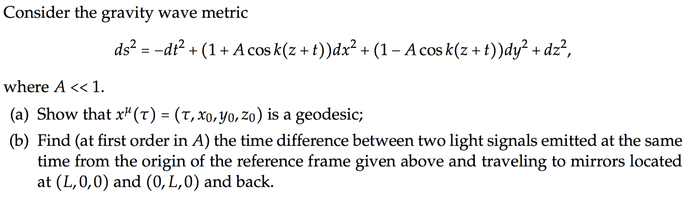
I was trying to solve this exercise:
D1rhS.png


Now I was able to find the eq. of geodetics (or directly by Christoffel formulas calculation or by the Lagrangian for a point particle). And I verified that such space constant coordinate point is a geodetic.

Now, for the second point I considered$$ds^2=0$$

to isolate the$$dt$$ and find the time difference between the two routes. But I don't know how to solve for a generic path of a light ray. So I considered that maybe the text wants a light ray traveling along x-axis and the second along y axis.

I checked in other sources and all people make the same, by considering a light ray along x-axis and then setting$$dy=dz=0$$
.

But when I substitute these in my geodesic equations it turns out that they are not true even at first order in A! So these people that consider a light ray traveling along x-axis, such as in an interferometer, are not considering a light geodesic. All of this if and only if my calculations are true.

So I know that if$$ds^2=0$$
I have a light geodesic. And so it should solve my eq. of geodesics. But if I restrain my motion on x-axis what I can say is that the$$ds^2=0$$
condition now is on a submanifold of my manifold. So, the light wave that I consider doesn't not move on a geodesic of the original manifold but on one of the x axis. This is the only thing that came in my mind.

Is there any way to say that I can set

$$dy=dz=0$$
without worring? And if I can't set it how can I solve the second point?

I want also to ask is there other geodesics that go from the 3d point (0,0,0) to (L,0,0)?
 
Physics news on Phys.org
I'm working beyond my knowledge here (very much a beginner), but if you put ##dy=0## and ##dz=0## into the above, you still have ##ds^2 = - dt^2 + (1+ A cos( k(z+t))dx^2## and if ##ds^2 = 0## for light, you get a relationship between ##dt## and ##dx##.

To the admins, I hope that doesn't constitute too much of an answer, I'm hoping to test my own rudimentary knowledge too. I've deliberately left out the final step I think.
 
  • Like
Likes   Reactions: Dale
I solved the exercise and made all the necessary calculations and obtained the correct results. What I asking is a more theoretical question, to justify what I did. If the question is not formulated well please tell me.
 
Salah93 said:
What I asking is a more theoretical question, to justify what I did.

You will need to show more of your work. In particular you should show explicitly what you did here:

Salah93 said:
when I substitute these in my geodesic equations it turns out that they are not true even at first order in A!
 
Ok, I write the equations that I obtain(one can use action variation with an affine parameter, or EL eq. with affine parameter or use directly geodesic eqs with affine parameter by first calculating Christoffel symbols):

$$\ddot{t}=\frac{Ak}{2}sin(k(z+t)) (\dot{x}^2-\dot{y}^2)$$

$$\ddot{t}=\frac{Ak \sin(k(z+t))}{1+Acos(k(z+t))} (\dot{z}+\dot{t})\dot{x}$$

$$\ddot{y}=-\frac{Ak \sin(k(z+t))}{1-Acos(k(z+t))} (\dot{z}+\dot{t})\dot{y}$$

$$\ddot{z}=-\frac{Ak}{2}sin(k(z+t)) (\dot{x}^2-\dot{y}^2)$$Now these eqs define a geodesic.

I know that taking $$ds^2=0$$ this defines a light geodesic(and I can use any monotone function to parametrize it). Now I can set freely $$dy=dz=0$$ and take a light ray that travels along x-axis form (0,0,0) to (L,0,0) and then obtain the result of the second point for this particular light ray.

My questions are:
1) if I substitute $$dy=dz=0$$ I correctly have the eq. for $$\ddot{y}$$ zero. But the ones for $$\ddot{t}$$, $$\ddot{x}$$ , $$\ddot{z}$$ are not zero(if I made calculations well). So or I made wrong calculations or I can't use these equations for the light ray.

2)I saw that all the books ,ex. Schultz for RG, that treat interference for light rays take directly I ray that travels along x or y-axis (with a gravitational wave propagating in the z direction). Now are there other light rays that can go from (0,0,0) to (L,0,0)?

I hope I posted better the question. Thank you
 

Similar threads

  • · Replies 11 ·
Replies
11
Views
2K
  • · Replies 76 ·
3
Replies
76
Views
4K
  • · Replies 3 ·
Replies
3
Views
970
  • · Replies 1 ·
Replies
1
Views
1K
  • · Replies 13 ·
Replies
13
Views
2K
Replies
82
Views
5K
  • · Replies 10 ·
Replies
10
Views
3K
  • · Replies 27 ·
Replies
27
Views
7K
  • · Replies 17 ·
Replies
17
Views
2K
  • · Replies 4 ·
Replies
4
Views
3K