Solve Simple Circuit Problem: R1 = 2.00 Ω, R2 = 4.00 Ω, R3 = 8.00 Ω

  • Context: Engineering 
  • Thread starter Thread starter Nexest
  • Start date Start date
  • Tags Tags
    Circuit
Click For Summary

Discussion Overview

The discussion revolves around solving a circuit problem involving three resistors (R1, R2, R3) and three voltage sources (V1, V2, V3). Participants are examining the equations derived from Kirchhoff's laws to find the currents in the circuit. The scope includes theoretical application and problem-solving in a homework context.

Discussion Character

  • Homework-related
  • Technical explanation
  • Debate/contested

Main Points Raised

  • One participant presents a set of equations based on Kirchhoff's junction and loop rules but expresses uncertainty about their correctness.
  • Another participant suggests that the original poster should provide a diagram for clarity, indicating that the lack of visual representation may hinder problem-solving.
  • A third participant notes that the equations presented include one Kirchhoff's Current Law (KCL) equation and two Kirchhoff's Voltage Law (KVL) equations, suggesting the need for an additional independent KVL equation.
  • Subsequent replies indicate that the problem could potentially be simplified to two equations for solving the currents.
  • Hints are provided regarding the use of mesh currents in the circuit analysis.

Areas of Agreement / Disagreement

Participants generally agree that the original equations may need refinement and that additional information (such as a diagram) is necessary for effective problem-solving. However, there is no consensus on the correctness of the initial equations or the best approach to take.

Contextual Notes

The discussion highlights the importance of visual aids in circuit analysis and the potential for multiple approaches to solving the problem, including the need for independent equations. There is also an indication of possible errors in the initial equations, but no specific corrections are provided.

Nexest
Messages
5
Reaction score
0
Here is the problem:

The diagram below shows a circuit where; R1 = 2.00 Ω, R2 = 4.00 Ω, R3 = 8.00 Ω, V1 = 7.500 V, V2 = 10.00 V, and V3 = 8.00 V. (In solving the problems that follow, initially pick the current directions as shown. If the actual current turns out to be in the opposite direction, then your answer will be negative).
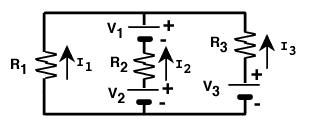
iy1wtc.jpg


Using the junction and loop rules I came up with these equations but apparently something is wrong, please help me:

I1 + I2 + I3 = 0

-V1 + I2R2 - V2 - I1R1 = 0

I3R3 - V3 + V2 - I2R2 + V1 = 0

EDIT:

I know how to solve this problem in theory with the equations but when I did I got the wrong answer so I'm checking if my original equations are right
 
Last edited:
Physics news on Phys.org
Firstly, this should probably be in the homework help forum.

Secondly, you haven't uploaded an image, or provided a link to somewhere else where this image is posted! (If you have an image, you should upload it to, say, tinypic.com, imageshack.us, or freeimagehosting.net, as opposed to uploading an image here, since it'll take some time for the mods to get around to approving the image / attachments).

EDIT: Can you report your own post to get your image approved faster? Or would the mods frown upon abuse of the abuse line?
 
I can't see the diagram you're talking about, but it looks like you have 1 KCL equation and 2 KVL equations written. You're probably looking for a third (independent) KVL equation to solve for the currents I1, I2 and I3.
 
Sorry, I wasn't aware of the image problem, is it working better now?
 
it shows up fine. you should be able to reduce that to two equations.
 
Yep, I can see it now.

Yeah just write two mesh equations and solve and that will get you the currents in all the branches of the circuit.

Hint: remember two mesh currents will be going through the center branch
 

Similar threads

  • · Replies 26 ·
Replies
26
Views
3K
  • · Replies 34 ·
2
Replies
34
Views
6K
  • · Replies 12 ·
Replies
12
Views
2K
  • · Replies 3 ·
Replies
3
Views
3K
  • · Replies 2 ·
Replies
2
Views
2K
  • · Replies 25 ·
Replies
25
Views
4K
  • · Replies 4 ·
Replies
4
Views
2K
  • · Replies 3 ·
Replies
3
Views
2K
  • · Replies 18 ·
Replies
18
Views
3K
  • · Replies 9 ·
Replies
9
Views
3K