Solve the problem that involves Binomial distribution and hypothesis test

  • Thread starter Thread starter chwala
  • Start date Start date
  • Tags Tags
    Test
Click For Summary
SUMMARY

The discussion revolves around the application of the Binomial distribution in hypothesis testing, specifically regarding the claim that 8% of sugar bags are damp. Participants clarify the calculations for P(D = 2) and P(D > 3) using the binomial formula, with n = 70 and p = 0.08. The confusion arises from the notation used in the problem, particularly regarding the summation of probabilities for P(X ≤ 2). The correct interpretation is that P(X ≤ 2) includes the probabilities for X = 0, 1, and 2, which is essential for determining the acceptance or rejection of the null hypothesis.

PREREQUISITES
  • Understanding of Binomial distribution, specifically B(n, p)
  • Familiarity with hypothesis testing concepts, including null and alternative hypotheses
  • Knowledge of probability notation and calculations
  • Ability to perform combinatorial calculations, such as binomial coefficients
NEXT STEPS
  • Study the Binomial distribution and its applications in hypothesis testing
  • Learn how to calculate cumulative probabilities using the Binomial formula
  • Explore common notations used in probability and statistics, including P(X ≤ k)
  • Review examples of hypothesis testing with real-world scenarios to solidify understanding
USEFUL FOR

Students studying statistics, particularly those focusing on hypothesis testing and probability distributions, as well as educators seeking to clarify these concepts for their learners.

chwala
Gold Member
Messages
2,828
Reaction score
421
Homework Statement
see attached
Relevant Equations
Binomial distribution
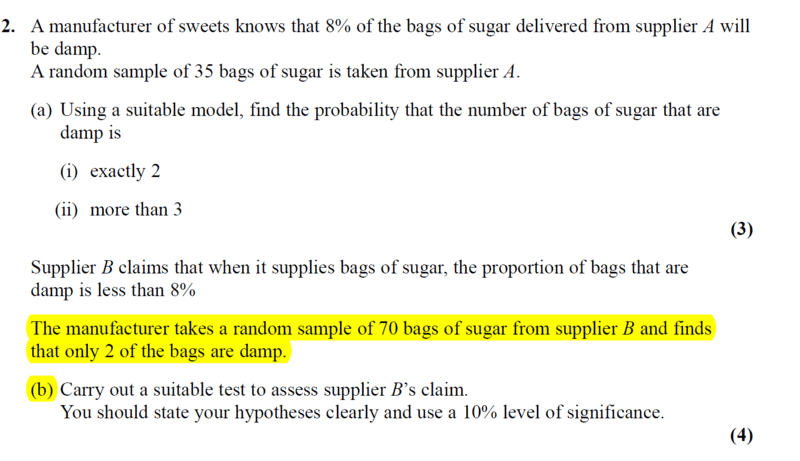
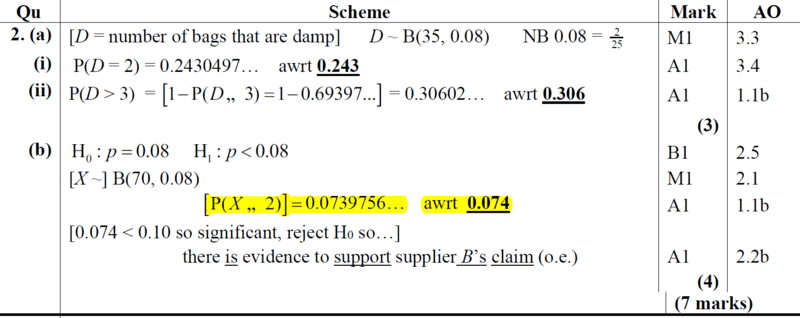
For this problem, the steps are quite clear. My question would be on the highlighted part, clearly we are told ##n=2## as claim from supplier then why did they consider other ##n## values? that is, ##n=1## and ##n=0## to give us,

##[P,X=2] = 0.002918+0.017764 + 0.053292 = 0.07397562##

why did they not use the value for ##n=2## as it is? Maybe, I am not getting the word problem clearly...
1712572979171.png


1712573018425.png
 
Last edited:
Physics news on Phys.org
chwala said:
why did they not use the value for n=2 as it is? Maybe, I am not getting the word problem clearly...
Because P(D = 2) (i.e., exactly 2 damp bags) is part (a), subpart (i). Subpart (ii) asks you to find P(D > 3).
 
  • Like
Likes   Reactions: SammyS
Mark44 said:
Because P(D = 2) (i.e., exactly 2 damp bags) is part (a), subpart (i). Subpart (ii) asks you to find P(D > 3).
Sorry my question is on question 2(b) only. I have no problem with 2 (i) and 2(ii). This part is easy for me.

This part is fine,

For 2(i), i have

##{_{35}C_2} (0.08)^2 (0.92)^{33} = 0.243##

For part (ii) i have,

##P(D>3) = 1 - [0.054+0.1644+0.2430+0.2324]##
##P(D>3) = 1 - 0.6938=0.3062##

My question is on 2(b)
They clearly used

##[P,X=2] = 0.002918+0.017764 + 0.053292 = 0.07397562##

This is where my problem is as the question states only 2 of the bags are damp.

Why not ##[P,X=2] = 0.05329##
 
Last edited:
I don't understand what their notation is saying, for example [P(X ,, 2)] or in the work for 2a(ii) where they have [1 - P(D ,, 3) = ...]

Also, it looks like the answer key has a typo in the second line of 2b:
[X~]B(70, 0.08)
I believe this should be [X ~ B(70, 0.08)], meaning that X is a random variable with a binomial distribution with n = 70 and p = 0.08.
,
 
Last edited:
Mark44 said:
I don't understand what their notation is saying, for example [P(X ,, 2)] or in the work for 2a(ii) where they have [1 - P(D ,, 3) = ...]

Also, it looks like the answer key has a typo in the second line of 2b:

I believe this should be [X ~ B(70, 0.08)}, meaning that X is a random variable with a binomial distribution with n = 70 and p = 0.08.
,
Correct, that is a typo.
 
Do you understand what they mean by [P(X ,, 2)]? Do they explain this notation elsewhere in the textbook?
 
Mark44 said:
Do you understand what they mean by [P(X ,, 2)]? Do they explain this notation elsewhere in the textbook?
I do not understand.

This question is from an A-level past paper question.
 
Mark44 said:
Do you understand what they mean by [P(X ,, 2)]? Do they explain this notation elsewhere in the textbook?
... but going with the mark scheme guide, that should not be difficult to determine. It is simply a sum of combinations that is, P[X=0 ] + P[X=1 ] + P[X=2] = P[X ,,2].
 
chwala said:
They clearly used
##[P,X=2] = 0.002918+0.017764 + 0.053292 = 0.07397562##

This is where my problem is as the question states only 2 of the bags are damp.

Why not ##[P,X=2] = 0.05329##
I believe the idea here is that they're calculating the probability ##P(X \le 2)##, which means they need to calculate the sum ##P(X = 0) + P(X = 1) + P(X - 2)##. I get the same numbers you did and that are shown in the mark scheme.
Like I said, their notation leaves something to be desired. It would be clearer if they wrote ##P(X \le 2)## or maybe [P, X=0...2] with the understanding that X ~ B(70, .08). Keep in mind that the hypothesis test is whether p = 0.08 vs the alternate hypothesis that p < 0.08.
 
Last edited:
  • #10
I don't think you understood my question. The way they worked the problem to solution is quite clear @Mark44

I just need to understand the highlighted part in post ##3##.
 
  • #11
chwala said:
I don't think you understood my question.
I don't think you understood the question for 2b.
A candy manufacturer makes the claim that 8% of the bags of sugar that are received from the supplier are wet. The supplier disputes that claim, and instead asserts that the proportion of wet bags of sugar is less than 8%.
The supplier sets up a hypothesis test to determine a confidence interval with ##\alpha = 0.10## for the true value of p, the proportion of wet sugar bags.
##H_0 : p = 0.08## -- The manufacturer's claim
##H_a : p < 0.08## -- The supplier's claim

The null hypothesis is equivalent to ##P(D = 2)##. The alternate hypothesis is equivalent to ##P(D \le 2)## which in turn is equal to ##P(D = 0) + P(D = 1) + P(D = 2)##. If this probability turns out to be less than 0.10, we reject the null hypothesis because we're way into the left tail of the distribution. If that probability turns out to be 0.10 or larger, we accept the null hypothesis.

As you have already found, ##P(D \le 2) \approx 0.074##, which implies that in actuality, fewer than 8% of the bags of sugar are wet.
 
  • Like
Likes   Reactions: chwala

Similar threads

  • · Replies 7 ·
Replies
7
Views
2K
  • · Replies 7 ·
Replies
7
Views
2K
  • · Replies 7 ·
Replies
7
Views
3K
Replies
3
Views
1K
  • · Replies 1 ·
Replies
1
Views
1K
  • · Replies 3 ·
Replies
3
Views
1K
  • · Replies 8 ·
Replies
8
Views
2K
  • · Replies 8 ·
Replies
8
Views
1K
  • · Replies 13 ·
Replies
13
Views
2K
Replies
2
Views
1K