Solve this differential equation for the curve & tangent diagram

Click For Summary
SUMMARY

The forum discussion focuses on solving the differential equation x(dy/dx) = 2y, specifically in the context of finding the tangent line and its intersection with the x-axis. Participants clarify that the midpoint M is the average of the points O (origin) and T, and that the slope of the tangent line is represented by dy/dx. The solution simplifies to y = (dy/dx)(1/2)x, leading to the conclusion that x(dy/dx) = 2y. The discussion emphasizes the importance of recognizing the relationship between the coordinates of points and the slope of the tangent line.

PREREQUISITES
  • Understanding of differential equations, specifically first-order linear equations.
  • Familiarity with the concept of tangent lines and their slopes.
  • Knowledge of the midpoint formula in coordinate geometry.
  • Ability to manipulate algebraic expressions involving derivatives.
NEXT STEPS
  • Study the derivation of first-order linear differential equations.
  • Learn about the geometric interpretation of derivatives and tangent lines.
  • Explore the midpoint formula and its applications in calculus.
  • Practice solving differential equations using substitution methods.
USEFUL FOR

Students studying calculus, particularly those focusing on differential equations, as well as educators seeking to clarify concepts related to tangent lines and their slopes.

so_gr_lo
Messages
69
Reaction score
10
Homework Statement
Hi,
I have included an attachment of the question about differential equations. I found a similar question and solution on this website:

https://doubtnut.com/question-answer/a-tangent-at-a-point-p-on-the-curve-cuts-the-x-axis-at-a-and-b-is-the-foot-of-perpendicular-from-p-o-262330
Relevant Equations
Given differential equation:
xdy/dx = 2y
Here is my attempt at a solution:

y = f(x)

yp - ym = dy/dx(xp-xm)

ym = 0

yp = dy/dx(xp-xm)

xm=ypdy/dx + xm

xm is midpoint of OT

xm = (ypdy/dx + xm) /2

Not sure where to go from there because the solution from the link uses with the midpoint of the points A and B intersecting the x-axis, whereas the assignment question concerns the points M and T on the x-axis, where M is the midpoint between the origin and T. Can anybody give any clues?
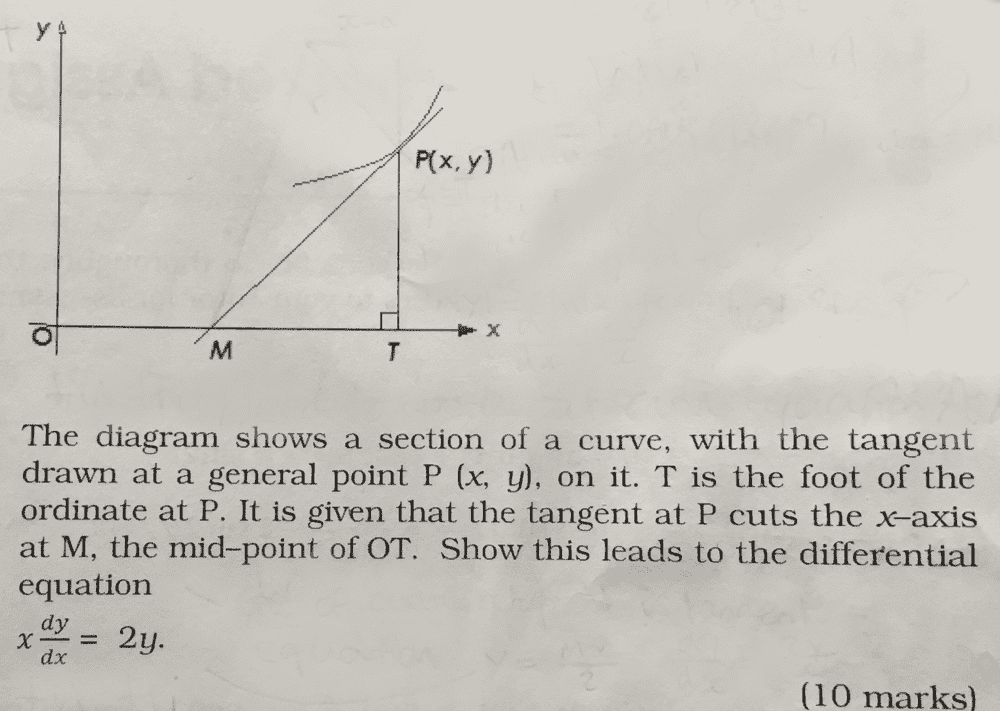
259E39C1-8D4D-4744-A50A-3E405B0EC5DE.png
 
Last edited by a moderator:
Physics news on Phys.org
so_gr_lo said:
Homework Statement:: Hi,
I have included an attachment of the question about differential equations. I found a similar question and solution on this website:

https://doubtnut.com/question-answe...-is-the-foot-of-perpendicular-from-p-o-262330
Relevant Equations:: Given differential equation:
xdy/dx = 2y

Here is my attempt at a solution:

y = f(x)

yp - ym = dy/dx(xp-xm)

ym = 0

yp = dy/dx(xp-xm)

xm=ypdy/dx + xm

xm is midpoint of OT

xm = (ypdy/dx + xm) /2

Not sure where to go from there because the solution from the link uses with the midpoint of the points A and B intersecting the x-axis, whereas the assignment question concerns the points M and T on the x-axis, where M is the midpoint between the origin and T. Can anybody give any clues?
Hello, @so_gr_lo .

:welcome:

Notice that xp = 2 xm .

Also, xp and yp are the same as x and y, the coordinates of the general point, P .

I have no idea of what the statement regarding points A and B could possibly mean.

Full size image:
259e39c1-8d4d-4744-a50a-3e405b0ec5de-png.png
 
The equation for the tangent line is:

$$y - y_n = m(x - x_n)$$

##m = \frac{dy}{dx}## is the slope, and ##P_n = (x_n, y_n)## is the point. Also note the midpoint formula:

$$(x_n, y_n) = (\frac{x_L + x_H}{2}, \frac{y_L + y_H}{2})$$
$$(x_n, 0) = (\frac{x_L + x_H}{2}, 0)$$

You know ##y_n = 0 \Rightarrow y = \frac{dy}{dx} (x - x_n)## because the midpoint is always on the x-axis for any point ##P_n##. Now ##x_n = \frac{x_L + x_H}{2} \Rightarrow##

$$y + \frac{dy}{dx} (\frac{x_L + x_H}{2}) = \frac{dy}{dx} x$$

What do you know about ##x_L##, and ##x_H##?
 
Last edited:
x1 = 1/2x2

or

x2 = 1/2x1
I have tried substituting these into y + dy/dx(x1 + x2) = dy/dxx

but can’t see how that helps, I also don’t know how to get rid of on of the dy/dx to turn it into the required differential equation.
 
so_gr_lo said:
Homework Statement:: Hi,
I have included an attachment of the question about differential equations. I found a similar question and solution on this website:

https://doubtnut.com/question-answe...-is-the-foot-of-perpendicular-from-p-o-262330
Relevant Equations:: Given differential equation:
xdy/dx = 2y

Here is my attempt at a solution:

y = f(x)

yp - ym = dy/dx(xp-xm)

ym = 0

yp = dy/dx(xp-xm)

xm=ypdy/dx + xm

xm is midpoint of OT

xm = (ypdy/dx + xm) /2

Not sure where to go from there because the solution from the link uses with the midpoint of the points A and B intersecting the x-axis, whereas the assignment question concerns the points M and T on the x-axis, where M is the midpoint between the origin and T. Can anybody give any clues?View attachment 265378
As @SammyS pointed out, you don't need subscripted variables, and the hint given by @STEMucator is much more complicated than is needed. You don't really need either the point-slope form of a line or the midpoint formula.
The proof can be done in two lines, if you assign coordinates to points T and M, and recognize that the derivative dydx gives the slope of the tangent line.
 
Last edited:
  • Like
Likes   Reactions: etotheipi
so_gr_lo said:
x1 = 1/2x2

or

x2 = 1/2x1
I have tried substituting these into y + dy/dx(x1 + x2) = dy/dxx

but can’t see how that helps, I also don’t know how to get rid of on of the dy/dx to turn it into the required differential equation.

I would double check your math, but please review my prior post. I feel my notation was somewhat unclear before, and maybe the information will help.

Given ##x_L = 0##, and ##x_H = T##, can you create a standard differential equation that you can compute using this hint?
 
STEMucator said:
I would double check your math, but please review my prior post. I feel my notation was somewhat unclear before, and maybe the information will help.
Your notation was clear enough, but extraneous information such as the point-slope form of the equation of a line and the midpoint formula are overcomplications that are not helpful.

As I said before, all that is needed is to label points P, T, and M in the simplest way possible, and recognize that the slope of the tangent line is ##\frac{dy}{dx}##. When this is done, finding the differential equation requires only two lines.
 
  • Like
Likes   Reactions: etotheipi
So I think this is the way to do it:

y - yM = dy/dx(x - xM)

yM = 0

y = dy/dx(x - xM)

xM = 1/2x

y = dy/dx(1/2x)

xdy/dx = 2y

Thanks for the help, since the question had 10 marks I assumed the answer was complicated and got confused by the solution in the link.
 
  • Like
Likes   Reactions: Delta2
Or more simply, the gradient of the tangent line is ##\frac{dy}{dx}##, and that equals the rise over run of that triangle, ##\frac{y}{\frac{x}{2}}##. Namely, ##\frac{dy}{dx} = \frac{2y}{x}##.
 
  • #10
I agree with the solution provided by Mark, and eto.

I was providing a hint that related with the link the OP provided.
 
  • #11
Ok, I will use the solution given by Mark and eto. Thanks again for the help.
 
  • #12
so_gr_lo said:
So I think this is the way to do it:

y - yM = dy/dx(x - xM)
yM = 0
y = dy/dx(x - xM)
xM = 1/2x
y = dy/dx(1/2x)
I know what you mean, but that's not what you wrote.
1/2x means ##\frac 1 2 x##, because multiplication and division have the same precedence, and are grouped from left to right. That means that 1/2x is considered to mean (1/2)x, not 1/(2x) as you intended.
To indicate that 2x is in the denominator in both equations above, use parentheses around 2x, like this:
xM = 1/(2x)
y = dy/dx(1/(2x))
so_gr_lo said:
xdy/dx = 2y

Thanks for the help, since the question had 10 marks I assumed the answer was complicated and got confused by the solution in the link.
 
  • Like
Likes   Reactions: SammyS

Similar threads

Replies
3
Views
2K
  • · Replies 1 ·
Replies
1
Views
2K
  • · Replies 2 ·
Replies
2
Views
2K
  • · Replies 32 ·
2
Replies
32
Views
4K
  • · Replies 1 ·
Replies
1
Views
1K
  • · Replies 4 ·
Replies
4
Views
2K
Replies
5
Views
952
  • · Replies 24 ·
Replies
24
Views
2K
  • · Replies 4 ·
Replies
4
Views
2K
  • · Replies 8 ·
Replies
8
Views
2K
