Solved: Hydrostatic Force Calculation of Vertical Tank

  • Thread starter Thread starter trekie4ever
  • Start date Start date
  • Tags Tags
    Forces Hydrostatic
Click For Summary
SUMMARY

The discussion focuses on calculating the hydrostatic force against a vertical tank containing freshwater using Riemann sums and integrals. The correct formula derived is F = (1000)(9.8) * ∫ from 0 to 5 (100 - x^2)^(1/2)(-2x)dx, leading to a final force value of approximately 2.29 x 10^6 N. The user initially calculated the force incorrectly but later confirmed the correct approach through u-substitution and integration techniques.

PREREQUISITES
  • Understanding of hydrostatic pressure principles
  • Familiarity with Riemann sums and integral calculus
  • Knowledge of u-substitution in integration
  • Basic physics concepts related to fluid mechanics
NEXT STEPS
  • Study hydrostatic pressure calculations in fluid mechanics
  • Learn advanced techniques in integral calculus, particularly u-substitution
  • Explore applications of Riemann sums in engineering problems
  • Review examples of hydrostatic force calculations in various tank shapes
USEFUL FOR

Students in engineering or physics courses, particularly those focusing on fluid mechanics and calculus, as well as educators looking for practical examples of hydrostatic force calculations.

trekie4ever
Messages
3
Reaction score
0
[SOLVED] Hydrostatic Forces

Any Help would be GREATLY appreciated. My grade depends on me understanding this.

Homework Statement


A tank contains freshwater. The end of a tank containing water is vertical and has the indicated shape. Explain how to approximate the hydrostatic force against the end of the tank by a Riemann sum. Then express the force as an integral and evaluate it.
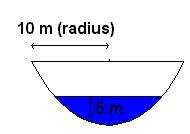
calculus.jpg


Homework Equations


F=pgAd
A=wdx

The Attempt at a Solution


F= int 0->5 1000(9.8)2sqrt(100-y^2)(5)
98000*int 0->5 sqrt(100-y^2)
u=100-y^2
-1/2*du=dy
98000*int 75->100 u^(.5)
98000{(2/3)u^(3/2)} 75->100
64171414.85 N
 
Last edited:
Physics news on Phys.org
I figured it out finally...
The right answer should be 2.29x10^6. I actually did it right another way the first time.

F=(1000)(9.8)*int 0->5 (100-x^2)^.5(-2x)dx
=-9800{(2/3)(75^(2/3)-1000}0->5

U substitution works too... that's what I did hours ago, but I doubted my answer.


F=(1000)(9.8)(2)(5)*int 0->5 (100-x^2)^.5
=98000 int 0->5 sqrt(100-x^2)
u=100-x^2
-2dx=du
dx=-.5du
98000 int 75->100 u^.5
98000{(2/3)u^(3/2)}75->100
 

Similar threads

  • · Replies 2 ·
Replies
2
Views
3K
  • · Replies 5 ·
Replies
5
Views
2K
  • · Replies 27 ·
Replies
27
Views
2K
  • · Replies 3 ·
Replies
3
Views
2K
Replies
20
Views
2K
Replies
1
Views
2K
Replies
3
Views
4K
  • · Replies 2 ·
Replies
2
Views
5K
  • · Replies 4 ·
Replies
4
Views
14K
  • · Replies 11 ·
Replies
11
Views
3K