Solving 3D Statics Problem with Two Equal Mass Rods

  • Thread starter Thread starter bigdaddynate
  • Start date Start date
  • Tags Tags
    Statics
Click For Summary
SUMMARY

The discussion focuses on solving a 3D statics problem involving two equal mass rods, each measuring 35 cm in length, connected by a 3 cm connecting rod. The objective is to sum the moments around point O and determine the reactions of each rod. Participants emphasize the importance of drawing diagrams and labeling forces, as well as utilizing the cross product or right-hand rule for moment calculations.

PREREQUISITES
  • Understanding of 3D statics principles
  • Proficiency in using the cross product for vector calculations
  • Ability to draw and interpret free-body diagrams
  • Familiarity with moment summation techniques
NEXT STEPS
  • Research the application of the cross product in 3D statics problems
  • Study how to effectively draw and label free-body diagrams
  • Learn about moment summation around various points in static systems
  • Explore the right-hand rule for determining moment directions
USEFUL FOR

Students and professionals in engineering, particularly those specializing in mechanics and statics, as well as anyone involved in analyzing 3D structures and forces.

bigdaddynate
Messages
3
Reaction score
0
I have attached a sketch of a 3-d system. There are two rods of equal length (35cm) and equal mass. The masses are equal but unknown (mass of rod #1 = mass of rod #2). Please note that rod #2 is attached to rod one by a small connecting rod (3cm in length). Also note that the width of all rods is arbitrary. The question asks to sum the moments around point O & find the reactions of each rod.
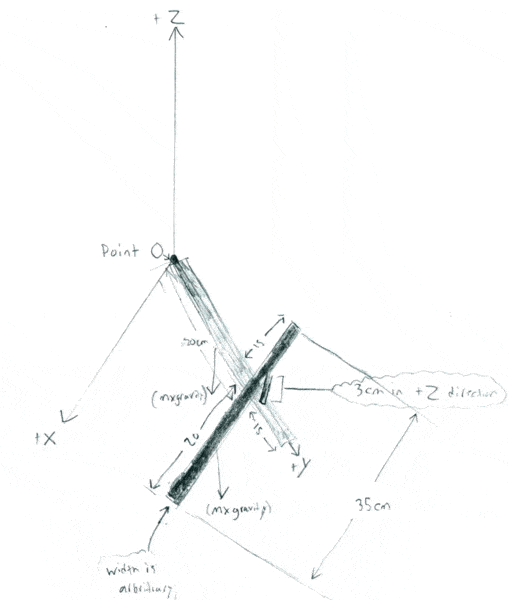
statics.gif


(Please click on image for a larger view)

I would really appreciate any input or advice on how to go about this problem. Thanks in advance.
 
Physics news on Phys.org
the image isn't showing up. Try uploading it to fileshack or something.

All i can say for now is draw a diagrams and label all your force. If they ask you to sum moments at a points then you will have to use the cross product or right rule.
 

Similar threads

  • · Replies 3 ·
Replies
3
Views
4K
  • · Replies 17 ·
Replies
17
Views
2K
Replies
13
Views
2K
  • · Replies 1 ·
Replies
1
Views
2K
  • · Replies 5 ·
Replies
5
Views
2K
  • · Replies 13 ·
Replies
13
Views
2K
  • · Replies 4 ·
Replies
4
Views
3K
  • · Replies 1 ·
Replies
1
Views
4K
Replies
11
Views
4K
  • · Replies 9 ·
Replies
9
Views
5K