Solving a Problem With Fourier Transforms: Heaviside Unit Step Function

Click For Summary
The discussion revolves around solving a problem involving the Fourier transforms of the Heaviside unit step function. The user is tasked with finding the Fourier integral representation of the function f(x) = H(x) - H(x-l) and determining the value of a specific integral. They express uncertainty about their approach, particularly regarding the odd extension of the function and the divergence of the cosine integral. Clarifications are provided about the relationship between the odd extension g(x) and the original function f(x), as well as the behavior of f(x) based on the value of l. The conversation also touches on technical issues with LaTeX rendering in the forum.
Telemachus
Messages
820
Reaction score
30
Hi there. I'm starting with the Fourier transforms, and I'm having some trouble with my first exercise on this topic.
The problem says: Given f(x)=H(x)-H(x-l) (H(x) is the Heaviside unit step function).
a) Consider the odd extension for f and find its Fourier integral representation.
b) Using the previous incise calculate the value for \int_0^{\infty}\frac{1-cos (\omega l)}{\omega}\sin (\omega l) d\omega

Well, for a) I think I should get the Fourier transfor for the sign function, I don't know if this is right, but anyway I've defined the function like this:
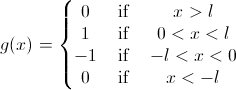
attachment.php?attachmentid=36336&stc=1&d=1307746243.png


Then the Fourier integral representation:
g(x)=\displaystyle\frac{1}{2\pi}\displaystyle\int_{-\infty}^{\infty}\displaystyle\int_{-\infty}^{\infty}g(x)e^{-i \omega x}dx e^{i \omega x}d\omega

But g(x) is odd, then:

attachment.php?attachmentid=36337&stc=1&d=1307746243.png


And the thing is that the integral for the cosine diverges as I see it, but I'm probably doing something wrong.

Help please :)

PD, I don't know why latex isn't working in some cases, so I've attached some images.
 

Attachments

  • godd.png
    godd.png
    1.2 KB · Views: 423
  • finteg.png
    finteg.png
    5.2 KB · Views: 453
Last edited:
Physics news on Phys.org
Can you tell us how your g(x) is related to the f(x) in the problem statement?

Also, is there any assumption regarding whether l is positive, negative, or zero?

If l is positive, then f(x) should be 1 for 0 < x < l and 0 elsewhere. (Change < to \leq as appropriate, depending on how you defined the Heaviside function.)

P.S. Your Latex looks fine, but be aware that it doesn't seem to render correctly in your own browser after you first post it. If you refresh the page, it should fix itself.
 
Hi jbunni. Thanks for posting.

Can you tell us how your g(x) is related to the f(x) in the problem statement?
Yes, g(x) is the odd extension for f(x). Here you have a graph of both, I take l=2, but l is arbitrary (I think that when I find the Fourier Integral I must be doing something like l->infinity, so I think I should get the sign function):
attachment.php?attachmentid=36341&stc=1&d=1307753650.png


You're right about that it must be 1 at x=0. But it doesn't make any difference I think.

About latex, I've realized that sometimes I have to refresh to see the "pictures" instead of the code, but today it just didn't work, and for some commands (the brackets for example, to define a trunked function) it just doesn't work for me, I've tried to refresh, but it didn't work, so then I've uploaded the pictures.
 

Attachments

  • graph.PNG
    graph.PNG
    710 bytes · Views: 583
Last edited:
The odd function can be also defined as g(x)=H(x)-H(x-l)-H(-x)+H(-x-l)
 
Question: A clock's minute hand has length 4 and its hour hand has length 3. What is the distance between the tips at the moment when it is increasing most rapidly?(Putnam Exam Question) Answer: Making assumption that both the hands moves at constant angular velocities, the answer is ## \sqrt{7} .## But don't you think this assumption is somewhat doubtful and wrong?

Similar threads

Replies
1
Views
2K
  • · Replies 3 ·
Replies
3
Views
2K
  • · Replies 6 ·
Replies
6
Views
3K
  • · Replies 5 ·
Replies
5
Views
2K
  • · Replies 2 ·
Replies
2
Views
3K
  • · Replies 1 ·
Replies
1
Views
2K
  • · Replies 2 ·
Replies
2
Views
3K
  • · Replies 3 ·
Replies
3
Views
5K
Replies
8
Views
2K
Replies
5
Views
2K