Solving Beam with 2 Hinges: Struggling with FBD & Forces

  • Thread starter Thread starter DrVirz
  • Start date Start date
  • Tags Tags
    Beam Hinges
Click For Summary
SUMMARY

This discussion focuses on solving a beam problem involving two hinges and the associated free body diagram (FBD) analysis. Participants confirm that the moment at the hinges is zero, emphasizing that a pinned connection cannot support any moment. The conversation highlights the necessity of splitting the beam into sections to analyze internal forces accurately, specifically suggesting dividing it into four parts: the whole beam, left side, right side, and middle. Proper understanding of support reactions and internal forces is crucial for solving such problems.

PREREQUISITES
  • Understanding of static equilibrium principles
  • Knowledge of free body diagrams (FBD)
  • Familiarity with beam mechanics and hinge connections
  • Ability to analyze internal and external forces in structural systems
NEXT STEPS
  • Study the concept of internal forces in beams, focusing on sections and hinge effects
  • Learn about static equilibrium conditions and their application in structural analysis
  • Review examples of free body diagrams for beams with multiple supports
  • Explore the implications of pinned connections in structural mechanics
USEFUL FOR

Engineering students, structural analysts, and professionals involved in mechanics and civil engineering who are looking to enhance their understanding of beam analysis and support reactions.

DrVirz
Messages
24
Reaction score
0
Hi all,

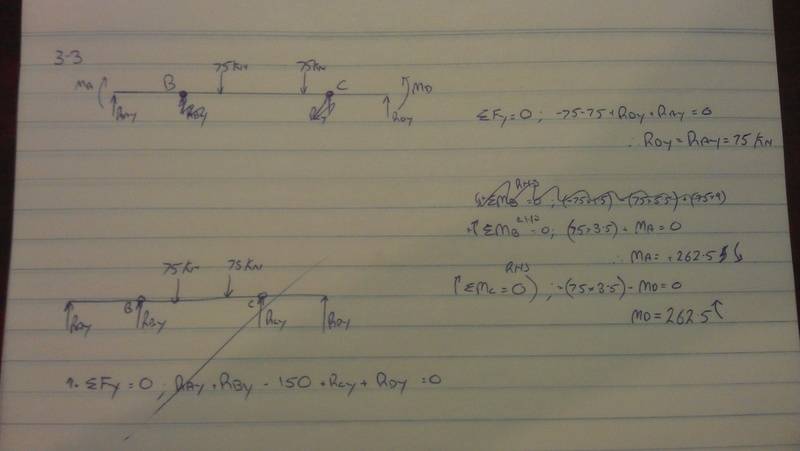
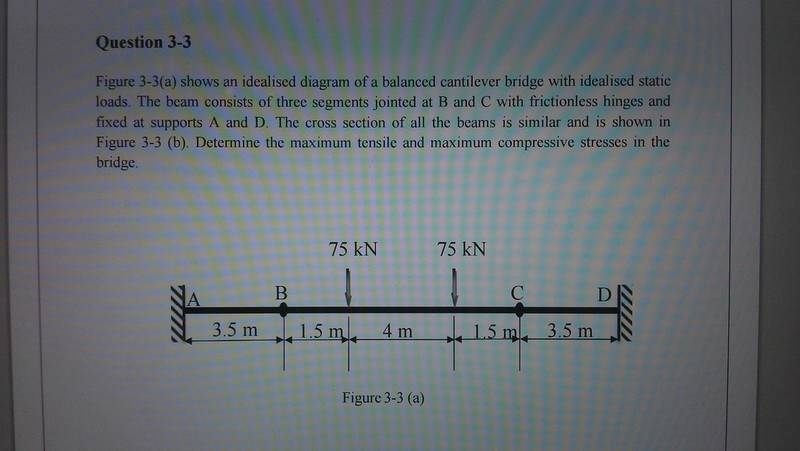
Having trouble with the following question, trying to work out the FBD and forces. I am fine with working out the max tensile and compressive forces however I can't get that far as the two hinges are throwing me off. As I understand, the moment at the hinges should be 0, is this correct? I think my RDy and RAy are incorrect as I somehow have to incorporate vertical forces at C and B..?

Thanks for your help!

I have attached a photo of the question and my attempted solution for the forces.
IMAG0071_zpsopo1ixl1.jpg

15de8933-a498-4fb4-b22f-15eaf8e2dc7b_zpsetnqhsyh.jpg
 
Physics news on Phys.org
Correct, the hinge applies zero moment. Also there is also a resistive moment being applied by the two wall connections. (But it looks like you included that).

Try to take apart the beam and include internal forces.
 
Last edited:
x86 said:
Try to take apart the beam and include internal forces.

This is where I am getting confused. Because the beam has 2 hinges, would I split the beam into 3 parts. Then at each hinge I would have a force in the y direction (and x however this is neglected). So for section 1 at B I would have a positive y force, for section 2 at B I would have a negative y force?
 
DrVirz said:
This is where I am getting confused. Because the beam has 2 hinges, would I split the beam into 3 parts. Then at each hinge I would have a force in the y direction (and x however this is neglected). So for section 1 at B I would have a positive y force, for section 2 at B I would have a negative y force?

Right, whenever you have a hinge there are two unknowns: +y and +x. And you can actually split it into 4 parts. 1) the whole beam, 2) left side, 3) right side, 4) middle

If you're unsure of the direction, just assume its in the positive direction. If you solve it and its negative, you know your direction was wrong.
 
Also just reading your question again: you said something about the moment at the hinges/pins being zero. I took statics a long time ago and I don't know if this is true.

However, I know for a fact the moment applied by the hinge is zero.

If you are told that the body is in equilibrium, then the moment anywhere is zero.

But if you are told nothing, I don't know if we can say the moment at the pin is zero or not.

Perhaps you should check your notes for this.
 
A pinned connection cannot support any moment, and neither can there be any moment in the beam at that connection. A pinned support cannot support any moment, but there may or may not be a moment in the beam at that support, depending upon whether the pinned support is located at the end of the beam or in between the ends.
In this problem, no moment at pins, and no moment in beam at those pins. The support reaction forces and moments are correct, and the proper direction (cw vs. ccw) of the fixed support moments are shown in the calcs correctly, but assumed incorrectly in the figure.
Note that the reactions at supports A and D are external to the beam. The forces at B and C are internal, and only show up when taking a free body diagram of the section BC. AB, or CD. They don't show up when looking at the entire beam system.
 
PhanthomJay said:
A pinned connection cannot support any moment, and neither can there be any moment in the beam at that connection. A pinned support cannot support any moment, but there may or may not be a moment in the beam at that support, depending upon whether the pinned support is located at the end of the beam or in between the ends.
In this problem, no moment at pins, and no moment in beam at those pins. The support reaction forces and moments are correct, and the proper direction (cw vs. ccw) of the fixed support moments are shown in the calcs correctly, but assumed incorrectly in the figure.
Note that the reactions at supports A and D are external to the beam. The forces at B and C are internal, and only show up when taking a free body diagram of the section BC. AB, or CD. They don't show up when looking at the entire beam system.

This clears up a lot! Thanks for that. I will go and do the rest of the question when I get home later today.
 

Similar threads

  • · Replies 36 ·
2
Replies
36
Views
4K
  • · Replies 8 ·
Replies
8
Views
2K
  • · Replies 10 ·
Replies
10
Views
3K
Replies
3
Views
2K
  • · Replies 15 ·
Replies
15
Views
6K
Replies
1
Views
6K
  • · Replies 7 ·
Replies
7
Views
2K
  • · Replies 9 ·
Replies
9
Views
32K
  • · Replies 6 ·
Replies
6
Views
2K
Replies
8
Views
6K