Solving Beam with 2 Hinges: Struggling with FBD & Forces

  • Thread starter Thread starter DrVirz
  • Start date Start date
  • Tags Tags
    Beam Hinges
Click For Summary

Discussion Overview

The discussion revolves around solving a problem related to a beam with two hinges, focusing on the free body diagram (FBD) and the forces involved. Participants are exploring the implications of hinge connections on moments and forces, as well as how to effectively break down the beam into sections for analysis.

Discussion Character

  • Technical explanation
  • Debate/contested
  • Mathematical reasoning

Main Points Raised

  • One participant expresses confusion about the moment at the hinges, questioning if it should be zero and how to incorporate vertical forces at points B and C.
  • Another participant confirms that the hinge applies zero moment but mentions a resistive moment from wall connections, suggesting the need to consider internal forces.
  • There is a discussion about splitting the beam into sections due to the two hinges, with one participant proposing three parts and another suggesting four parts for analysis.
  • Some participants clarify that a pinned connection cannot support any moment, and there may or may not be a moment in the beam at that connection, depending on its location.
  • One participant notes that while the moment at the hinges is zero in equilibrium, this may not be universally applicable without specific conditions being stated.
  • Clarifications are made regarding the distinction between external support reactions and internal forces at the hinges, emphasizing that internal forces only appear in specific free body diagrams.

Areas of Agreement / Disagreement

Participants generally agree that a pinned connection cannot support a moment, but there is uncertainty regarding the implications of this in different contexts. The discussion remains unresolved regarding the specifics of how to analyze the forces and moments in the beam.

Contextual Notes

There are limitations in the discussion regarding assumptions about equilibrium and the specific conditions under which moments at the hinges can be considered zero. The participants also express varying levels of confidence in their understanding of the concepts involved.

DrVirz
Messages
24
Reaction score
0
Hi all,

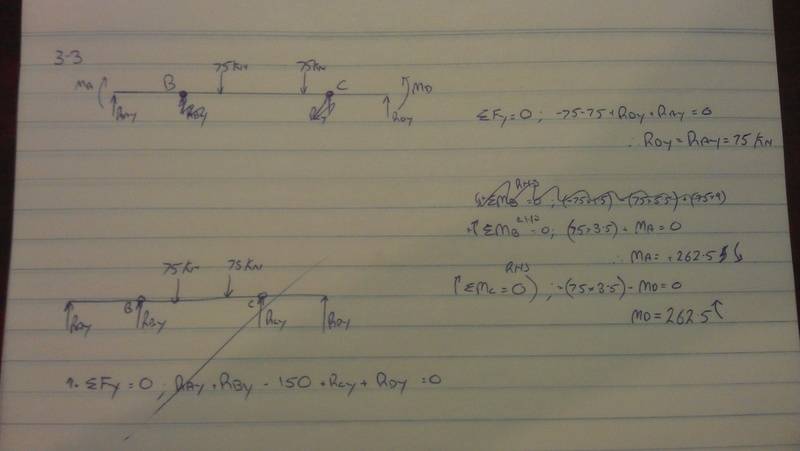
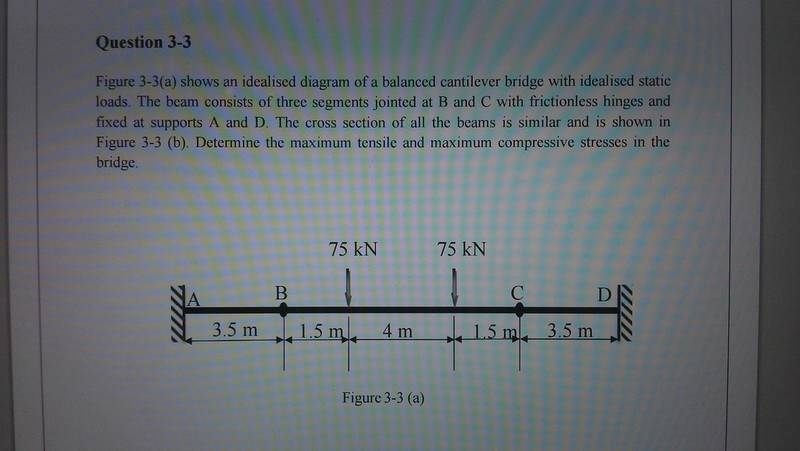
Having trouble with the following question, trying to work out the FBD and forces. I am fine with working out the max tensile and compressive forces however I can't get that far as the two hinges are throwing me off. As I understand, the moment at the hinges should be 0, is this correct? I think my RDy and RAy are incorrect as I somehow have to incorporate vertical forces at C and B..?

Thanks for your help!

I have attached a photo of the question and my attempted solution for the forces.
IMAG0071_zpsopo1ixl1.jpg

15de8933-a498-4fb4-b22f-15eaf8e2dc7b_zpsetnqhsyh.jpg
 
Physics news on Phys.org
Correct, the hinge applies zero moment. Also there is also a resistive moment being applied by the two wall connections. (But it looks like you included that).

Try to take apart the beam and include internal forces.
 
Last edited:
x86 said:
Try to take apart the beam and include internal forces.

This is where I am getting confused. Because the beam has 2 hinges, would I split the beam into 3 parts. Then at each hinge I would have a force in the y direction (and x however this is neglected). So for section 1 at B I would have a positive y force, for section 2 at B I would have a negative y force?
 
DrVirz said:
This is where I am getting confused. Because the beam has 2 hinges, would I split the beam into 3 parts. Then at each hinge I would have a force in the y direction (and x however this is neglected). So for section 1 at B I would have a positive y force, for section 2 at B I would have a negative y force?

Right, whenever you have a hinge there are two unknowns: +y and +x. And you can actually split it into 4 parts. 1) the whole beam, 2) left side, 3) right side, 4) middle

If you're unsure of the direction, just assume its in the positive direction. If you solve it and its negative, you know your direction was wrong.
 
Also just reading your question again: you said something about the moment at the hinges/pins being zero. I took statics a long time ago and I don't know if this is true.

However, I know for a fact the moment applied by the hinge is zero.

If you are told that the body is in equilibrium, then the moment anywhere is zero.

But if you are told nothing, I don't know if we can say the moment at the pin is zero or not.

Perhaps you should check your notes for this.
 
A pinned connection cannot support any moment, and neither can there be any moment in the beam at that connection. A pinned support cannot support any moment, but there may or may not be a moment in the beam at that support, depending upon whether the pinned support is located at the end of the beam or in between the ends.
In this problem, no moment at pins, and no moment in beam at those pins. The support reaction forces and moments are correct, and the proper direction (cw vs. ccw) of the fixed support moments are shown in the calcs correctly, but assumed incorrectly in the figure.
Note that the reactions at supports A and D are external to the beam. The forces at B and C are internal, and only show up when taking a free body diagram of the section BC. AB, or CD. They don't show up when looking at the entire beam system.
 
PhanthomJay said:
A pinned connection cannot support any moment, and neither can there be any moment in the beam at that connection. A pinned support cannot support any moment, but there may or may not be a moment in the beam at that support, depending upon whether the pinned support is located at the end of the beam or in between the ends.
In this problem, no moment at pins, and no moment in beam at those pins. The support reaction forces and moments are correct, and the proper direction (cw vs. ccw) of the fixed support moments are shown in the calcs correctly, but assumed incorrectly in the figure.
Note that the reactions at supports A and D are external to the beam. The forces at B and C are internal, and only show up when taking a free body diagram of the section BC. AB, or CD. They don't show up when looking at the entire beam system.

This clears up a lot! Thanks for that. I will go and do the rest of the question when I get home later today.
 

Similar threads

  • · Replies 36 ·
2
Replies
36
Views
4K
  • · Replies 8 ·
Replies
8
Views
2K
  • · Replies 10 ·
Replies
10
Views
3K
Replies
3
Views
2K
  • · Replies 15 ·
Replies
15
Views
7K
Replies
1
Views
6K
  • · Replies 7 ·
Replies
7
Views
2K
  • · Replies 9 ·
Replies
9
Views
32K
  • · Replies 6 ·
Replies
6
Views
3K
Replies
8
Views
6K