Solving for $$\omega_2$$ using Conservation of Angular Momentum

Join the discussion
Ask a follow-up here, or get your own question answered by working scientists, mathematicians and engineers — people, not an autocomplete.
Real named experts · corrections over time · the nuance an AI answer skips
14 replies · 3K views
Combinatorics
Messages
31
Reaction score
5
Homework Statement
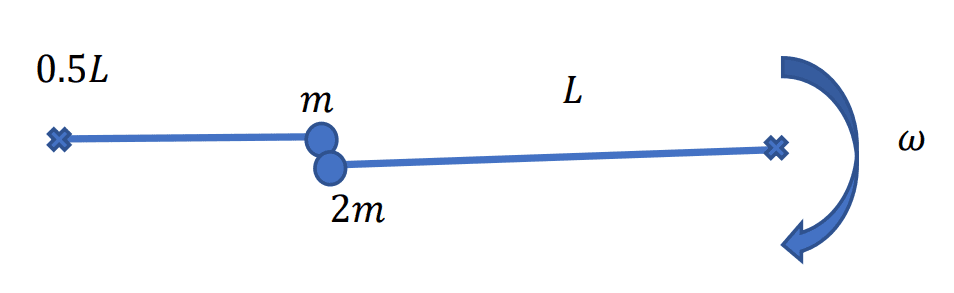
A point mass "2m" is rotating around a fixed axis and collides with a stationary mass "m" that starts rotating around another fixed axis. $$\omega$$ is the angular velocity of mass $$2m$$ before the collision and $$0.8\omega$$ is its velocity after the collision.
I need to calculate the energy lost during the collision.
Relevant Equations
J=mvr
J initial = J final?
E_k = 0.5mv^2
Unfortunately, I couldn't arrive to the correct answer ($$=0.28mL^2 \omega^2$$ ) and will be happy to understand what am I doing wrong.

**My attempt:**

Using $$
E_k = \frac{1}{2} I \omega^2
$$
I obtain that the difference I need to calculate is
$$
\frac{1}{2} (2mL^2)(0.8\omega)^2 + \frac{1}{2} \left( m \frac{1}{2}^2 L^2 \right) \omega_2 ^2 - \frac{1}{2} (2mL^2) \omega^2,
$$
where $$\omega_2$$ is the angular velocity of mass $$m$$ after the collision. To calculate its velocity, I use conservation of angular momentum and the formula $$J=mvr$$ for a point mass rotating around a fixed axis:
$$
J_i = -2m\omega L^2 = J_f = -2m 0.8 \omega L^2 + m\omega_2 \frac{1}{2}L^2 \Leftrightarrow \omega_2 = -\frac{36}{5}\omega.
$$
And therefore the difference is $$6.12mL^2 \omega^2$$.
publish.PNG
 
Last edited:
on Phys.org
PeroK said:
That's hard to read. You need two dollar signs (or two hash signs) to delimit your Latex.

What's the question or quantity you're trying to find?
I apologize for not noticing the equations didn't appear as I wanted. I have now edited the thread.
 
Combinatorics said:
I apologize for not noticing the equations didn't appear as I wanted. I have now edited the thread.
How are you using conservation of angular momentum here? About which point is angular momentum conserved?
 
PeroK said:
How are you using conservation of angular momentum here? About which point is angular momentum conserved?
This is probably what I didn't understand. I used total angular momentum wrt the two fixed axes, since I couldn't think of any other way to calculate the angular velocity $$\omega_2$ of the second point mass. How can I solve this question in another way?
 
Combinatorics said:
This is probably what I didn't understand. I used total angular momentum wrt the two fixed axes, since I couldn't think of any other way to calculate the angular velocity $$\omega_2$ of the second point mass. How can I solve this question in another way?
Angular momentum is always measured relative to some point or axis, so you can't mix and match your axes like that.

Perhaps there's a simple solution. Focus on the collision itself.
 
PeroK said:
Angular momentum is always measured relative to some point or axis, so you can't mix and match your axes like that.

Perhaps there's a simple solution. Focus on the collision itself.
Is it true that close enough to the collision I can just use conservation of linear momentum to find the velocity of the second mass after the collision?
 
Combinatorics said:
Is it true that close enough to the collision I can just use conservation of linear momentum to find the velocity of the second mass after the collision?
You could always try and see what answer you get.
 
PeroK said:
You could always try and see what answer you get.
Using conservation of linear momentum, I obtain that $$ \omega_2 = 0.2\omega $$. Substituting in the energy difference gives $$ -0.355 mL^2 \omega^2 $$, which is still not the right answer... What am I doing wrong here?

Thank you
 
Combinatorics said:
Using conservation of linear momentum, I obtain that $$ \omega_2 = 0.2\omega $$. Substituting in the energy difference gives $$ -0.355 mL^2 \omega^2 $$, which is still not the right answer... What am I doing wrong here?

Thank you
You got the wrong answer. I can't tell what you're doing wrong without seeing your calculations.
 
haruspex said:
Wrong already.
PeroK said:
You got the wrong answer. I can't tell what you're doing wrong without seeing your calculations.
Thanks for your feedback! here is my attempt. Using conservation of linear momentum, I obtain
$$
2m\cdot \frac{\omega}{L} = m\cdot \frac{\omega_2}{0.5L} + 2m\cdot \frac{0.8\omega}{L}
$$
where I used $$v=\frac{\omega}{L}$$.
Solving this equation implies
$$
\omega_2 = 0.2\omega.
$$
When I substitute this expression into the energy difference:
$$
\frac{1}{2} (2mL^2)(0.8\omega)^2 + \frac{1}{2} \left( m \frac{1}{2}^2 L^2 \right) \omega_2 ^2 - \frac{1}{2} (2mL^2) \omega^2,
$$
I obtain
$$
-0.355 mL^2 \omega^2.
$$

What am I doing wrong?

Thank you very much again!
 
PeroK said:
The speed of the mass is not ##\omega /L##.
Thank you PeroK, you helped a lot!
 
Combinatorics said:
Here's an argument to support what you are doing. If the impact takes place over a very short distance, then the "external" forces on the two masses ##m, 2m## exerted by the light rods are perpdendicular to the direction of motion, so do not effect momentum in the direction of motion during the collision.

That's why you may consider this as a simple linear collision.
 
  • Informative
Likes   Reactions: Combinatorics