Solving for y-intercept on a wavefunction graph

  • Thread starter Thread starter Linus Pauling
  • Start date Start date
  • Tags Tags
    Graph Wavefunction
Click For Summary
SUMMARY

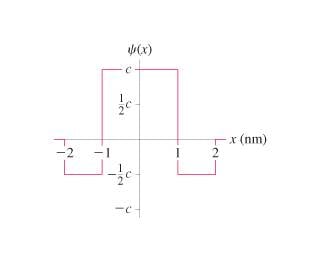
The discussion focuses on determining the normalization constant 'c' for a wavefunction graph, specifically using the integral of the squared wavefunction. The integral from -1 to 1 yields the equation 2/3 = 2c², leading to the conclusion that c = sqrt(1/3) = 0.58 nm-1/2. Participants clarify that the area under the squared wavefunction must be considered to compute probabilities, with the total area equating to 1. The probability of finding the particle between -1 and 1 nm is calculated as the integral of psi squared over that interval.

PREREQUISITES
  • Understanding of wavefunction normalization in quantum mechanics
  • Familiarity with integral calculus, particularly definite integrals
  • Knowledge of probability density functions in quantum mechanics
  • Ability to interpret graphical representations of mathematical functions
NEXT STEPS
  • Study the concept of wavefunction normalization in quantum mechanics
  • Learn about the properties of integrals, specifically in the context of probability density functions
  • Explore piecewise functions and their applications in quantum mechanics
  • Investigate the implications of probability calculations in quantum mechanics, including expected values
USEFUL FOR

Students and professionals in physics, particularly those specializing in quantum mechanics, as well as anyone involved in mathematical modeling of wavefunctions and probability calculations.

Linus Pauling
Messages
187
Reaction score
0
1.
40.EX16.jpg


What is c?


2. 1 = integral of wavefunction2 from -infinity to +infinity


3. From the graph, the area above the x-axis is 2/3 the total area. I solved the following integral (int) from -1 to +1:

2/3 = int(c2dx)

Obtaining 2/3 = 2c2

So c = sqrt(1/3) = 0.58 nm-1/2
 
Physics news on Phys.org
Linus Pauling said:
1.
40.EX16.jpg


What is c?

2. 1 = integral of wavefunction2 from -infinity to +infinity
3. From the graph, the area above the x-axis is 2/3 the total area. I solved the following integral (int) from -1 to +1:

2/3 = int(c2dx)Obtaining 2/3 = 2c2

So c = sqrt(1/3) = 0.58 nm-1/2

Remember, your are integrating the wave function squared, so you cannot just look at THAT graph. You must realize that the graph to look at is that graph with every value squared. What happens to negative values and fractions?
 
Last edited:
I'm lost. What equation describes the shape of the wavefunction given in the picture? I Understand that I will square that function, then integrate between the boundaries setting the integral equal to one, then solving for c...
 
Linus Pauling said:
I'm lost. What equation describes the shape of the wavefunction given in the picture? I Understand that I will square that function, then integrate between the boundaries setting the integral equal to one, then solving for c...

I'm not sure what function. I am just saying from the graph given, graph the square of the function (which you can just do visually by squaring all the \psi values). Then you can pull off the integration.
 
Also, you can just define the piecewise function. So -inf < x < -2 , psi = 0 and so on. Then just square each piece.
 
Ok, so the shape of the squared wavefunction is basically two smaller rectangles with height 0.25c^2 and base of length 1, and a bigger one with base of 2 and height c^2. Total area = the integral = 1 = (5/2)c^2, so c = 0.632

Correct?
 
I am also asked (and am confused about) computing the probability of finding thte particle between -1 and 1nm.

Do I simply take the integral/area of the "bigger rectangle" that goes from -1 to 1nm, whose are is 2c^2, then divide by the total area 2.5c^2, i.e. 80% probability?
 
Linus Pauling said:
Ok, so the shape of the squared wavefunction is basically two smaller rectangles with height 0.25c^2 and base of length 1, and a bigger one with base of 2 and height c^2. Total area = the integral = 1 = (5/2)c^2, so c = 0.632

Correct?

Yup.
 
Linus Pauling said:
I am also asked (and am confused about) computing the probability of finding thte particle between -1 and 1nm.

Do I simply take the integral/area of the "bigger rectangle" that goes from -1 to 1nm, whose are is 2c^2, then divide by the total area 2.5c^2, i.e. 80% probability?

Well now you know what c is and the probability of finding the particle between -1 and 1 is the integral of psi squared from -1 to 1.
 

Similar threads

  • · Replies 6 ·
Replies
6
Views
1K
  • · Replies 18 ·
Replies
18
Views
1K
  • · Replies 3 ·
Replies
3
Views
857
  • · Replies 15 ·
Replies
15
Views
3K
Replies
25
Views
2K
  • · Replies 5 ·
Replies
5
Views
2K
  • · Replies 8 ·
Replies
8
Views
2K
Replies
6
Views
1K
Replies
1
Views
826
  • · Replies 10 ·
Replies
10
Views
2K