Discussion Overview
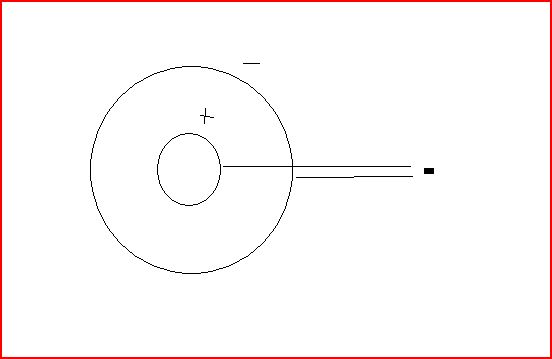
The discussion revolves around the application of Gauss' Law to a scenario involving two concentric hollow spheres, one positively charged and the other negatively charged. Participants explore the implications of this configuration on the electric field outside the spheres, questioning whether a test charge placed outside would experience any electric force.
Discussion Character
- Debate/contested
- Mathematical reasoning
- Conceptual clarification
Main Points Raised
- One participant asserts that since the total enclosed charge is zero, the electric field outside the spheres must also be zero, leading to confusion about the behavior of a test charge placed outside.
- Another participant challenges this reasoning by pointing out that the distribution of charge on the outer sphere affects the electric field, particularly noting that the negative charge is further away from the test charge.
- A participant expresses difficulty reconciling Gauss' Law with their understanding of Coulomb's Law, suggesting that the closer positive charge should exert a force on the test charge.
- Concerns are raised about the lack of spherical symmetry in the setup, which complicates the application of Gauss' Law.
- Some participants reference simulations to visualize the electric field and question the validity of their results in light of Gauss' Law.
- Discussion includes the Shell Theorem as a potential framework for understanding the situation, with participants considering how forces from different points on the spheres might cancel out.
- One participant attempts to model the problem using discrete slices of the spheres, arguing that the forces from these slices do not sum to zero.
- Another participant suggests that the key to understanding lies in exploiting symmetries that allow for the cancellation of forces, referencing various resources for further exploration.
Areas of Agreement / Disagreement
Participants express differing views on the application of Gauss' Law in this context, with no consensus reached regarding the behavior of the electric field or the forces acting on the test charge. The discussion remains unresolved, with multiple competing interpretations of the problem.
Contextual Notes
Participants note limitations in their understanding related to the assumptions of symmetry and the specific configurations of charges. The discussion highlights the complexity of applying Gauss' Law in non-ideal situations.