Solving MOSFET Circuit Problem with Q1 & Q2

  • Thread starter Thread starter etf
  • Start date Start date
  • Tags Tags
    Circuit Mosfet
Click For Summary

Discussion Overview

The discussion revolves around a MOSFET circuit problem involving two transistors, Q1 (NMOS) and Q2 (PMOS). Participants explore the operational modes of the MOSFETs, their Q points, output DC voltage, and voltage gain, while addressing contradictions and challenges in the circuit analysis.

Discussion Character

  • Technical explanation
  • Debate/contested
  • Mathematical reasoning

Main Points Raised

  • One participant presents the circuit and equations for the NMOS and PMOS transistors, assuming both operate in saturation and deriving current equations based on given parameters.
  • Another participant expresses confusion regarding the roles of Q1 and Q2, suggesting that the circuit is over-specified and requests a circuit diagram to clarify the contradictions present.
  • A participant references a textbook example, providing specific values for voltages and currents, and mentions a solution provided in the text.
  • One participant notes that a simulation tool (NI Multisim) fails to simulate the original circuit unless a slightly adjusted gate voltage is used, indicating a potential issue with the specified parameters.
  • Another participant introduces the concept of finite Early voltages and suggests incorporating these into the drain current equations, presenting a modified approach to account for channel modulation.
  • A later reply describes a method to analyze the circuit as a "folded cascode" amplifier, providing specific calculations for voltages and currents, while also critiquing the accuracy of a provided circuit diagram.

Areas of Agreement / Disagreement

Participants express differing views on the circuit's operation and the validity of the parameters used. There is no consensus on the correct approach or resolution of the contradictions identified in the circuit analysis.

Contextual Notes

Participants highlight potential limitations in the circuit specifications, including the assumption of saturation for both transistors and the implications of finite Early voltages. The discussion reflects unresolved mathematical steps and dependencies on the definitions of parameters.

etf
Messages
179
Reaction score
2
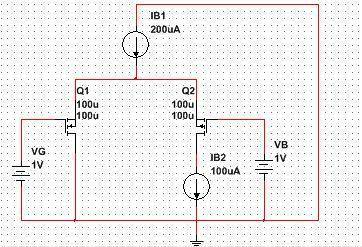
Here is my circuit:

kolo.JPG


Q1 is NMOS and Q2 is PMOS.
Q1: VT1=0.7V, beta1=2mA/V^2
Q2: VT2=-0.9V, beta2=1.8mA/V^2.
I assumed that both transistors work in saturation. In this mode it must be:
Q1: VG1S1 > VT1, VG1D1 < VT1, ID1=beta1*(VG1S1-VT1)^2/2,
Q2: VS2G2 > -VT2, VD2G2 < -VT2, ID2=beta2*(VS2G2+VT2)^2/2.

We see on scheme that ID2=IB2. Using KCL we get ID1=IB1-ID2=100uA.
Using KVL we get VG1S1=VG. If we put VG1S1=VG in our equation for drain's current in saturation mode we get that ID1=9*10^(-5) A so our equation doesn't hold? (ID1=IB1-ID2=100uA.) :confused:
 
Last edited:
Engineering news on Phys.org
I am confused.
Q1 is a voltage follower that sets the voltage to the common source and 200uA current source.
Q2 can only have 100uA current sink.
Q1 current must carry the difference which is –100 uA, (backwards).
But Q2 is controlled by VB between the drain and gate, not the source.

You have specified voltages and currents and the V~I relationships.
There is no degree of freedom, so you have an over-specified contradiction.

Can you produce a circuit diagram that shows the circuit you are modelling, as it would be implemented between supply rails. That should identify the contradiction.
 
  • Like
Likes   Reactions: 1 person
This is example from my textbook. Here is complete text and original scheme:
Find modes of operation of MOSFETs, their Q points, output DC voltage and voltage gain Av. VG=1V, Vt1=0.7V, Vt2=-0.9V, VA1=VA2=20V, beta1=2mA/V^2, beta2=1.8mA/V^2, IB1=200uA, IB2=100uA, VB=1V.

You can see solution below "Rezultat".
 

Attachments

  • 24052014886.jpg
    24052014886.jpg
    31.6 KB · Views: 618
Last edited:
MOSFET circuit contradiction

Just to mention that NI Multisim 13.0 refuses to simulate original circuit, but if I put VG=1.0162V (100*10^-6 approximately equals 2*10^(-3)*(1.0162-0.7)^2/2 so relation ID1=beta1*(VG1S1-VT1)^2/2 is satisfied) instead of Vg=1V Multisim simulates circuit.
 
Last edited:
Since there are finite Early voltages (VA1=VA2=20V) I must include these voltages in drain's currents like this:
ID1=(beta1/2)*((VG1S1-VT1)^2)*(1+lambda*VD1S1),
ID2=(beta2/2)*((VS2G2+VT2)^2)*(1+lambda*VS1D1),
where lambda is coefficient of channel modulation, lambda=1/VA.
 
You show as a "folded cascode" amplifier (CS + CG).
First what you need is to use this equation
Id1 = 0.5*β*(Vgs1 + Vt1)^2 * (1 + λ*Vds1) and solve is for Vds1.
Because from inspection we know that Vgs1 = 1V and Id1 = 100μA.
After we solve this we get Vds1 = 2.22222V. Thanks to this we can find Vgs2 and solve for Vsd2.
Vgs2 = - 1.22222V and Vsd2 = 1.40309V

And Vout = Vds1 - Vsd2 = 2.22222V - 1.40309V = 0.81913V

And simulation (LTspice) shows similar result.

Edit... And your multisim digram is completely wrong. Q1 is upside down and you have no VDD source.
 

Attachments

  • ff.PNG
    ff.PNG
    4.9 KB · Views: 629
Last edited:
  • Like
Likes   Reactions: 1 person

Similar threads

  • · Replies 19 ·
Replies
19
Views
4K
  • · Replies 2 ·
Replies
2
Views
3K