Solving Related Rates Problem: Understanding Differentiation and the Power Rule

  • Thread starter Thread starter fitz_calc
  • Start date Start date
  • Tags Tags
    Related rates
Click For Summary

Homework Help Overview

The discussion revolves around a related rates problem involving differentiation, specifically focusing on the application of the power rule and the differentiation of constants in the context of a volume formula.

Discussion Character

  • Conceptual clarification, Mathematical reasoning, Assumption checking

Approaches and Questions Raised

  • Participants explore the necessity of applying the power rule to the term r^2 and question the differentiation of constants like 4 and π. There is also a discussion about the correct differentiation of the volume formula and the implications of the original statement being differentiated.

Discussion Status

Participants are actively questioning the differentiation process and the application of the power rule. Some express confusion about the steps taken in the differentiation, while others clarify that constants do not require differentiation. The conversation reflects a mix of interpretations and attempts to understand the reasoning behind the differentiation rules applied.

Contextual Notes

There appears to be some misunderstanding regarding the differentiation of specific terms in the volume formula, as well as the application of the power rule. Participants are also navigating the implications of constants in differentiation.

fitz_calc
Messages
41
Reaction score
0
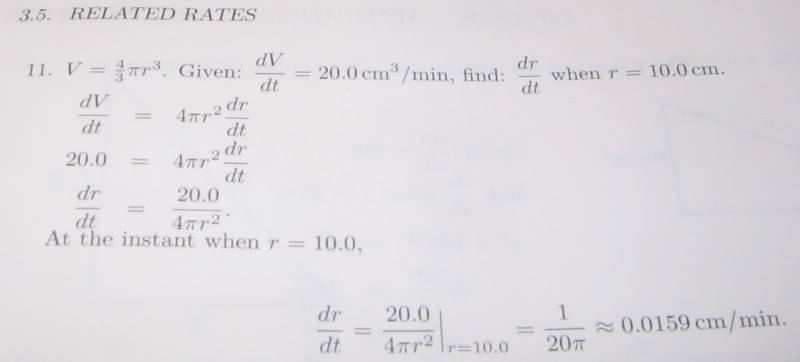
Here is the solution to one of my problems:
Picture.jpg


When inserting dV/dt to differentiate the equation as a function of time, why doesn't the book use the power rule on r^2 and multiply the entire equation by 2? I thought when dr/dt was put into the equation you had to differentiate?
 
Physics news on Phys.org
i don't see why there is a need to multiply by 2? if anything, dividing by 4 would clean things up.

and there is no need to apply the power rule on r^2 b/c it was already differentiated.

sorry i can't give you a more detailed answer.
 
Why would they multiply by 2?

they differentiated it correctly.Unless you are differentiating the wrong statement.

[tex]\frac{d}{dt}(\frac{4}{3}\pi r^3)= (3(\frac{4}{3})\pi r^2))\frac{dr}{dt}[/tex]

which is [tex]=4\pi r^2 \frac{dr}{dt}[/tex]
 
ahh yeah I was looking at the formula as being 4pi*r^2 instead of cubed, even though it was right in front of me in it's correct form!

Another question given this same example, why do you only differentiate r^2 -- why not 4 and pi as well?
 
fitz_calc said:
ahh yeah I was looking at the formula as being 4pi*r^2 instead of cubed, even though it was right in front of me in it's correct form!

Another question given this same example, why do you only differentiate r^2 -- why not 4 and pi as well?
r^3***

and we don't differentiate 4pi bc it's a constant

you could do the product rule on them but you would yield the same results

y=2x
y'=2
 

Similar threads

  • · Replies 3 ·
Replies
3
Views
5K
  • · Replies 30 ·
2
Replies
30
Views
4K
Replies
2
Views
1K
  • · Replies 4 ·
Replies
4
Views
2K
  • · Replies 10 ·
Replies
10
Views
6K
  • · Replies 13 ·
Replies
13
Views
2K
Replies
3
Views
2K
  • · Replies 10 ·
Replies
10
Views
2K
  • · Replies 7 ·
Replies
7
Views
3K
  • · Replies 12 ·
Replies
12
Views
3K