Solving the Charged Bubble Problem with Gas and Electrostatic Forces

  • Thread starter Thread starter Ahmed Farhan
  • Start date Start date
  • Tags Tags
    Bubble Charged
Click For Summary
SUMMARY

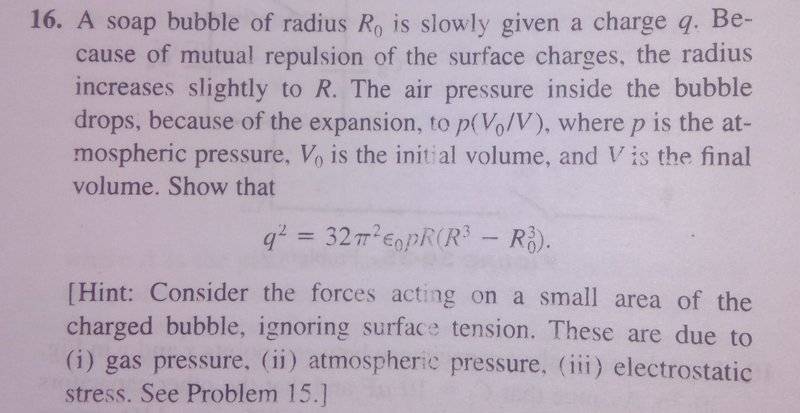
The discussion focuses on solving the Charged Bubble Problem by balancing forces from gas pressure, atmospheric pressure, and electrostatic repulsion. The equation derived includes gas pressure expressed as p(V0/V) dA, atmospheric pressure as p dA, and electrostatic pressure defined as σ²/2ε₀, where σ equals q/(4πR²). Participants are encouraged to provide detailed attempts and insights related to problem 15, which is relevant to the current problem-solving process.

PREREQUISITES
  • Understanding of gas pressure equations and their applications
  • Familiarity with electrostatic forces and Coulomb's law
  • Knowledge of the concept of electric field and potential energy
  • Basic calculus for manipulating equations involving volume and area
NEXT STEPS
  • Research the derivation of electrostatic pressure in charged systems
  • Study the application of the ideal gas law in varying pressure scenarios
  • Explore the relationship between electric fields and forces in charged bubbles
  • Examine problem 15 in detail to identify relevant principles and equations
USEFUL FOR

Physicists, engineers, and students studying electrostatics and fluid dynamics, particularly those interested in the interactions between gas pressure and electrostatic forces in charged systems.

Ahmed Farhan
1.
3016.jpg
2. The force due to gas pressure = p(V0/V) dA
The force due to atmospheric pressure = p dA
The force due to electrostatic repulsion = undetermined

3. Though I don't surely know what the expression for electric force should be, I took an educated guess and solved using the relation:
force of gas pressure + electric repulsion = atmospheric pressure force
but couldn't get the expression asked for in the problem. Can anyone please take a look?
 
Physics news on Phys.org
Please show details of your attempt. The question refers to problem 15. Is there anything in that problem that you could list as relevant to this problem?
 
electrostatic pressure = σ2/2ε0
where σ=q/(4πR2)
now,
pV0/V + σ2/2ε = p
V0=4/3*π*R03 and V=4/3*π*R3
this follows the result
 

Similar threads

  • · Replies 5 ·
Replies
5
Views
884
  • · Replies 69 ·
3
Replies
69
Views
7K
  • · Replies 11 ·
Replies
11
Views
2K
  • · Replies 18 ·
Replies
18
Views
3K
  • · Replies 19 ·
Replies
19
Views
2K
Replies
18
Views
5K
  • · Replies 10 ·
Replies
10
Views
2K
Replies
17
Views
3K
  • · Replies 9 ·
Replies
9
Views
4K
  • · Replies 4 ·
Replies
4
Views
1K