womfalcs3 said:
Chester, thanks for your help, but I may just go ahead and simplify the BCs such that I use a sol-air temperature rather than explicitly include radiation effects.
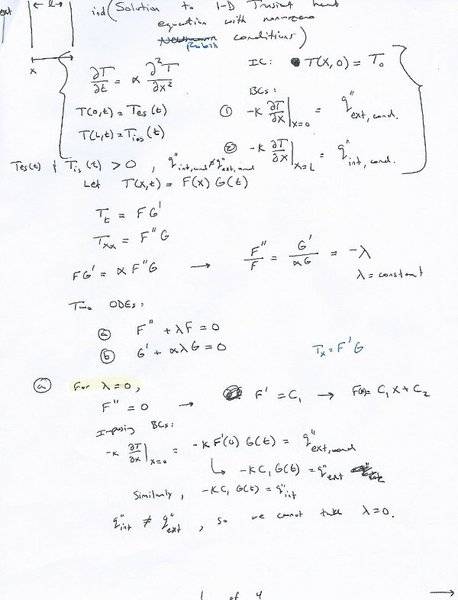
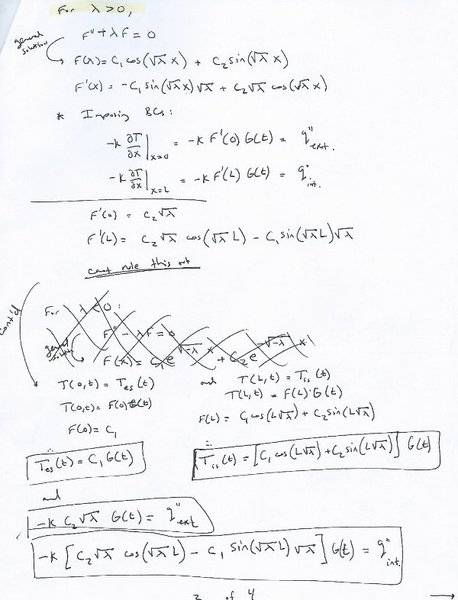
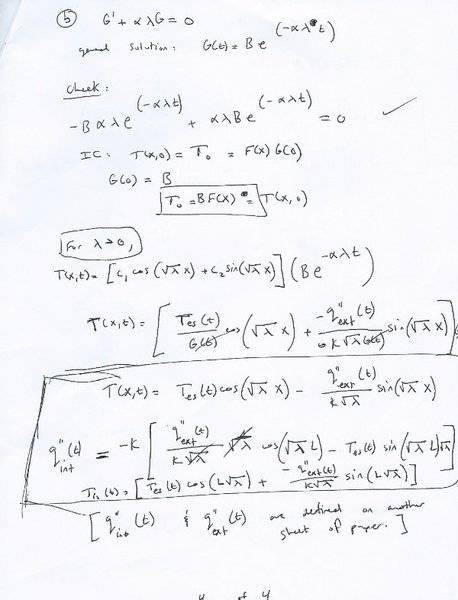
I've just solved the problem where I have 1-D space with one end's temperature fixed to zero and the other has convection term equal to the conduction flux. But I seem to have come to the same issue, how does one analytically solve a problem when both ends have an undefined heat flux. It also seems doable if a we have a homogeneous Nuemann condition on one end and a non-zero Robin condition on the other.
The boundary conditions I would resort to would then be:
-k*(dT/dx)=h1*(Tsol-air(t)-T(0,t)) at x=0
and
-k*(dT/dx)=h2*(T(L,t)-Tindoor(t)) at x=L
The coefficients are exogenously defined.
I would just like some direction rather than a solution.
OK. I can help you work through the solution to this version of the formulation, which is linearized with respect to the external heat transfer.
The way I would solve this problem would be to use both linear superposition and time convoluation.
The drivers for this problem are Tsol-air(t) and Tindoor(t). Both of these are specified functions of time. Step 1 in what we are going to do is to solve the problem with Tsol-air and Tindoor being constant with time. We will then show how to extend the solution to include time varying Tsol-air and Tindoor. Anyway, if we can't solve the problem for this case, we certainly won't be able to solve it for the time varying case.
We will represent the solution to the problem in step 1 as the linear sum of the solutions to two other problems:
Problem 1: Same differential equation, but with Tsol-air specified, and Tindoor = T
0
Problem 2: Same differential equation, but with Tindoor specified, and Tsol-air = T
0
Because of the linearity of the equations, the sum of the solutions to these problems will be the solution for Step 1.
To solve Problem 1, the first thing we will do will be to determine the steady state solution for long times. This will be the solution to the differential equation and boundary conditions with the time derivative set equal to zero. Call this steady state solution T
ss(x). We will then express the solution to Problem 1 as T(x,t)=T*(x,t)+T
ss(x). If we substitute this into the differential equation and boundary conditions we obtain the same differential equation for T*, but with boundary and initial conditions as follows:
T* = T
0-T
ss(x) at t = 0
-k*(dT*/dx)=-h1*(T*(0,t)) at x=0
and
-k*(dT*/dx)=h2*(T*(L,t)) at x=L
This problem can be readily solved by T*=F(t)G(x).
See if you can get the analytic solution to this problem and then get back with me. We will then be able to immediately get the solution to Problem 2 from this result. This will then give us the general solution for Step 1.
Chet