Spacecraft Reentry - Drag Decrease?

Click For Summary
SUMMARY

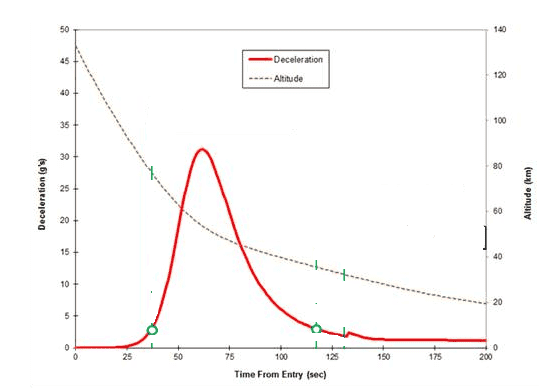
The discussion centers on the dynamics of drag experienced by a spacecraft during reentry into Earth's atmosphere. Initially, the spacecraft, traveling at approximately 18,000 miles per hour, experiences increasing drag due to its high velocity. However, after about 70 seconds, drag decreases despite increasing density, as the spacecraft approaches terminal velocity. This phenomenon occurs because drag is influenced by both speed and air density; while density increases, the spacecraft's velocity decreases, leading to a net reduction in drag force.

PREREQUISITES
  • Understanding of drag force and its relationship with velocity and air density.
  • Familiarity with the concept of terminal velocity in atmospheric physics.
  • Knowledge of spacecraft dynamics during atmospheric reentry.
  • Basic principles of orbital mechanics and velocity.
NEXT STEPS
  • Study the physics of drag force in different atmospheric conditions.
  • Learn about the calculations involved in determining terminal velocity for various objects.
  • Explore the dynamics of spacecraft reentry profiles and their impact on drag.
  • Investigate the effects of altitude on air density and its implications for drag.
USEFUL FOR

Aerospace engineers, physicists, students studying atmospheric dynamics, and anyone interested in the mechanics of spacecraft reentry.

The Don
Messages
11
Reaction score
1
I was given the following drag profile for a spacecraft upon reentry. I understand that the moment it enter's Earth's atmosphere it will be accelerated due to gravity and pick up speed which in turn increases drag however I don't understand why drag then decreases.

Wouldn't density cause drag to keep increasing since density increases the closer you get to Earth's surface? The end makes sense because the object would reach terminal velocity thus drag should equal 1G but I just don't get why drag suddenly decreases after 70 seconds since velocity and density would still be increasing after that point.
upload_2016-3-7_12-39-17.png
 

Attachments

  • upload_2016-3-7_12-38-58.png
    upload_2016-3-7_12-38-58.png
    25.2 KB · Views: 607
  • Like
Likes   Reactions: 1oldman2
Physics news on Phys.org
The Don said:
I just don't get why drag suddenly decreases after 70 seconds since velocity and density would still be increasing after that point.
What makes you think that the velocity increases after that point?
 
Since it hasn't hit terminal velocity, velocity should still be increasing (although not as quickly as before since it's decelerating) until terminal velocity is acquired which isn't till ~150 seconds. What am I missing?
 
The Don said:
velocity should still be increasing (although not as quickly as before since it's decelerating)
"Decelerating" means that velocity is increasing?
 
The Don said:
Since it hasn't hit terminal velocity, velocity should still be increasing (although not as quickly as before since it's decelerating) until terminal velocity is acquired which isn't till ~150 seconds. What am I missing?
It is approaching terminal velocity from above. Its speed is decreasing toward terminal velocity. [Pretending for the moment that "terminal velocity" is a single fixed speed in this scenario].
 
jbriggs444 said:
It is approaching terminal velocity from above. Its speed is decreasing toward terminal velocity. [Pretending for the moment that "terminal velocity" is a single fixed speed in this scenario].

Hmm, what causes the speed to decrease though? Wouldn't drag itself still increase due to the increase in density as you approach the surface?
 
A.T. said:
"Decelerating" means that velocity is increasing?

No but I'm confused on how it's possible for an object's velocity to increase and then decrease in free fall. The curve is telling me that when the objects enters the atmosphere it will accelerate and the velocity will hit increase and likewise drag, but then drag peaks and then decreases but how can an object in free fall experience an increase in velocity and then decrease?

I guess I'm just used to thinking of an object being dropped from a plane...it's velocity will increase until it hits terminal velocity which would be the max velocity the object can obtain in free fall (never does the object experience a decrease in velocity just increase)
 
The Don said:
Hmm, what causes the speed to decrease though?
Drag

The Don said:
Wouldn't drag itself still increase due to the increase in density as you approach the surface?
Drag is a function of speed too, not just density.
 
The Don said:
No but I'm confused on how it's possible for an object's velocity to increase and then decrease in free fall. The curve is telling me that when the objects enters the atmosphere it will accelerate and the velocity will hit increase and likewise drag, but then drag peaks and then decreases but how can an object in free fall experience an increase in velocity and then decrease?
It's not free fall if there is drag

The Don said:
object being dropped from a plane...it's velocity will increase
Depends on the object and how fast the plane is.
 
  • #10
A.T. said:
DragDrag is a function of speed too, not just density.
Ok I think I'm starting to get it. The peak is pretty much the point in which velocity will start to decrease towards terminal velocity. However why does a spacecraft start at a speed higher than terminal velocity?

(I'm using to thinking objects speed up to terminal velocity, but can't think of how the spacecraft would start above terminal velocity since it's floating through space with no acceleration before it enters the atmosphere)
 
  • #11
The Don said:
Ok I think I'm starting to get it. The peak is pretty much the point in which velocity will start to decrease towards terminal velocity. However why does a spacecraft start at a speed higher than terminal velocity?
The point when drag exceeds one gee is the point at which velocity starts decreasing. The spacecraft starts in low Earth orbit at around 18,000 miles per hour. That is WAY WAY in excess of terminal velocity.
(I'm using to thinking objects speed up to terminal velocity, but can't think of how the spacecraft would start above terminal velocity since it's floating through space with no acceleration before it enters the atmosphere)
Acceleration and velocity are different things.
 
  • Like
Likes   Reactions: 1oldman2
  • #12
The Don said:
However why does a spacecraft start at a speed higher than terminal velocity?
Higher than which terminal velocity? Terminal velocity depends on the density of air and thus altitude.
 
  • Like
Likes   Reactions: 1oldman2
  • #13
The Don said:
Ok I think I'm starting to get it. The peak is pretty much the point in which velocity will start to decrease towards terminal velocity.
No. Velocity is decreasing over the whole graph.
The peak is where the drag force is the highest. Drag force is going to be a function of speed and air density. That makes sense right? Drag arises because the spacecraft has to push air out of the way as it moves. The faster the spacecraft is moving, the more air it moves through each second, so the more it has to push out of the way. Also, since it is moving faster, it pushes the air more violently. More dense air also increases drag for the same reason.

Before the peak, air density is so low that even though the craft is moving through a large volume of air per second, that volume doesn't contain much mass, so less air has to be pushed out of the way. After the peak, the air is more dense, but the craft is moving slower, so even though the density has increased, the volume of air per second that the vehicle has to move, and the violence with which it must be moved, have decreased.

The Don said:
However why does a spacecraft start at a speed higher than terminal velocity?
It starts off at orbital velocity, which is many thousands of miles per hour. It got to that speed via its engines when it was launched.
 

Similar threads

  • · Replies 2 ·
Replies
2
Views
1K
  • · Replies 1 ·
Replies
1
Views
2K
  • · Replies 7 ·
Replies
7
Views
1K
Replies
57
Views
3K
  • · Replies 4 ·
Replies
4
Views
2K
  • · Replies 8 ·
Replies
8
Views
1K
  • · Replies 3 ·
Replies
3
Views
2K
  • · Replies 11 ·
Replies
11
Views
4K
  • · Replies 2 ·
Replies
2
Views
2K
Replies
5
Views
4K