Achintya
- 40
- 4
.
The discussion revolves around the concept of simple harmonic motion (SHM), specifically focusing on the relationship between the general equation of SHM and the notation involving angular frequency (ω) and the spring constant (k) over mass (m). Participants explore the derivation and assumptions behind these relationships, questioning the basis for certain notations and their physical significance.
Participants do not reach a consensus on the assumptions behind the notation and relationships in SHM. There are competing views regarding whether the relationships are derived or assumed, and the discussion remains unresolved on several points.
Limitations include the lack of clarity on the derivation steps leading to the relationship between k/m and ω², as well as the implications of assuming one-dimensional motion without justification.
This was not hard to find:Achintya said:Summary:: While coming across the general equation of SHM i wondered as to how the concept of Sin fn came into this equation...and how have we replaced k/m with (w^2). ?
.
.PeroK said:
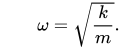
It's not a guess, it's just shorthand notation.Achintya said:.
but sir my question is on what basis are we assuming this fact.
how would someone guess this...
PeroK said:It's not a guess, it's just shorthand notation.
Sir that is an example of SHM, so that will definitely follow the general equation of the SHMetotheipi said:What's the equation of motion for a block on the end of a horizontal spring?
Achintya said:can you be more clear...because i read many textbooks and i couldn't find the reason behind this assumption...we just assume it out of no where...
It's not an assumption, it's a shorthand notation. Physics texts often write:Achintya said:can you be more clear...because i read many textbooks and i couldn't find the reason behind this assumption...we just assume it out of no where...
sir i have seen the derivation but that does not contain the omega term unless and until we take this assumptionetotheipi said:It's not assumed, it's derived. Write down the full ##F_x = m\ddot{x}## relation for the spring and see where it gets you!
It's not an assumption.Achintya said:just check this out ...the solution of the differential equaltion came in the form of k/m...but it is only after the assumption that k/m=w^2 that we can see the w term in shm general equation
Achintya said:just check this out ...the solution of the differential equaltion came in the form of k/m...but it is only after the assumption that k/m=w^2 that we can see the w term in shm general equation
but sir this is something we know that shm is a one dimensional motion, so i think it makes sense to write F=-kx..since it was observed experimentally that the force is varying linearly with displacement..PeroK said:Let me try to answer this a different way. Suppose you were telling me about SHM and you wrote down your equation:
$$F = -kx$$
And I asked: "why are you assuming that the motion is in the x-direction?" What happens if the motion is not in the x-direction? Then your equation and everything you are doing is invalid.
Then, I might ask, "why are you assuming the spring constant is ##k##"? What happens if the spring constant is ##2k##? Then all your equations don't work.
How would you answer that?
What happens if motion is in the ##y## direction? How do you know it's in the x-direction?Achintya said:but sir this is something we know that shm is a one dimensional motion, so i think it makes sense to write F=-kx..since it was observed experimentally that the force is varying linearly with displacement..
it hardly makes a difference even if the motion were in the y-direction...what we are sure about is that its a one dimensional motion...isn't it?PeroK said:What happens if motion is in the ##y## direction? How do you know it's in the x-direction?
Exactly, the motion could be in the y-direction. I want you to justify your assumption that motion is in the x-direction. Why use ##x## instead of ##y##?Achintya said:it hardly makes a difference even if the motion were in the y-direction...what we are sure about is that its a one dimensional motion...isn't it?
so what's the conclusion?PeroK said:Exactly, the motion could be in the y-direction. I want you to justify your assumption that motion is in the x-direction. Why use ##x## instead of ##y##?
The answer is that it's not an assumption, in the sense of something to assume without justification. The motion is assumed to be one-dimensional. It's not an additional assumption that the motion is in the x-direction. We take ##x## to be the direction of motion.Achintya said:so what's the conclusion?
PeroK said:The answer is that it's not an assumption, in the sense of something to assume without justification. The motion is assumed to be one-dimensional. It's not an additional assumption that the motion is in the x-direction. We take ##x## to be the direction of motion.
Likewise, we take the quantity ##\omega## to be the quantity ##\sqrt{k/m}##. This is not an assumption.
It's so fundamental to mathematical physics that you can replace a complicated expression with a single letter that it's difficult to explain.
Anyway, if you don't like ##\omega##, then whenever you see ##\omega## just replace it with ##\sqrt{k/m}##. They are equivalent ways of writing the same thing.
Achintya said:Sir actually the source of confusion here was that the omega already has some physical significance of its own...its not an arbitrary variable...so u see this gives a wrong impression
Wow..nice .i understand it nowGaussian97 said:Ok let's see, if you derive the equation of motion you get
$$\ddot{x}=-\frac{k}{m}x$$
which has as general solution:
$$x(t)=A\sin{\left(\sqrt{\frac{k}{m}} t + \phi_0\right)}$$
Ok until here? Let's find now the period ##T##, that is defined as the smallest non-zero time that fulfils ##x(t)=x(t+T)## for ANY value of ##t## so, by definition
$$x(t+T)=A\sin{\left(\sqrt{\frac{k}{m}} t+ \sqrt{\frac{k}{m}} T + \phi_0\right)}=A\sin{\left(\sqrt{\frac{k}{m}} t + \phi_0\right)}$$
$$\sin{\left(\sqrt{\frac{k}{m}} t+ \sqrt{\frac{k}{m}} T + \phi_0\right)}-\sin{\left(\sqrt{\frac{k}{m}} t + \phi_0\right)}=0$$
Applying some trigonometric identities
$$2\sin{\left(\sqrt{\frac{k}{m}} \frac{T}{2}\right)}\cos{\left(\sqrt{\frac{k}{m}} t+ \sqrt{\frac{k}{m}} \frac{T}{2} + \phi_0\right)}=0$$
The only way this can be true for ANY ##t## is
$$\sin{\left(\sqrt{\frac{k}{m}} \frac{T}{2}\right)}=0 \Longrightarrow \sqrt{\frac{k}{m}} \frac{T}{2}=k\pi\Longrightarrow T = 2k\pi \sqrt{\frac{m}{k}}$$
Because we want the smalles non-zero time
$$T = 2\pi \sqrt{\frac{m}{k}}$$
This is the period, then the angular frequency is defined as
$$\omega = \frac{2\pi}{T}=\sqrt{\frac{k}{m}}$$