Spring diameter change under pressure

Click For Summary
SUMMARY

The forum discussion centers on the relationship between the compression of a spring and its outer diameter change under pressure. Participants reference the formula for outer diameter expansion from the "DESIGN HANDBOOK Engineering Guide To Spring Design, 1987 Edition," which includes parameters such as the helix angle and developed length of wire. Key insights include the understanding that the wire length remains constant during compression, and the derived equations relate axial length, wire diameter, and the number of turns in the spring. The discussion emphasizes the need for clarity on the dimensions involved in spring design.

PREREQUISITES
  • Understanding of compression springs and their mechanics
  • Familiarity with the concept of helix geometry
  • Knowledge of basic calculus for differentiation and integration
  • Ability to interpret engineering design handbooks and formulas
NEXT STEPS
  • Research "Helix geometry in spring design" for a deeper understanding of spring shapes
  • Study "Pythagorean theorem applications in mechanical engineering" for relevant calculations
  • Explore "Spring design equations and parameters" to understand the relationships between dimensions
  • Investigate "Superficial strain in materials" to comprehend the effects of compression on springs
USEFUL FOR

Mechanical engineers, spring designers, and students studying mechanical systems will benefit from this discussion, particularly those focused on the design and analysis of compression springs.

dislect
Messages
163
Reaction score
0
Hi guys,

I have a question and I would love some guidance or external reference for relevant information.

I have a normal compression spring (see attached pic - 1), I apply a force to compress it by x length.
I want to create a formula connecting between the small increase of the outer diameter of the spring and the length x.
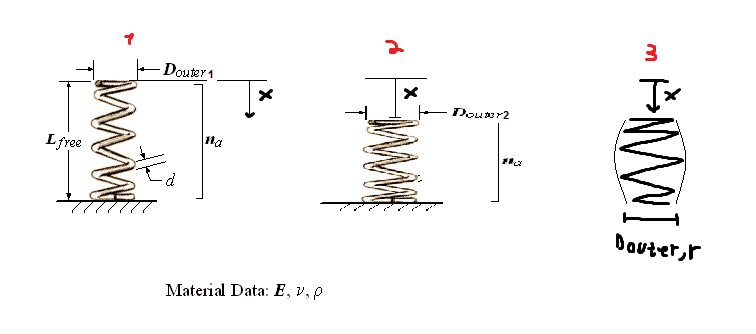
spring.png


1. Would the shape of the spring look like in pic - 2 by a good approximation or more similar to pic - 3, meaning the outer diameter is not the same throughout the length of the spring when compressed and is of a parabolic shape?
2. Help figuring out how to connect between x and the new Douter?

Thanks a lot guys,

Have a good day
 
Engineering news on Phys.org
If the end diameters were not constrained laterally, it would be like in Figure 2. Look up the equation for a helix. The constraint is that the developed length of wire in the helix is unchanged when you compress.

Chet
 
Hi Chestermiller,
I'm sorry but I don't follow. What do you mean equation for a helix?
What is "the developed length of wire" - The total length of the wire if I was to straighten it?

I came across this info of the diameter change (http://springipedia.com/compression-general-design.asp) with the formula:
O.D.expension= sqr root (D^2+ d + (p^2-d^2/(Pi^2))-OD
DESIGN HANDBOOK Engineering Guide To Spring Design, 1987 Edition, Page 31, Associated Spring - Barnes Group Inc

But I really want to know how it was developed, plus it has nothing to do with the compression length I called x
 
Last edited:
dislect said:
Hi Chestermiller,
I'm sorry but I don't follow. What do you mean equation for a helix?
What is "the developed length of wire" - The total length of the wire if I was to straighten it?

I came across this info of the diameter change (http://springipedia.com/compression-general-design.asp) with the formula:
O.D.expension= sqr root (D^2+ d + (p^2-d^2/(Pi^2))-OD
DESIGN HANDBOOK Engineering Guide To Spring Design, 1987 Edition, Page 31, Associated Spring - Barnes Group Inc

But I really want to know how it was developed, plus it has nothing to do with the compression length I called x
I don't really know what the parameters in the above equation are. If I were writing the equation for a helix, I would write something like the parametric equations

r = Helix radius = const.
θ = θ(s)
z = z(s)

where s is the developed length along the helix. If \phi is the helix angle (which is constant), then

\theta=\frac{s}{r}\cos \phi
z=s\sin \phi

If you stretch the spring, z gets longer, while the total developed length s and the total number of turns (as characterized by the the total spiral angle θ) is held constant. So how does r change as a function of z, holding θ and s constant?

Your are correct that the developed length s is the total length of the wire if you straightened it.
 
Hi thanks for the reply!
I would say that just playing with equations gives me r=\frac{z}{θ*tan∅}

But I'm not sure I understand what θ and ∅ stands for, can you refer me to a sketch showing the dimensions? I want to translate these to typical spring dimensions such as number of coils, pitch and so on.
 
Consider a spring of n turns, axial length y and wire mid-diameter x = (ID + OD) / 2.
Initially axial length is yi and mid-diameter = xi
The wire length per turn is Sqrt( ( Pi * xi )^2 + (yi / n)^2 )
The spring length y will control the mid-diameter x.

Sqrt( ( Pi * x )^2 + (y / n)^2 ) = Sqrt( ( Pi * xi )^2 + (yi / n)^2 )
( Pi * x )^2 = ( Pi * xi )^2 + (yi / n)^2 – (y / n)^2
Pi * x = Sqrt( ( Pi * xi )^2 + (yi / n)^2 – (y / n)^2 )

Therefore x = Sqrt( ( Pi * xi )^2 + (yi / n)^2 – (y / n)^2 ) / Pi
 
Hi Baluncore, thank you for the rapid reply.
Again, I'm struggling understanding the dimensions (axial length yi? xi?)
Could you please take a random spring jpeg and mark the dimensions?

thanks a lot and sorry for the trouble
 
dislect said:
Hi thanks for the reply!
I would say that just playing with equations gives me r=\frac{z}{θ*tan∅}

But I'm not sure I understand what θ and ∅ stands for, can you refer me to a sketch showing the dimensions? I want to translate these to typical spring dimensions such as number of coils, pitch and so on.

θ is 2π times the number of turns.
tan(phi) is the pitch divided by 2πr

In the analysis I did, I was just following the centerline of the coil, which, for a wire diameter that is small compared to the spring diameter, is adequate. If you take the equations that I gave you and integrate, you get simply

z^2+(r\theta)^2=z_0^2+(r_0\theta)^2=s^2

where z is the total length of the spring, and r is the radius of the spring. So, if we differentiate, we obtain:

z0dz+θ2r0dr=0
The superficial strains in the axial and radial directions, respectively are
εz=dz/z0
εr=dr/r0

So, z_0^2\epsilon_z+\theta^2r_0^2\epsilon_r=0

So, using the relationships I presented in a previous post, we obtain:

\epsilon_r=-\tan^2\phi\epsilon_z
where \phi is the helix angle of the spring.
 
Last edited:
dislect said:
Hi Baluncore, thank you for the rapid reply.
Again, I'm struggling understanding the dimensions (axial length yi? xi?)
Could you please take a random spring jpeg and mark the dimensions?
See attached.
Also;
OD = outside diameter of coil spring
ID = inside diameter of coil spring
For a wire diameter d, we then get
OD = x + d and
ID = x – d.
 

Attachments

  • spring.jpg
    spring.jpg
    11.1 KB · Views: 821
  • #10
I made some changes in my post #8 to correct an error, and to complete the analysis. It shows that the superficial strain in the radial direction is equal to minus the superficial strain in the axial direction time the tangent square of the initial helix angle.

Chet
 
  • #11
Hi Baluncore, Thank you for the pic!
So you say that the wire length on a single turn is equal when the spring is compressed and when it is free, right?
How did you come by the equation Sqrt( ( Pi * xi )^2 + (yi / n)^2 ) ?


Chestermiller, It was kind of hard for me to follow once you got to differentiating. I understood what you've done up to that point.
 
  • #12
dislect said:
Chestermiller, It was kind of hard for me to follow once you got to differentiating. I understood what you've done up to that point.

Check out the equation I wrote for s^2 in post #8. That tells it all.
 
  • Like
Likes 1 person
  • #13
dislect said:
How did you come by the equation
The flattened surface of the cylinder that contains one turn of the spring is a rectangle.
It has a width that is the circumference of the cylinder, = Pi * x.
It has a length of one turn which is the spring pitch, = yi / n.
The wire runs diagonally across that surface.
Pythagoras said the length of the diagonal was the root of the sum of the squares.
Hence length of one turn of the relaxed spring is; = Sqrt( ( Pi * xi )^2 + (yi / n)^2 )
 
  • Like
Likes 1 person
  • #14
Baluncore I can't quite imagine it from the view you're talking about.
I understand the length but not the width.
Are you seeing this as something like this?
If so i don't understand why pi*xi and not xi

image.png
 
  • #15
A helix defines a cylinder that has a diameter and a circumference = Pi * diameter.
One turn of the wire spring advances yi/n.
The circumference of the helix is Pi*xi.
The length of one turn of the wire is Sqrt( ( yi/n)^2 + ( Pi*xi)^2)
If you compress the spring from axial length yi to y without changing n or the wire length then;
Sqrt( ( y/n)^2 + ( Pi*x)^2) = Sqrt( ( yi/n)^2 + ( Pi*xi)^2)
 
  • Like
Likes 1 person

Similar threads

  • · Replies 1 ·
Replies
1
Views
2K
Replies
22
Views
2K
Replies
14
Views
1K
Replies
4
Views
2K
  • · Replies 9 ·
Replies
9
Views
2K
  • · Replies 2 ·
Replies
2
Views
1K
  • · Replies 2 ·
Replies
2
Views
1K
  • · Replies 45 ·
2
Replies
45
Views
6K
  • · Replies 2 ·
Replies
2
Views
5K
  • · Replies 4 ·
Replies
4
Views
5K