asdf12312
- 198
- 1
Square Pulse Train Fourier Series help??
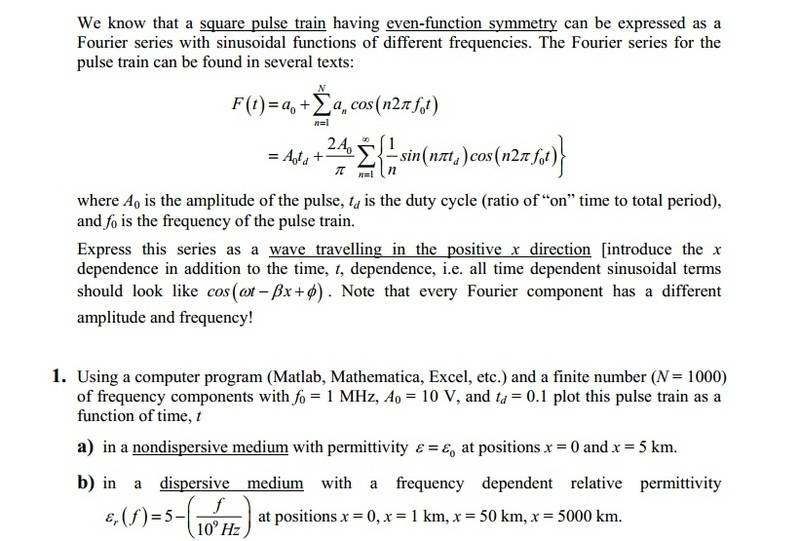
problem+directions below:
ω=2\pif
β=\frac{2\pi}{\lambda}
Since the problem asks to make all time-dependent sinusoidal functions deal with x-direction, i don't think i need to worry about the sin function because it is dependent on td (duty cycle) and not time. I am aware of the cos format for x and t dependent but this is how i would plan to change it (for the equation with both sin and cos):
cos(n*2\pif*t) -> cos[n(ωt-βx)]
basically I just factored out the n, and I don't think I need to include any phase shift. I just changed the cos part, the rest of the equation stays the same.
I can worry about using Fourier series with MATLAB later, I just wanted to know if the equation for the Fourier series I had was right. also, I don't know how to find the value of wavelength for β, since it is not given anywhere. would i need to use the equation for phase velocity, if it is related to the f given somehow?
Homework Statement
problem+directions below:
Homework Equations
ω=2\pif
β=\frac{2\pi}{\lambda}
The Attempt at a Solution
Since the problem asks to make all time-dependent sinusoidal functions deal with x-direction, i don't think i need to worry about the sin function because it is dependent on td (duty cycle) and not time. I am aware of the cos format for x and t dependent but this is how i would plan to change it (for the equation with both sin and cos):
cos(n*2\pif*t) -> cos[n(ωt-βx)]
basically I just factored out the n, and I don't think I need to include any phase shift. I just changed the cos part, the rest of the equation stays the same.
I can worry about using Fourier series with MATLAB later, I just wanted to know if the equation for the Fourier series I had was right. also, I don't know how to find the value of wavelength for β, since it is not given anywhere. would i need to use the equation for phase velocity, if it is related to the f given somehow?
Last edited: