Stability Order of resonating structures

Click For Summary
SUMMARY

The stability order of the resonating structures of vinyl chloride is debated, with the user asserting the order as I>III>II based on charge stability, while a textbook states I>II>III. Structure I is deemed most stable due to the absence of charge, while structure II is less stable due to chlorine's electronegativity and positive charge. The user questions the validity of structure III, noting that chlorine in this structure appears to have 10 electrons in its valence shell, which contradicts the octet rule.

PREREQUISITES
  • Understanding of resonance structures in organic chemistry
  • Knowledge of electronegativity and its effects on molecular stability
  • Familiarity with the octet rule and valence shell electron configurations
  • Basic concepts of vinyl chloride and its chemical properties
NEXT STEPS
  • Research the principles of resonance and stability in organic molecules
  • Study the effects of electronegativity on molecular stability and charge distribution
  • Learn about the octet rule and exceptions in chemical bonding
  • Examine the structure and properties of vinyl chloride in detail
USEFUL FOR

Chemistry students, organic chemists, and educators seeking to deepen their understanding of resonance structures and molecular stability.

randomgamernerd
Messages
139
Reaction score
4
I have uploaded the picture of the structures because I couldn't figure out how to type.
Its vinyl chloride.
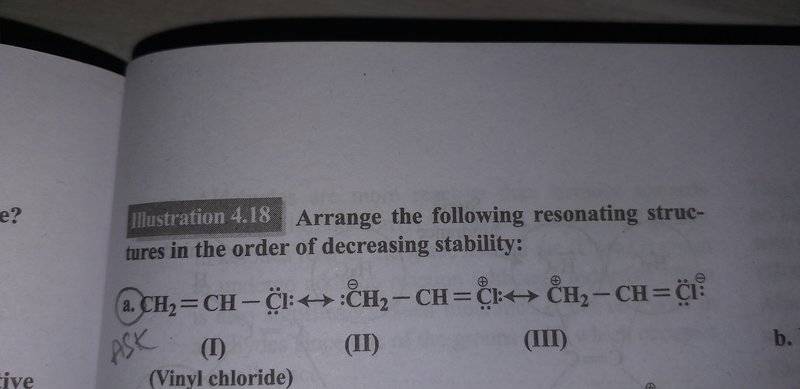
15314715716633361855743515196350.jpg

According to me the order should be
I>III>II
because I has no charge so it must be most stable
in II we have Cl an electronegative element bearing positive charge which makes it unstable.
Hence I get the order.
But the book says the order is I>II>III
Please Help
 

Attachments

  • 15314715716633361855743515196350.jpg
    15314715716633361855743515196350.jpg
    24.7 KB · Views: 1,334
Chemistry news on Phys.org
How many electrons are in the valence shell of the Cl in III?
 
mjc123 said:
How many electrons are in the valence shell of the Cl in III?
apparently 10how is that possibleit can hold at max 8 if I'm not wrong
 
So III is not a permissible resonance structure according to the ordinary rules.
 
I came.across a headline and read some of the article, so I was curious. Scientists discover that gold is a 'reactive metal' by accidentally creating a new material in the lab https://www.earth.com/news/discovery-that-gold-is-reactive-metal-by-creating-gold-hydride-in-lab-experiment/ From SLAC - A SLAC team unexpectedly formed gold hydride in an experiment that could pave the way for studying materials under extreme conditions like those found inside certain planets and stars undergoing...

Similar threads

  • · Replies 4 ·
Replies
4
Views
5K
Replies
3
Views
12K
  • · Replies 9 ·
Replies
9
Views
10K
  • · Replies 3 ·
Replies
3
Views
5K
Replies
2
Views
2K
  • · Replies 8 ·
Replies
8
Views
8K
  • · Replies 2 ·
Replies
2
Views
7K
Replies
9
Views
4K
  • · Replies 1 ·
Replies
1
Views
2K
  • · Replies 3 ·
Replies
3
Views
5K