Static electricity shock: Can it ever be lethal?

Click For Summary

Discussion Overview

The discussion revolves around the potential lethality of static electricity shocks, exploring whether it is possible for static charges to cause significant harm or even death. Participants examine various scenarios, materials, and calculations related to static electricity, including the effects of different environments and activities that may lead to dangerous static discharges.

Discussion Character

  • Exploratory
  • Technical explanation
  • Debate/contested
  • Mathematical reasoning

Main Points Raised

  • One participant questions the possibility of charging oneself with static electricity to a lethal extent and asks about the calculations involved.
  • Another participant references a movie to illustrate that helicopters can generate lethal static charges.
  • Several participants discuss the dangers of using Van de Graaff generators, noting that larger generators can store significant charge and pose health risks.
  • A participant shares an anecdote about servicing a heart defibrillator, suggesting that capacitors can indeed be lethal.
  • There is a discussion about incidental static charging during activities like filling a tank, with concerns about neglecting earthing.
  • One participant provides a calculation based on the Human Body Model for capacitance, suggesting that a high voltage could potentially be lethal under certain conditions.
  • Another participant raises the question of how much voltage can be generated by walking on a carpet, indicating uncertainty about estimating this value.
  • There is mention of the safety of discharge paths and how they affect the risk of electrocution, particularly in relation to the human body.
  • Participants discuss the potential for static electricity to cause harm in specific scenarios, such as being near explosive vapors.
  • One participant notes that while it is theoretically possible to be harmed by static electricity, the probability of such events occurring may be low.

Areas of Agreement / Disagreement

Participants express a range of views on the lethality of static electricity, with some suggesting it is possible under certain conditions while others emphasize the improbability of such outcomes. The discussion remains unresolved, with multiple competing perspectives on the risks associated with static electricity.

Contextual Notes

Participants acknowledge various limitations in their calculations and assumptions, including the dependence on specific conditions, materials, and the nature of the discharge path. There is also a recognition that the relationship between static electricity and lethality is complex and context-dependent.

  • #31
I'm finding this helicopter static, side topic, somewhat amusing, as I'm having trouble finding credible evidence that it is anything more than a discomfort. I think the "Hunt for Red October" scene may be "Hollywood embellishment".


zap comes at about t=30 seconds


In any event, our government has previously funded a study of the problem, and outlined the procedure for us:
TCREC TECHNICAL REPORT 62-33
HELICOPTER STATIC ELECTRICITY
DISCHARGING DEVICE
Task 1D1Z14OIA'14130
(Formerly Task 9R38-01-017,-30)
Contract DA 44-177-TC-728
December 1962​
...
page 47
4. Human Sensitivity to Electrostatic Discharge
The sensitivity of humans to electrostatic discharge has been reported in References 3 to 6. From these references it may be concluded that a discharge involving an energy release of 1 millijoule may be considered as the minimum level detectable by an average person.
In order to verify this information, this Contractor has performed a survey using capacitance values in the same range as the capacitance of an H-37 Army helicopter.
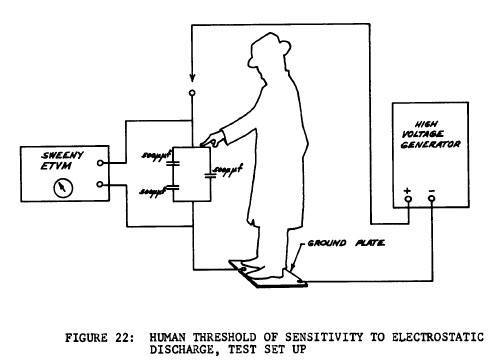
pf.2015.04.17.1306.touch.this.jpg
Recommendations from the study are on page 4.
(My interpretation of the summary: "We should study this more".)

Again, TMI for me to study the whole thing.

The image is what had me cracking up:
Private; "Ok, sergeant, what do I do now"?
Sergeant; "Touch that plate there".​
 
Engineering news on Phys.org
  • #32
OmCheeto said:
I'm finding this helicopter static, side topic, somewhat amusing, as I'm having trouble finding credible evidence that it is anything more than a discomfort. I think the "Hunt for Red October" scene may be "Hollywood embellishment".

I'm shocked, shocked at the thought that 'Red October' would embellishment anything.
 
  • #33
Years ago, a friend and I were experimenting with using a kite to loft our ham radio antennas from behind his boat. We had a huge reel of kynar insulated wire from wire-wrapping. The kite was a good 300 feet in the air. We had secured the antenna wire to the kite string about ten feet down from the kite. Initially the wire was dangling down in the water as we were trying to retrieve it. It was a bright sunny day. We snipped off the end of the wire after retrieving it with a boat hook. I noticed a sizzling sound but I couldn't figure out what it was.

Then my buddy picked up the wire and accidentally touched the bare end while attaching it to the antenna tuner. The static shock threw him across the deck. After that, we learned our lesson. We carefully installed an RF choke to ground to bleed off the charge.

Yes, static electricity can be very dangerous. Safety first.
 
  • #34
JakeBrodskyPE said:
Then my buddy picked up the wire and accidentally touched the bare end while attaching it to the antenna tuner. The static shock threw him across the deck. After that, we learned our lesson. We carefully installed an RF choke to ground to bleed off the charge.

I don't understand the electronics involved but was this static or related to the circuitry that drives your antenna? I mean, you must have a power source to get that antenna to radiate, right? Could that be the source?
 
  • #35
OmCheeto said:
I'm finding this helicopter static, side topic, somewhat amusing, as I'm having trouble finding credible evidence that it is anything more than a discomfort. I think the "Hunt for Red October" scene may be "Hollywood embellishment".

Do the ramp guys at airports have to face a similar sting from aircraft coming to the airbridge?

I'd imagine an aircraft having several times the charge buildup potential as a helicopter. In terms or total area, speed & time aloft.

Is the contact through rubber tyres enough to discharge the static?
 
  • #36
nsaspook said:
I've seen it many times during landings on metal decks but typically with shipboard combat cargo the bird never lands, you hook the sling to the underside cargo hook.

What happens on oil-rigs, carrier-decks, LNG carrier helipads etc. where there's a good chance of flammable ignition? Are special precautions needed?
 
  • #37
rollingstein said:
Do the ramp guys at airports have to face a similar sting from aircraft coming to the airbridge?

I'd imagine an aircraft having several times the charge buildup potential as a helicopter. In terms or total area, speed & time aloft.

Is the contact through rubber tyres enough to discharge the static?

I'm going to guess that it is fairly easy to discharge the buildup safely - there's plenty of time and methods to do so with a plane that lands on a runway.

A helicopter is unique in that its first contact can be with humans while it is still fully insulated from the ground.
 
  • #38
rollingstein said:
I don't understand the electronics involved but was this static or related to the circuitry that drives your antenna? I mean, you must have a power source to get that antenna to radiate, right? Could that be the source?

Jake didn't say what was the weather that day.

I once (and only once) experienced sizzling and static electricity about ten miles ahead of a thunderstorm in the gulfstream. Had it been nighttime I'm sure we'd have seen St Elmo's Fire... old sea stories speak of it a lot.

elmo.jpg


http://s2.photobucket.com/user/danolson/media/Blog stuff/elmo.jpg.html

http://en.wikipedia.org/wiki/St._Elmo's_fire
 
  • #39
DaveC426913 said:
I'm going to guess that it is fairly easy to discharge the buildup safely - there's plenty of time and methods to do so with a plane that lands on a runway.

What methods do you have in mind?

I don't recall any conductive path touching the airframe prior to the rampie opening the door. (unless the tire resistance is low enough to provide a good ground. Is it?)
 
  • #40
jim hardy said:
I once (and only once) experienced sizzling and static electricity about ten miles ahead of a thunderstorm in the gulfstream. Had it been nighttime I'm sure we'd have seen St Elmo's Fire... old sea stories speak of it a lot.

Just got me thinking: What about air-to-air refuelling ops?

Is there a roaring spark from the tanker plane? With a plane's large body I suppose the sparking potential is a 100x higher than a puny helicopter?

It might be a real risk there with tens of thousands of gallons of highy flamabble fuel in close range.
 
  • #41
rollingstein said:
What methods do you have in mind?

I don't recall any conductive path touching the airframe prior to the rampie opening the door. (unless the tire resistance is low enough to provide a good ground. Is it?)

Most aircraft have static 'wicks' to reduce static charges. Most of residual charge is dissipated into the ground when landing but grounding is always used during fueling.

 
  • #42
rollingstein said:
I don't understand the electronics involved but was this static or related to the circuitry that drives your antenna? I mean, you must have a power source to get that antenna to radiate, right? Could that be the source?

We were using an antenna matching network and feeding it with a 50 ohm transceiver. We were not transmitting. The static was building up due to the wind blowing across the wire hanging from the kite and probably getting amplified by the fact that some of the insulated wire was in the water. The wire was slack while we were retrieving it. I suspect it formed a capacitor with the water, amplifying the static charge significantly.
 
  • #43
JakeBrodskyPE said:
We were using an antenna matching network and feeding it with a 50 ohm transceiver. We were not transmitting. The static was building up due to the wind blowing across the wire hanging from the kite and probably getting amplified by the fact that some of the insulated wire was in the water. The wire was slack while we were retrieving it. I suspect it formed a capacitor with the water, amplifying the static charge significantly.

Very interesting observations.
 
  • #44
Jet fuel is not "flammable" at temperatures below 100F (that temperature is the flash point of Jet A). You have to have ambient temperatures above the flash point so that the partial pressure of the fuel (usually a mixture of diesel and kerosene) in air in order to form a combustible fuel air mixture. By definition fuels that are normally used below their flash point are labeled combustible not flammable. I am fairly certain that the refueling boom is in electrical contact (no sparks) before the fuel valve is opened.

http://en.wikipedia.org/wiki/Jet_fuel#Jet_A

http://en.wikipedia.org/wiki/Flash_point

Regards,
Chris
 
  • #45
rootone said:
Sitting on top of a van de graff generator then jumping on to the floor would be definitely be unhealthy for you.
Well, if you leave the VdG generator before you touch the floor, then no circuit has been made, no electricity will flow but you might twist your ankle if you land funny.
 
  • #46
variation32 said:
Well, if you leave the VdG generator before you touch the floor, then no circuit has been made, no electricity will flow but you might twist your ankle if you land funny.

I went to on a date with a friend to the local Science museum yesterday evening. (Adults only. Oh my god. Booze and Science...)
Anyways, one of the exhibits was the infamous big hair Van de Graaff experiment:
4-1-OMSIBAND.jpg

Although I didn't take my camera, this is an image of the actual generator.

So, the trick was, that the big haired person stood on a plastic milk crate, with a layer of rubber on top of the milk crate.
Insulation!

The first person we watched, ended up looking just like the lady above.

The next person, fortunately, had two semi-tipsy friends, who were not standing on the milk-crate-rubber-mat device, who would touch the sphere every 10 seconds or so, creating, even for a hard of hearing person like myself, an audible "ZAP!".
So science experiment person #2, never got her hair to stand on end.

But everyone laughed, and no one died. So, IMHO, it was a grand experiment.
 
  • #47
ps. The setup, is apparently set up, such that it is safe, for non-inebriated children.

how.to.make.electrostatics.nonlethal.to.children.jpg


Always a good thing. :smile:
 

Similar threads

  • · Replies 22 ·
Replies
22
Views
8K
  • · Replies 20 ·
Replies
20
Views
2K
  • · Replies 9 ·
Replies
9
Views
5K
  • · Replies 4 ·
Replies
4
Views
2K
  • · Replies 6 ·
Replies
6
Views
3K
  • · Replies 8 ·
Replies
8
Views
5K
  • · Replies 4 ·
Replies
4
Views
3K
  • · Replies 4 ·
Replies
4
Views
4K
  • · Replies 1 ·
Replies
1
Views
3K
  • · Replies 10 ·
Replies
10
Views
2K