PhysicsTest
- 260
- 27
- TL;DR
- I am trying to understand the static power bridge section, but confused with the notation.
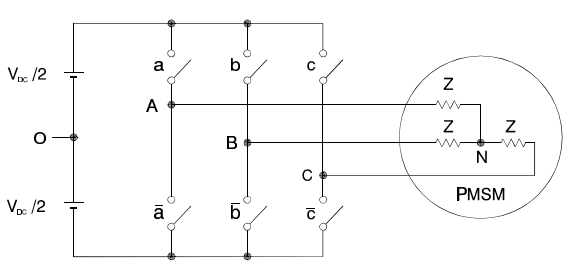
I am referring to the application note from TI, the below is the power bridge circuit.
The truth table is as below
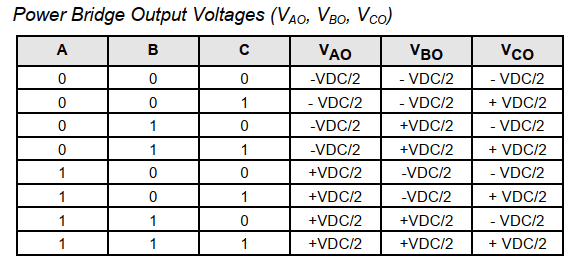
a. I try the first values of A=0, B=0, C=0 the circuit would then become like this according to me
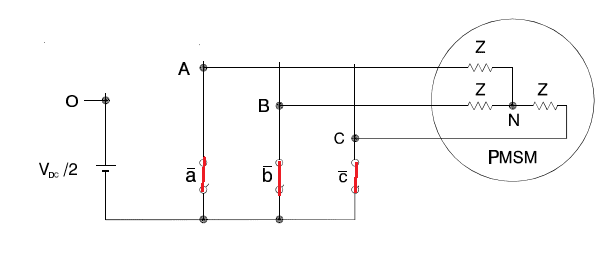
It is open above point O, then how the voltage of ##\frac{-V_{DC}} 2## will be applied at the point A,B,C as the table indicates.
b. I know these papers are written by experts but it confuses me , why should he consider a point "O"? Why did he not take just ##V_{DC}## instead of splitting into two power sources.
Note: I have attached the application note and it starts from page24.
The truth table is as below
a. I try the first values of A=0, B=0, C=0 the circuit would then become like this according to me
It is open above point O, then how the voltage of ##\frac{-V_{DC}} 2## will be applied at the point A,B,C as the table indicates.
b. I know these papers are written by experts but it confuses me , why should he consider a point "O"? Why did he not take just ##V_{DC}## instead of splitting into two power sources.
Note: I have attached the application note and it starts from page24.
Attachments