Discussion Overview
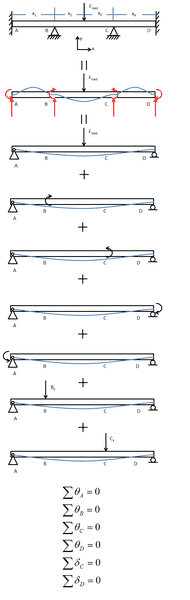
The discussion revolves around the analysis of a statically indeterminate beam of the sixth degree, specifically focusing on the application of the superposition method (force method) to determine the reactions, angles, and deflections at various points along the beam. The conversation includes considerations of boundary conditions and the governing differential equations for beam behavior.
Discussion Character
- Technical explanation
- Debate/contested
- Mathematical reasoning
Main Points Raised
- One participant questions the appropriateness of using the superposition method due to concerns that the equations for angle and deflection may not apply under the assumed linear differential equation conditions.
- Another participant clarifies that knife edge supports at points B and C allow for vertical reactions but permit rotation, leading to specific boundary conditions for deflection and slope at various points.
- A subsequent post acknowledges a misunderstanding regarding the support representation at B and C, indicating that a moment reaction can develop there, which affects the analysis.
- Further discussion highlights that if a moment reaction can develop at B and C while loading is only applied to segment BC, additional boundary conditions are necessary to fully determine the reactions in the beam, while still adhering to the linearized Euler-Bernoulli equation for small deflections.
Areas of Agreement / Disagreement
Participants express differing views on the correct representation of supports and the implications for boundary conditions. There is no consensus on the best approach to analyze the beam, indicating ongoing debate and uncertainty in the discussion.
Contextual Notes
Limitations include potential misinterpretations of support conditions and the applicability of linearized equations under specific loading scenarios. The discussion also reflects uncertainty regarding the effects of loading on different segments of the beam.