Statics - Max Tension in Cables

Click For Summary

Discussion Overview

The discussion revolves around a statics problem involving a cable supporting a uniformly distributed load. Participants are tasked with determining the maximum tension in the cable as a function of a variable n, which represents the height of support B relative to support A. The conversation includes attempts to derive equations related to the cable's shape and tension, as well as discussions on equilibrium and moments.

Discussion Character

  • Homework-related
  • Mathematical reasoning
  • Technical explanation
  • Exploratory

Main Points Raised

  • One participant expresses uncertainty about how to find the length xa and suggests using the formula for tension based on the cable's shape.
  • Another participant clarifies that the equation of the parabola can be expressed as y = kx² and mentions the relationship between xa and xb, noting that xa + xb = 48.
  • There is a suggestion to exploit the bending moment being zero at any point in the cable to derive simultaneous equations for xB and yB, although the equations are acknowledged to be non-linear.
  • A participant asks about writing equilibrium equations and taking moments about a point, indicating that this approach could help in solving the problem.
  • Further clarification is provided regarding the parabolic nature of the cable and the need to find the constant k in the equation y = kx².
  • One participant confirms that their initial equations are correct and provides relationships for ya and yb in terms of a and n, while suggesting that these equations can be solved simultaneously.

Areas of Agreement / Disagreement

Participants generally agree on the approach of using the parabolic equation and equilibrium equations to solve for the unknowns. However, there is no consensus on the specific methods to derive the necessary equations or the interpretation of certain variables, indicating that multiple viewpoints and uncertainties remain in the discussion.

Contextual Notes

The discussion involves non-linear equations and relationships that depend on the definitions of variables such as xa, xb, ya, and yb. There are unresolved steps in deriving the equations and clarifying the relationships between the variables.

keximaze
Messages
7
Reaction score
0
Please help

PROBLEM
PROJECT.jpg

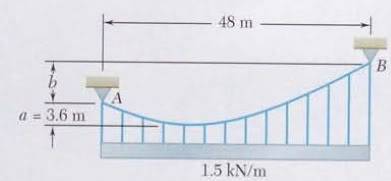
Cable AB supports a load distributed uniformly along the horizontal as shown. The lowest portion of the cable is located at a distance a = 3.6m below support A, and support B is located a distance b = na above A.

-> Determine the maximum tension in the cable as a function of n.

Homework Equations


The equation of the parabola the cable creates when an xy axes is placed at the lowest point of the cable, is
y = w(x^2) / 2*To

Key idea: the maximum tension is located at the support where the slope is maximum.

The Attempt at a Solution


I think I have to find the length xa first, then use the formula ya= w(xa)^2/ 2*To to get the formula for the tension. The problem is, I don't know how I could get xa.
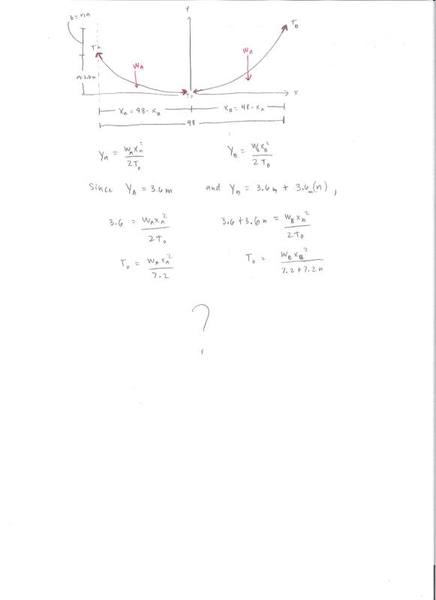
Image66.jpg
Please help. Thanks
 
Physics news on Phys.org
hi keximaze! :smile:

(try using the X2 and X2 icons just above the Reply box :wink:)
keximaze said:
I think I have to find the length xa first, then use the formula ya= w(xa)^2/ 2*To to get the formula for the tension. The problem is, I don't know how I could get xa.

(don't you mean xb ? :confused:)

let the parabola be y = kx2

then you know kxa2 and kxb2, and you know xa + xb = 48 :wink:
 
tiny-tim said:
hi keximaze! :smile:

(try using the X2 and X2 icons just above the Reply box :wink:)(don't you mean xb ? :confused:)

let the parabola be y = kx2

then you know kxa2 and kxb2, and you know xa + xb = 48 :wink:
Hello.
Yep, I meant xb

I know that I have to exploit the relations between xa, xb, ya, and yb...But I don't know what you mean by "you know kxa2 and kxb2"

Thanks.
 
You know that the bending moment is zero at any point in the cable. By creful choice of two locations, you can use this to get two simultaneous equations for xB and yB. Admittedly the equations are non-linear, but they are solvable.
 
pongo38 said:
You know that the bending moment is zero at any point in the cable. By creful choice of two locations, you can use this to get two simultaneous equations for xB and yB. Admittedly the equations are non-linear, but they are solvable.

Thanks for the hint...But I do not understand how to get these two equations :cry:
 
Do you know how to write down an equilibrium equation, taking moments about a point? If you do, then ascribe arbitrary directions to the reaction components at B. Then take moments about A for the whole structure. The sum of the moments should be zero. Can you do that?
 
hello keximaze! :smile:
keximaze said:
...But I don't know what you mean by "you know kxa2 and kxb2"

the question tells you that it is a parabola, so you know that (using the lowest point as the origin) the equation must be y = kx2, and all you need to do is find k …

the question also gives you the height of A and B above the origin :wink:
 
pongo38 said:
Do you know how to write down an equilibrium equation, taking moments about a point? If you do, then ascribe arbitrary directions to the reaction components at B. Then take moments about A for the whole structure. The sum of the moments should be zero. Can you do that?

That's what I did. I cut the cable where the lowest point is located, took the moment about a, and got
ya = waxa2 / 2To for the left side and
yb = wbxb2 / 2To for the right side

and when I took the moment about A for the entire body, I obtained another equation.

tiny-tim said:
hello keximaze! :smile:


the question tells you that it is a parabola, so you know that (using the lowest point as the origin) the equation must be y = kx2, and all you need to do is find k …

the question also gives you the height of A and B above the origin :wink:

k = wb / (2*To) .....what does it mean?
 
keximaze: You are doing well, so far. Your first two equations, at the beginning of post 8, are correct. As you know, ya = a, yb = a + b = a + n*a = a*(n + 1), and wa = wb = w.

Your third equation is the very last equation in post 2.

You now have three equations. Solve them simultaneously for the unknowns (as a function of n, which is a known).
 

Similar threads

Replies
2
Views
2K
Replies
25
Views
6K
Replies
1
Views
3K
  • · Replies 11 ·
Replies
11
Views
13K
  • · Replies 3 ·
Replies
3
Views
7K
  • · Replies 8 ·
Replies
8
Views
3K
  • · Replies 2 ·
Replies
2
Views
2K
  • · Replies 33 ·
2
Replies
33
Views
8K
  • · Replies 7 ·
Replies
7
Views
4K
Replies
4
Views
2K