Strange acceleration graph during a jump

Click For Summary

Discussion Overview

The discussion revolves around the unexpected acceleration readings obtained from smartphone accelerometers during various jumping experiments. Participants analyze the data collected while jumping from different heights and during free fall, questioning the reasons behind the observed acceleration values exceeding gravitational acceleration (g).

Discussion Character

  • Exploratory
  • Technical explanation
  • Conceptual clarification
  • Debate/contested

Main Points Raised

  • One participant notes that the absolute value of acceleration exceeds g during jumps, suggesting that body position changes during the jump may influence the readings.
  • Another participant raises the importance of considering all three axes of acceleration and how the orientation of the phone could affect measurements.
  • Concerns are expressed about the response time of smartphone accelerometers, which may not capture rapid changes accurately.
  • A participant introduces the concept of frames of reference, explaining that in an accelerating frame, one experiences pseudo forces that could account for the negative acceleration readings.
  • Discussion includes the idea that accelerometers at the center of mass in free fall measure zero acceleration, leading to deviations from the expected -1g in the lab frame.
  • Another participant shares personal experimentation, suggesting that body stretching during jumps may contribute to higher acceleration readings.

Areas of Agreement / Disagreement

Participants express various viewpoints on the factors influencing the acceleration readings, with no consensus reached on a single explanation. Multiple competing theories and interpretations of the data remain present throughout the discussion.

Contextual Notes

Participants mention limitations related to the orientation of the accelerometer, the response time of the device, and the effects of body position during jumps, which may affect the accuracy of the measurements.

nickek
Messages
21
Reaction score
1
Hi!
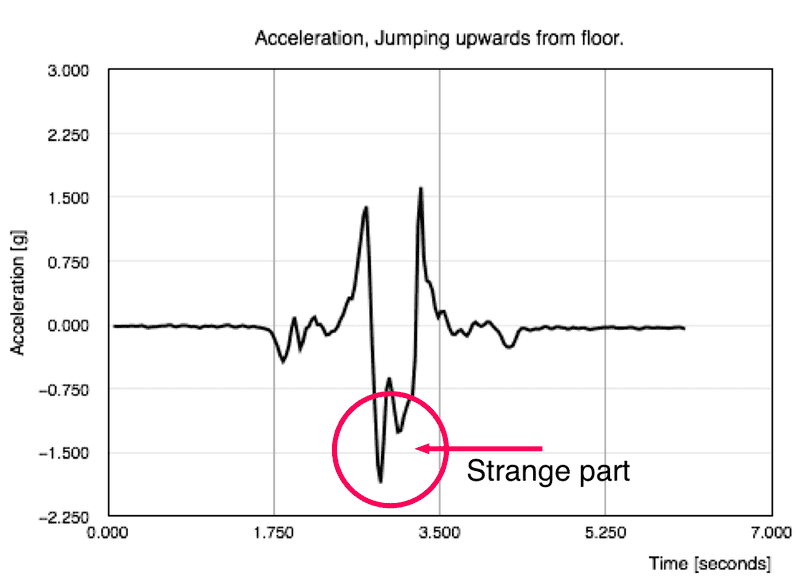
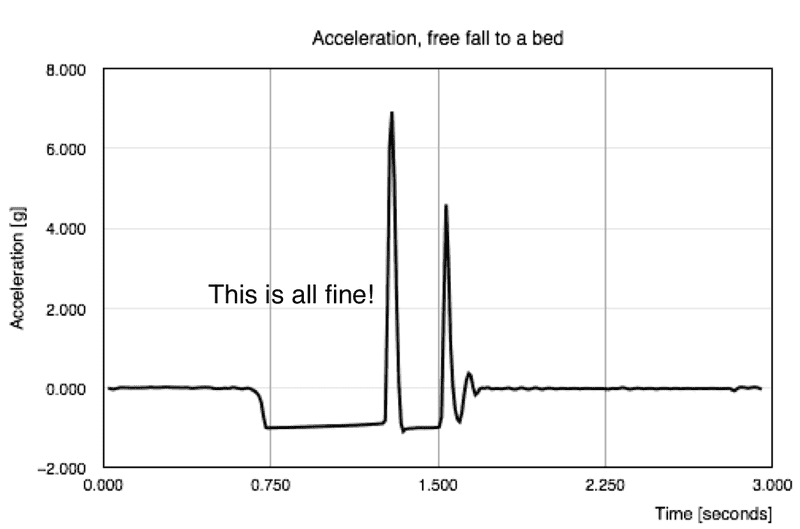
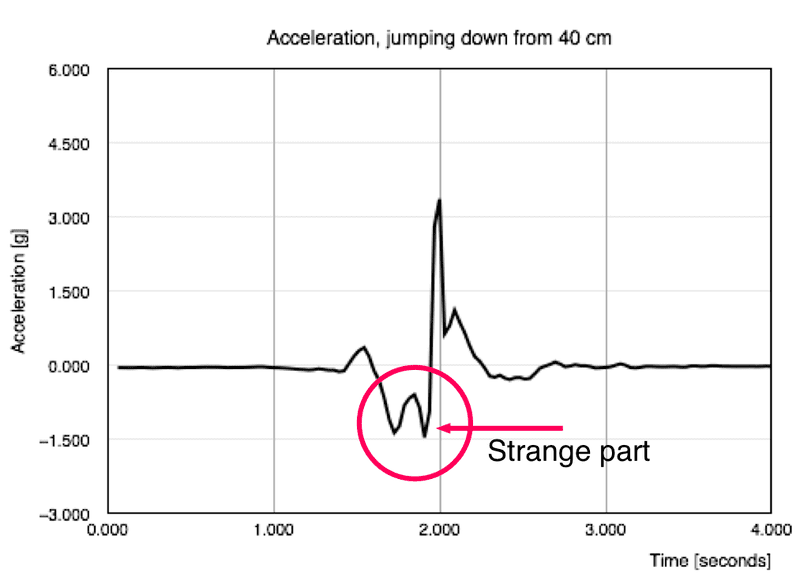
I have just performed some experiments with my phones accelerometer, and plotted the acceleration as a function of time from the raw data. The experiments I did was:
  • jumping down from a chair
  • jumping from the floor and up
  • let the device fall toward a bed
When I analyze the graphs, I think it's strange that the absolute value of the acceleration is more than g during the jumps, but close to g during the free fall (about 1.5g and 2.0g for jump from a 40 cm high chair and straight from the floor, respectively, during the free fall it seems). Can it be something I do during the jump (is technically possible without being stucked to the floor)?

During the jumping, the phone was fixed in the waist belt.

I attach the 3 graphs. Someone here who has an explanation for the marked strange parts in the graphs (it should be values of about -1, I think)?
RAn35DNU6N.png

J52Sz8jLDn.png

g3MCDvZw3B.png
 
Physics news on Phys.org
nickek said:
Can it be something I do during the jump (is technically possible without being stucked to the floor)?
Sure. The position of your waist relative to your center of mass changes if you change your body shape, e.g. change the position of your legs (something you certainly do in some way during the jump), which leads to an acceleration.

How did you take into account that the phone measures all three acceleration axes? Its orientation might change during the jump.

I don't know smartphone accelerometers well enough, but in general those things need some time for a proper measurement (in the same way a bathroom scale will need some time for the measurement). If acceleration changes suddenly, the values might be off.
 
  • Like
Likes   Reactions: nickek
Thank you. Maybe the position thing. About the acceleration axes, I just used the z-values (positive upward).
 
nickek said:
About the acceleration axes, I just used the z-values (positive upward).
The orientation of the phone can change, which will influence the measurement.
 
Try adding a line on the first graph at -1g.
 
It's also about frames of reference. When you're in an accelerating frame of reference, you feel an acceleration in the opposite direction to that of the reference frame. Say, for example you're in a very fast car( pick anyone you like, Aston Martin DB9, personally). When you put your foot down on the accelerator, you'll get pushed back into your seat. This is because you are in an accelerating reference frame.( Reference frame is basically the system you measure things in. So, if you make physical measurements in an accelerating car, you're in an accelerated reference frame. This is interesting stuff, so Google it for more info.) That force that pushes you back into your seat is a pseudo force- the effect of the acceleration.
Pseudo forces are needed in order for Newtons laws to appear correct in your frame of reference. The thing about these forces that you observe them to act in a direction opposite to your motion. That explains the negative acceleration.
An important thing about pseudo forces is that you only observe them in accelerated reference frame. So if some external observer was measuring your acceleration by some method, he wouldn't get these weird data. Because your accelerometer was strapped to you and hence also being accelerated, you got these weird results.
Btw, good job on the experiments- that's some good physics.
 
@UncertaintyAjay: Accelerometers at center of mass of an object in free fall will measure an acceleration of zero. As they expect to be on the surface of Earth, they subtract g and get -1 g acceleration in the lab frame. That's the baseline here. The thread is about the deviations from this -1 g.
 
Ah, but the reason an object in freefall feels weightless is because of the pseudo force in its frame of reference that's equal and opposite to the force of gravity on it. So maybe not that whole massive discussion but at least a small part of it is relevant to the topic right?
 
No, alright. I got what the thread is about. Apologies.
 
  • #10
I was doing the same vertical jump experiment and I came across this forum in search for an explanation for the same high acceleration pattern during flight i.e. free fall. It did not really make sense to me, even in an accelerated frame of reference. I played around a little and I came up with this explanation: I think it has mainly to do with the fact that you are usually stretching your body during the jump (hope that makes sense, I am not a native speaker) and what you actually do with your feet. When I tried to keep my feet flat during the jump, I ended up with accelerations closer to g during flight.
 

Similar threads

  • · Replies 10 ·
Replies
10
Views
3K
  • · Replies 2 ·
Replies
2
Views
2K
  • · Replies 11 ·
Replies
11
Views
4K
  • · Replies 1 ·
Replies
1
Views
2K
  • · Replies 11 ·
Replies
11
Views
3K
  • · Replies 19 ·
Replies
19
Views
4K
  • · Replies 8 ·
Replies
8
Views
6K
  • · Replies 1 ·
Replies
1
Views
6K
  • · Replies 2 ·
Replies
2
Views
16K
  • · Replies 26 ·
Replies
26
Views
10K