Stress around Fulcrum - How to Justify Net Momentum?

  • Context: Graduate 
  • Thread starter Thread starter 'roidbreaker
  • Start date Start date
  • Tags Tags
    Fulcrum Stress
Click For Summary
SUMMARY

The discussion centers on the justification of net momentum in a static square plate under various forces represented by f''(t) and f'(t). The participants clarify that while individual parts of the square may exhibit different momenta, the overall system remains static due to the net momentum being zero. The concept of conservation of energy is deemed inapplicable in this context since no movement occurs. The confusion arises from the misuse of the term "momentum" instead of "moment" about the axis.

PREREQUISITES
  • Understanding of static equilibrium and forces
  • Knowledge of momentum and moment in physics
  • Familiarity with the principles of conservation of energy
  • Basic concepts of vector analysis in mechanics
NEXT STEPS
  • Study the differences between momentum and moment in physics
  • Research static equilibrium conditions in rigid body mechanics
  • Learn about vector addition and its application in force systems
  • Explore the implications of conservation laws in static systems
USEFUL FOR

Physics students, mechanical engineers, and anyone involved in analyzing static systems and forces in mechanics.

'roidbreaker
Messages
14
Reaction score
0
"Stress" around fulcrum

helo,

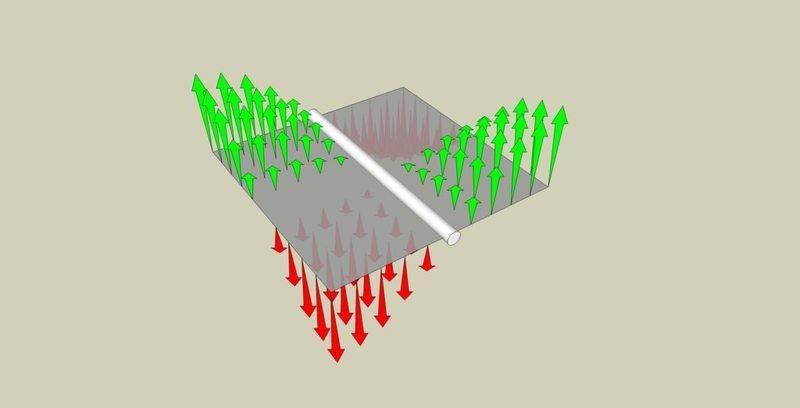
I have a couple of forces described in f''(t), and the f'(t) yields a momentum vector plane like pic:
YTb1kO7h.png


in this picture, we have a solid square plate of some hard material, and an axis where the white rod is.

Since the sum of the vectors on each side equal 0, the square is not rotating. What justification can I give to add -f'(t) to the system and demonstrate that f''(t)+(-f''(t))=0, and from that that the forces in f''(t) neutralize themselves and have no effect as long as the material does not transition into deformation?

Can I just say that the net momentum around the axis is 0 (by adding it all up), and cite conservation of energy?
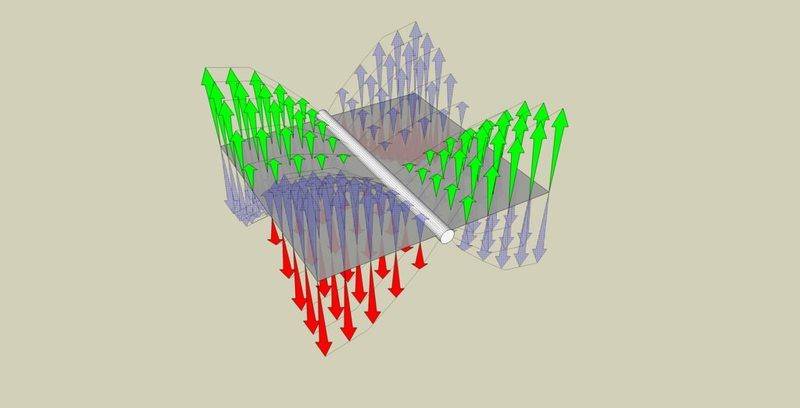
nMvQlAxh.png


thanks!
 
Last edited:
Physics news on Phys.org
Confusion: Is your square static or rotating ?
You are using the term; “Momentum” as applied to a moving mass; but do you mean “Moment” about an axis.
Force is not Energy unless something moves. Without movement here, conservation of energy is not applicable.
 
Baluncore said:
Confusion: Is your square static or rotating ?
You are using the term; “Momentum” as applied to a moving mass; but do you mean “Moment” about an axis.
Force is not Energy unless something moves. Without movement here, conservation of energy is not applicable.

discrete parts of the square would have various different "momentums" as indicated by the arrows, but the square as a whole isn't rotating, because the net momentum on both sides of the axis is zero.

actually forget the axis, the axis isn't doing anything and probably just confusing things.
 

Similar threads

  • · Replies 6 ·
Replies
6
Views
1K
  • · Replies 21 ·
Replies
21
Views
3K
  • · Replies 4 ·
Replies
4
Views
2K
  • · Replies 21 ·
Replies
21
Views
3K
  • · Replies 2 ·
Replies
2
Views
5K
  • · Replies 10 ·
Replies
10
Views
1K
  • · Replies 69 ·
3
Replies
69
Views
5K
Replies
7
Views
2K
  • · Replies 2 ·
Replies
2
Views
2K
Replies
23
Views
7K