Stress concentrations: find max d and min r on stepped bar

  • Thread starter Thread starter james_a
  • Start date Start date
  • Tags Tags
    Max Stress
Join the discussion
Registration is free. Ask a follow-up in this thread, or start your own.
2 replies · 7K views
james_a
Messages
7
Reaction score
0
The problem:
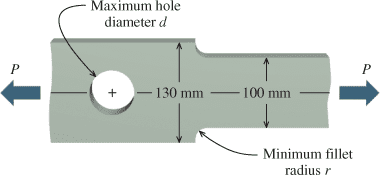
The stepped bar with a circular hole, shown in Figure P5.75, is made of annealed 18-8 stainless steel. The bar is 12-mm thick and will be subjected to an axial tensile load of P=70kN. The normal stress in the bar is not to exceed 150 MPa. To the nearest millimeter, determine
(a) the maximum allowable hole diameter d.
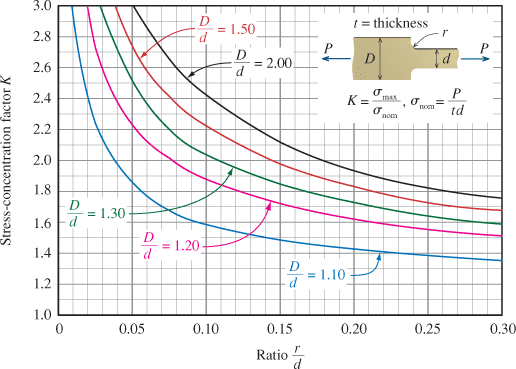
(b) the minimum allowable fillet radius r.​
Given figures:
w0438a.png

w0427.png
w0428.png


So let's talk about part a.
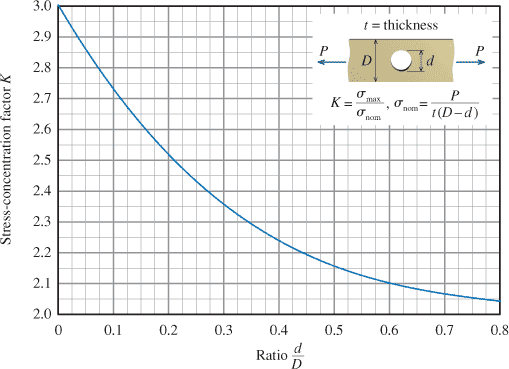
I understand that K=σmaxnom. D is given as a constant, so K seems to be a function which will vary with d.
σnom is also a function which will vary with d

Now if an actual formula were given for K in terms of d and D, we would have one equation and one unknown, and I would know how to solve for that. We just have a picture of the plot of K though. So how does one go about it? It seems the only way to do this is basically to just guess a d value, look up K, calculate σmax, and see how close you are to the 150MPa. Is it really just that? Or is there a better way to do this?

Thanks in advance to anyone who can shed some light on this.
 
Physics news on Phys.org
james_a said:
The problem:
The stepped bar with a circular hole, shown in Figure P5.75, is made of annealed 18-8 stainless steel. The bar is 12-mm thick and will be subjected to an axial tensile load of P=70kN. The normal stress in the bar is not to exceed 150 MPa. To the nearest millimeter, determine
(a) the maximum allowable hole diameter d.
(b) the minimum allowable fillet radius r.​
Given figures:
w0438a.png

w0427.png
w0428.png


So let's talk about part a.
I understand that K=σmaxnom. D is given as a constant, so K seems to be a function which will vary with d.
σnom is also a function which will vary with d

Now if an actual formula were given for K in terms of d and D, we would have one equation and one unknown, and I would know how to solve for that. We just have a picture of the plot of K though. So how does one go about it? It seems the only way to do this is basically to just guess a d value, look up K, calculate σmax, and see how close you are to the 150MPa. Is it really just that? Or is there a better way to do this?

Thanks in advance to anyone who can shed some light on this.

Yes, the procedure you describe would be how you found the size of the hole d, in the absence of knowing K as a function of the ratio (d/D).

Some plucky individuals might actually fit a curve thru various points taken from the K-factor graph and derive an expression for K in terms of (d/D), but that would be a lot of additional work that wouldn't be a good way to spend your time, unless you had a bunch of other similar problems like this to solve.
 
  • Like
Likes   Reactions: james_a
SteamKing said:
Yes, the procedure you describe would be how you found the size of the hole d, in the absence of knowing K as a function of the ratio (d/D).

Some plucky individuals might actually fit a curve thru various points taken from the K-factor graph and derive an expression for K in terms of (d/D), but that would be a lot of additional work that wouldn't be a good way to spend your time, unless you had a bunch of other similar problems like this to solve.

Thank you for your reply. I wanted to be sure I wasn't missing a more efficient way to go about it. I actually ended finding a fit curve with some stats software, and used that to solve for d, which came out to 37mm.