Sum of the Expected Values of Two Discrete Random Variables

Click For Summary
The discussion focuses on proving that the expected value of aX and bY equals aE[X] + bE[Y], where X and Y are discrete random variables. Participants clarify the transition from one line of the proof to another, emphasizing the use of marginal distributions and the law of total probability. An example with joint distributions is provided to illustrate how to derive marginal probabilities. There is a consensus that understanding these concepts is crucial for grasping the proof, with one participant acknowledging a need for further study. The conversation highlights the importance of clarity in mathematical notation, particularly regarding summation symbols.
TheBigDig
Messages
65
Reaction score
2
Homework Statement
Prove that E[aX+bY] = aE[X]+bE[Y]
Relevant Equations
[tex]E[X] = \sum_{x=0}^{\infty} x p(x)[/tex]
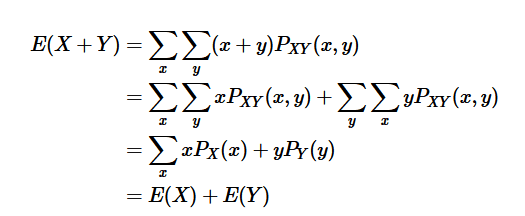
Apologies if this isn't the right forum for this. In my stats homework we have to prove that the expected value of aX and bY is aE[X]+bE[Y] where X and Y are random variables and a and b are constants. I have come across this proof but I'm a little rusty with summations. How is the jump from the second line to the third line made?
1602533296609.png
 
Physics news on Phys.org
The probability, ##P_X(x)##, for X taking a fixed value, x, is the sum over all values of Y of ##P_{XY}(x,y)##. So that is substituted in the third line. Likewise, the sum over all values of X of ##P_{XY}(x,y)## is replaced by ##P_Y(y)##.
 
It's because$$\sum_y x P_{XY}(x,y) = x \sum_y P_{XY}(x,y) = xP_X(x)$$where the second equality follows from the law of total probability.

N.B. I think you're missing a ##\sum## before the ##y P_Y(y)##
 
TheBigDig said:
How is the jump from the second line to the third line made?

Have you studied joint distributions and their associated "marginal distributions"?

As an example, suppose ##P_{X,Y}## is given by
##P_{X,Y}(1,1) = 0.4##
##P_{X,Y} (1,2) = 0.2##
##P_{X,Y} (2,1) = 0.3##
##P_{X,Y}(2,3) = 0.1##

The associated marginal distribution for ##X## is:
##P_X(1) = 0.6 = P_{X,Y}(1,1) + P_{X,Y}(1,2)##
##P_X(2) = 0.4##

The term ##\sum_x \sum_y x P_{X,Y}(x,y)## denotes:

##( (1) ( P_{X,Y}(1,1) + (1)P_{X,Y}(1,2) ) + ( (2) P_{X,Y}(2,1) + (2)P_{X,Y}(2,2))##
## = (1) P_X(1) + (2)P_X(x)##

In the next line, the term ##\sum_x x P_X(x)## also denotes
## (1) P_X(1) + (2)P_X(2) ##
 
Stephen Tashi said:
Have you studied joint distributions and their associated "marginal distributions"?

As an example, suppose ##P_{X,Y}## is given by
##P_{X,Y}(1,1) = 0.4##
##P_{X,Y} (1,2) = 0.2##
##P_{X,Y} (2,1) = 0.3##
##P_{X,Y}(2,3) = 0.1##

The associated marginal distribution for ##X## is:
##P_X(1) = 0.6 = P_{X,Y}(1,1) + P_{X,Y}(1,2)##
##P_X(2) = 0.4##

The term ##\sum_x \sum_y x P_{X,Y}(x,y)## denotes:

##( (1) ( P_{X,Y}(1,1) + (1)P_{X,Y}(1,2) ) + ( (2) P_{X,Y}(2,1) + (2)P_{X,Y}(2,2))##
## = (1) P_X(1) + (2)P_X(x)##

In the next line, the term ##\sum_x x P_X(x)## also denotes
## (1) P_X(1) + (2)P_X(2) ##

Okay yes, this definitely seems like something I need to read up on. Our instructor is a little handwavy at the moment saying we'll come across these concepts later but I'm one of those people who needs to understand each element.

etotheipi said:
It's because$$\sum_y x P_{XY}(x,y) = x \sum_y P_{XY}(x,y) = xP_X(x)$$where the second equality follows from the law of total probability.

N.B. I think you're missing a ##\sum## before the ##y P_Y(y)##

Thank you as well. Yes I think it is missing that. I found it online and just copied and pasted the image.
 
Question: A clock's minute hand has length 4 and its hour hand has length 3. What is the distance between the tips at the moment when it is increasing most rapidly?(Putnam Exam Question) Answer: Making assumption that both the hands moves at constant angular velocities, the answer is ## \sqrt{7} .## But don't you think this assumption is somewhat doubtful and wrong?

Similar threads

  • · Replies 5 ·
Replies
5
Views
1K
  • · Replies 7 ·
Replies
7
Views
2K
  • · Replies 2 ·
Replies
2
Views
2K
  • · Replies 30 ·
2
Replies
30
Views
4K
  • · Replies 12 ·
Replies
12
Views
2K
  • · Replies 8 ·
Replies
8
Views
2K
  • · Replies 2 ·
Replies
2
Views
2K
  • · Replies 10 ·
Replies
10
Views
2K
  • · Replies 4 ·
Replies
4
Views
3K
  • · Replies 1 ·
Replies
1
Views
4K