Switch Mode DC-DC step-down PSU design troubleshooting

Click For Summary

Discussion Overview

The discussion revolves around troubleshooting a switch mode power supply (PSU) designed for step-down voltage conversion using the LM2592 regulator. Participants explore various aspects of the circuit design, component selection, and performance issues, including output voltage discrepancies and load conditions.

Discussion Character

  • Technical explanation
  • Debate/contested
  • Experimental/applied

Main Points Raised

  • One participant reports an output voltage of ~18.6 VDC with a 5-watt LED load, while input voltage is 19.5 VDC and feedback voltage is 0.75 VDC, raising concerns about insufficient step-down.
  • Another participant suggests starting with a resistive load and a regulated lab PSU to address potential input filtering issues and low output load.
  • Concerns are raised about the adequacy of the 470 µF input capacitor and the suitability of the 100 mH inductor for the current requirements.
  • Participants discuss the possibility of running the transformer’s secondary windings in parallel to reduce resistive losses.
  • One participant emphasizes the importance of using a defined resistive load for testing instead of LEDs, recommending specific resistor values.
  • A participant highlights the feedback pin's voltage requirement of 1.23 V and notes that the observed 0.75 V could prevent proper operation, leading to no step-down and minimal heat generation.
  • Another participant questions whether the feedback pin is properly connected to ground.
  • After adjustments to the resistor values, one participant reports success in achieving the desired output voltage.
  • Further discussions include the potential for using a different version of the regulator IC that offers error reporting and the challenges of eliminating 120 Hz hum in the output.

Areas of Agreement / Disagreement

Participants express a mix of agreement and disagreement regarding troubleshooting methods and component choices. While some suggestions lead to successful outcomes, there remains uncertainty about the best practices for testing and component selection.

Contextual Notes

Participants mention various assumptions about component specifications, such as the inductor's current rating and the adequacy of input filtering, which may affect the overall performance of the PSU.

Who May Find This Useful

Electronics enthusiasts, engineers working on power supply design, and individuals troubleshooting similar switch mode power supply circuits may find this discussion beneficial.

TG_MechE
Messages
5
Reaction score
1
I am working on a switch mode psu in step down configuration with the key components being:
LM2592 (adj) http://www.ti.com/lit/ds/symlink/lm2592hv.pdf
530-PC-24-1000 http://www.mouser.com/ds/2/643/PC-594199.pdf
GSIB-25 http://www.vishay.com/docs/88646/gsib25xx.pdf

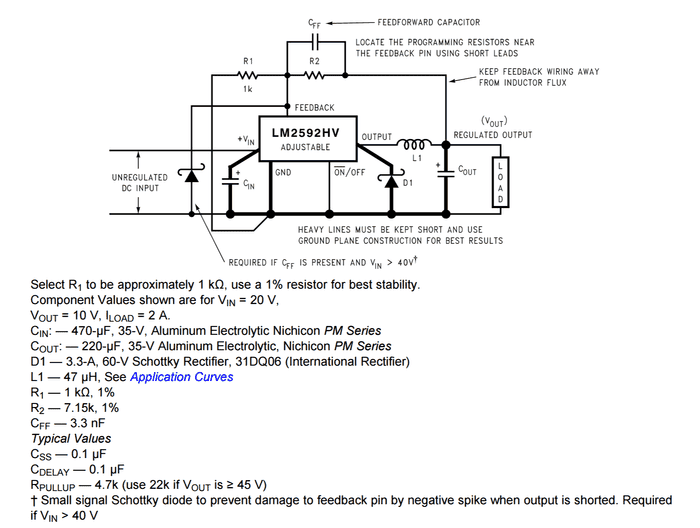
Using a slightly modified version of the example circuit where:
R2 = 23.82 KOhm
L1 = 100 mH
The diode on the left is not included but CFF is included as vin does not exceed 40vdc.
nf0ec4.jpg


I am using /HALF/ of the transformer and ending up with 20vdc at the output of the rectifier. (reading into this, it appears higher loads and adjustments of the filter capacitor should drop this down closer to 12vdc.) initially with both windings of the transformer attached, the rectifier was outputting a stunning ~40 vdc.

^this is not my issue however... (at least i don't think)

At the moment the power supply is outputting ~18.6 vdc... (to a 5watt load of LEDs)
With Vin reading 19.5 vdc and feedback to ground reading 0.75 vdc.

I am not sure why i am getting practically no step-down?

Adjusting R2 seems to have minimal affect on the output voltage.

It's also important to note that the LM2592 produces little to no heat... slightly disturbing..

Does anyone have a clue of some methods to troubleshoot this issue?
 
Engineering news on Phys.org
Well... For first run I would try to start it with resistive load and a regulated lab PSU for input. I think it'll be the inadequate amount of input filtering and low output load.
Also, you defined L1 as 100mH, but is the component OK for the current? By the way, are you sure it's a good idea to drive LEDs from medium grade fixed voltage source?
 
  • Like
Likes   Reactions: TG_MechE and davenn
I second Rive's observations.

My guess would be your 470 uf input capacitor is a bit skinny .
Pulling an amp out of a 470 uf drops its voltage 2.1 volts per millisecond,
ΔV/ΔT = I/C and there's 8 milliseconds between line cycle peaks.

Try tacking a 1000uf in parallel and see what happens?

And i hope by 100mh for your inductor you meant 100 Micro-henries not Milli-henries. Got a datasheet for it?
 
If the two secondary windings on the transformer are identical and isolated, then you might consider running them in parallel to reduce the resistive heat losses in the transformer secondary.

LEDs may just confuse things. You need to use a better defined resistive load during testing. I would start with a couple of 12 ohm, 10 watt, wire wound resistors in series.

It might help if you posted a photo of your circuit board with the components installed.
 
TG_MechE said:
...Does anyone have a clue of some methods to troubleshoot this issue?

You made a great first step right here:

TG_MechE said:
At the moment the power supply is outputting ~18.6 vdc... (to a 5watt load of LEDs)
With Vin reading 19.5 vdc and feedback to ground reading 0.75 vdc.
My high school electronics teacher lectured us boys "When all else fails , read the directions."
From that datasheet:
upload_2017-3-17_6-2-52.png


Feedback pin 4 wants 1.23 volts and is getting but 0.75, you say ? Good troubleshooting !
It'll stay saturated trying to raise feedback pin to 1.23 volts. So no stepdown and no heat. I like your powers of observation.

TG_MechE said:
Using a slightly modified version of the example circuit where:
R2 = 23.82 KOhm
L1 = 100 mH
What's R1 ? 1K as in drawing ?
Could it be as simple as:
1.23 = Vout X R1 / (R1+R2) = Vout / 24.82
to get 1.23 volts from a voltage divider of 1K and 23.8K will require 30.5 volts at output ?

Try adjusting ratio of R2/R1 to around (10/1.23) -1 ?
 
Last edited:
  • Like
Likes   Reactions: TG_MechE
TG_MechE. Have you tied pin 5, (off\on) to ground, or left it floating?
 
Jim, you are 100% correct!
I had put the incorrect voltage divider in!
Thank you so much for your help (and to everyone else who commented.)

R1 was 1K, I changed R2 to 10k to achieve roughly 13vdc (my end goal) and everything is working perfectly now.

I have included a picture for those who were interested.
2ebczz5.jpg

jim hardy said:
You made a great first step right here:

My high school electronics teacher lectured us boys "When all else fails , read the directions."
From that datasheet:
View attachment 114650

Feedback pin 4 wants 1.23 volts and is getting but 0.75, you say ? Good troubleshooting !
It'll stay saturated trying to raise feedback pin to 1.23 volts. So no stepdown and no heat. I like your powers of observation.What's R1 ? 1K as in drawing ?
Could it be as simple as:
1.23 = Vout X R1 / (R1+R2) = Vout / 24.82
to get 1.23 volts from a voltage divider of 1K and 23.8K will require 30.5 volts at output ?

Try adjusting ratio of R2/R1 to around (10/1.23) -1 ?
 
Rive said:
Well... For first run I would try to start it with resistive load and a regulated lab PSU for input. I think it'll be the inadequate amount of input filtering and low output load.
Also, you defined L1 as 100mH, but is the component OK for the current?By the way, are you sure it's a good idea to drive LEDs from medium grade fixed voltage source?

Ahh good point! The inductor claims to be good up to 1amp. I plan to draw roughly 0.7-0.5 amps at 13volts in the final application. As for the LED, it is purely for testing as it was available and capable of handling the power.
 
Baluncore said:
TG_MechE. Have you tied pin 5, (off\on) to ground, or left it floating?

Pin 5 is straight to ground for instant-on. As this is going to be used to drive and amplifier IC, a time delay on may be better?
 
  • Like
Likes   Reactions: jim hardy
  • #10
Thanks for the feedback, and congratulations on your success .

I really like that regulator IC, copied the datasheet to my "HandyThings to Know " folder.
Will get a few on next parts order.Thanks for the introduction to it !
 
  • Like
Likes   Reactions: TG_MechE
  • #11
jim hardy said:
Thanks for the feedback, and congratulations on your success .

I really like that regulator IC, copied the datasheet to my "HandyThings to Know " folder.
Will get a few on next parts order.Thanks for the introduction to it !

Good luck! There is another version of this IC with 2 more pins which provides error reporting as well. Now onto the arduous process of eliminating 120hz hum.
 
  • #12
jim hardy said:
I really like that regulator IC, copied the datasheet to my "HandyThings to Know " folder.
Will get a few on next parts order.Thanks for the introduction to it !
Assembled adjustable DC-DC buck converter modules, (using LM2596), cost less than $2 each on ebay.
 
  • Like
Likes   Reactions: jim hardy
  • #13
Baluncore said:
Assembled adjustable DC-DC buck converter modules, (using LM2596), cost less than $2 each on ebay.

Amazing times we live in. Thanks, Balun !
 

Similar threads

  • · Replies 8 ·
Replies
8
Views
2K
Replies
4
Views
2K
  • · Replies 7 ·
Replies
7
Views
5K
Replies
5
Views
4K
  • · Replies 1 ·
Replies
1
Views
4K