Take v(t) and h(t) to make v(h)

  • Context: Undergrad 
  • Thread starter Thread starter Adoniram
  • Start date Start date
Click For Summary
SUMMARY

The discussion focuses on deriving a velocity function, v(h), as a function of height from given functions v(t) and h(t). The height function h(t) is defined as an exponential function, which complicates finding an analytical inverse. Participants suggest using logarithmic transformations and spline fitting to approximate the relationship, while also discussing the integration of a force function F(t, h) over height. The integration approach involves converting the limits and differential elements appropriately, with numerical methods being a viable solution for practical applications.

PREREQUISITES
  • Understanding of velocity and height functions in physics
  • Familiarity with numerical integration techniques
  • Knowledge of polynomial and spline fitting methods
  • Basic calculus, particularly integration and differentiation
NEXT STEPS
  • Explore numerical integration methods in Python using libraries like SciPy
  • Learn about spline interpolation techniques for data fitting
  • Study logarithmic transformations and their applications in regression analysis
  • Investigate the properties of exponential functions and their inverses
USEFUL FOR

Mathematicians, physicists, and engineers involved in modeling dynamic systems, particularly those requiring integration of complex functions over varying parameters.

Adoniram
Messages
93
Reaction score
6
So I have some very complicated functions that do not have trivial inverses, but I'd really like to make a new function from them. What I have is:
v(t): velocity as a function of time
h(t): height as a function of time (never mind that is says hb)
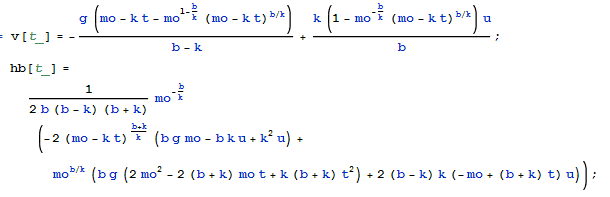
upload_2017-2-10_10-52-29.png


What I want:
v(h): velocity as a function of height

The height function goes as an exponential function, so there are no local minima to worry about:
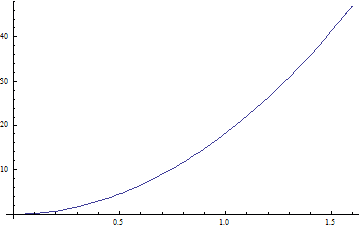
upload_2017-2-10_10-51-4.png


Other than fitting a polynomial to the h(t) function (which I'm not sure would be invertible anyway), does anyone know of a good way to combine these functions into v(h)?
 
Physics news on Phys.org
I don't know if there is a closed-form analytical solution, but since you are sure that h(t) is monotonically increasing, you could make a table of t as a function of h and fit a function through it.
From the looks of it, I would first try taking a logarithm of height and see if a regression line gives you the accuracy you want.
If that doesn't work, you can fit a spline function through it and make the resolution as good as you need. (A spline would only be practical if you make computer code to implement it.)
 
Last edited:
How/where do you need v(h)? It is easy to calculate individual points, and you can also calculate the derivative v'(h) analytically for every point where you know t.
If (b+k)/k is a small integer, it is possible to write down t(h) in closed form, otherwise it is probably impossible.

Introducing new variables for t-independent stuff would make the equations much more readable.
 
The reason I want this v(h) form is so that I can integrate a function which relies, in part, on v(t).

So... I have another function:
F(t,h)=c_1v(t)+c_2g(h)
where c_1 and c_2 are constants and g(h) is another well-understood function of height.
What I want to find is:
\int_{h=0}^{h_f}F dh
to find the work done by this force over some height. And since velocity and height are well-defined functions, I figured it would make my life easier to integrate over a single variable, dh, instead of trying to figure out how to get work from a function of both time and height.

So, if I could get t(h) and plug that into v(t(h)), my life would be easier...

Unfortunately, the quantity (b+k)/k will be, at best, 1 so it can't be ignored...
 
Ummm... maybe I could do this (please comment your thoughts!):

\int_{h=0}^{h_f} F dh = \int_{h=0}^{h_f} F dh \frac{dt}{dt} = \int_{t=0}^{t_f} F v(t) dt

Does that work, or is there a different conversion for the limits of integration or differential element that I'm forgetting?
 
Do you need it to be closed form or can you use numerical methods?
 
FactChecker said:
Do you need it to be closed form or can you use numerical methods?
Numerical results are perfectly fine!
 
Adoniram said:
Unfortunately, the quantity (b+k)/k will be, at best, 1 so it can't be ignored...
If it is 1, h(t) is a polynomial of degree 2, and easy to invert.

Numerically, you can just integrate over t and don't need anything special.
 
Yeah the problem is, it'll never be 1 in reality. It'll be something like (0.05+k)/k which is why it's so hard to invert.
 
  • #10
All that doesn't matter if you just need a numerical value for the integral.
 

Similar threads

  • · Replies 3 ·
Replies
3
Views
2K
  • · Replies 5 ·
Replies
5
Views
2K
  • · Replies 33 ·
2
Replies
33
Views
4K
  • · Replies 1 ·
Replies
1
Views
2K
Replies
34
Views
2K
  • · Replies 4 ·
Replies
4
Views
2K
  • · Replies 1 ·
Replies
1
Views
3K
  • · Replies 1 ·
Replies
1
Views
1K
  • · Replies 3 ·
Replies
3
Views
4K
  • · Replies 8 ·
Replies
8
Views
2K