Taylor Series Expansion of Quadratic Derivatives: Goldstein Ch. 6, Pg. 240

Click For Summary

Discussion Overview

The discussion revolves around the Taylor series expansion of derivatives in the context of kinetic energy expressions in classical mechanics, specifically referencing Goldstein's Classical Mechanics. Participants are exploring the implications of quadratic and linear terms in this expansion and their contributions to the kinetic energy in small oscillation scenarios.

Discussion Character

  • Technical explanation
  • Debate/contested
  • Mathematical reasoning

Main Points Raised

  • One participant questions why a quadratic term in the Taylor series expansion vanishes, referencing a specific passage from Goldstein.
  • Another participant argues that the quadratic term does not vanish, explaining that the kinetic energy expression already incorporates a quadratic term from the derivatives, leading to the neglect of higher-order terms for small oscillations.
  • A participant seeks clarification on how a linear term becomes cubic when substituted into a specific equation, indicating a need for further explanation of the mathematical operations involved.
  • Some participants assert that multiplying a quadratic term by a linear term results in a cubic term, emphasizing the order of terms in the context of small oscillations.
  • There is confusion regarding the nature of derivatives and their orders, with participants discussing how the multiplication of terms affects their overall order in the context of Taylor expansions.
  • One participant attempts to clarify their understanding of the displacement variable in small oscillation problems and how it relates to the Taylor expansion, specifically questioning the multiplication of derivatives and their contributions to the overall expression.
  • Another participant points out that inserting the expansion into the relevant equation yields a term that is cubic in small oscillations, challenging the doubts raised by others.
  • There is a mention of the relationship between the order of a differential equation and the multiplication of a variable by its derivative, indicating an exploration of the mathematical principles at play.

Areas of Agreement / Disagreement

Participants express differing views on the behavior of terms in the Taylor series expansion, particularly regarding the vanishing of certain terms and the implications for kinetic energy expressions. The discussion remains unresolved, with multiple competing interpretations of the mathematical relationships involved.

Contextual Notes

Participants reference specific equations and terms from Goldstein's text, which may introduce limitations based on the assumptions and definitions used in the discussion. The exploration of small oscillations and Taylor expansions is dependent on the context provided by the original material.
Ben Geoffrey
Messages
16
Reaction score
0
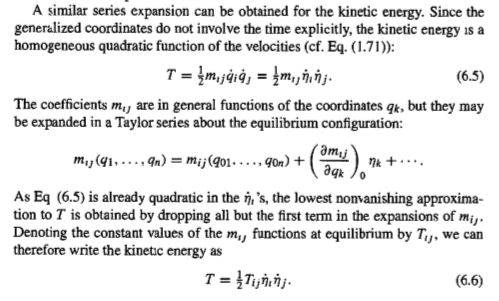
Can anyone tell me how if the derivative of n(n') is quadratic the second term in the taylor series expansion given below vanishes. This doubt is from the book Classical Mechanics by Goldstein Chapter 6 page 240 3rd edition. I have attached a screenshot below
osc.JPG
 

Attachments

  • osc.JPG
    osc.JPG
    27.5 KB · Views: 1,347
Physics news on Phys.org
It does not vanish and it is not what is being said. What is being said is that the expression for the kinetic energy already contains a quadratic term through the derivatives. Anything in the expansion of m that is of linear order or higher will therefore not contribute to the kinetic energy at quadratic order (eg, the linear term will lead to an overall cubic term) and can be neglected for small oscillations.
 
Can you tell me how the linear term in n becomes cubic when substituted in equation 6.5 ?

Appreciate your patience in dealing with amateurs
 
Something quadratic times something linear is something cubic.
$$
\mathscr O(x^2) \mathscr O(x) = \mathscr O(x^3)
$$
 
No but derivative of n is quadratic and n is linear, if we multiply both we we would get derivative of n square times n right ?
 
Ben Geoffrey said:
No but derivative of n is quadratic and n is linear, if we multiply both we we would get derivative of n square times n right ?
Which makes the term cubic in ##\eta##. Both ##\eta## and ##\dot\eta## count.

Also, it is not clear what you mean by "derivative of ##\eta## is quadratic". It is not, the point is that the expression for the kinetic energy is already quadratic in the small oscillations due to the appearance of ##\dot\eta_i \dot \eta_j##. Multiplying it by something that is linear therefore results in a cubic term.
 
No my doubt is x times derivative of x, will become x2 ?
 
Ben Geoffrey said:
No my doubt is x times derivative of x, will become x2 ?
It will be of second order in the small oscillations. When you assume that the oscillations are small, imagine writing ##x = \epsilon y##, where ##\epsilon## is a small fixed number. Then expand everything in ##\epsilon##. You should find that ##x## and ##\dot x## are of first order in ##\epsilon##.
 
Can you see I've understood it right, if x is displacement, in small oscillation problem we take x = xo + η where xo initial position is made to coincide with origin and hence becomes zero and there we have only the small displacement η . Now when substituting the first order Taylor expansion of mij into 6.5 in the second term we have to multiply the derivative of ni and the derivative of nj times n. That part is what I don't understand ?
 
  • #10
could you explain that part a little more ? what is the derivative of n ? and how does multiplying with n make it quadratic in n ? I understand if you multiply two same linear terms like x and x they become quadratic. But how come in this case ?
 
  • #11
When you insert the expansion of m into 6.5 you get a term proportional to ##\eta_k \dot \eta_i \dot\eta_j##. This term is obviously cubic in the small oscillations. Why do you doubt this?
 
  • #12
So its like the order of a differential equation ? y multiplied by y' . will have an order 2 ?
 

Similar threads

  • · Replies 2 ·
Replies
2
Views
1K
  • · Replies 2 ·
Replies
2
Views
6K
  • · Replies 3 ·
Replies
3
Views
4K
Replies
2
Views
1K
  • · Replies 5 ·
Replies
5
Views
1K
Replies
1
Views
6K
Replies
24
Views
8K
  • · Replies 7 ·
Replies
7
Views
4K
  • · Replies 9 ·
Replies
9
Views
4K