How to Derive the Taylor Series for log(x)?

Click For Summary
SUMMARY

The discussion focuses on deriving the Taylor series for the natural logarithm function, log(x), specifically addressing the confusion around its derivatives and the base of the logarithm. The correct derivative of log(x) is established as f'(x) = 1/x, evaluated at a point a, leading to f'(a) = 1/a. The participants clarify that "log" refers to the natural logarithm (ln) in this context, which resolves the discrepancies in the Taylor series terms presented.

PREREQUISITES
  • Understanding of Taylor series expansion
  • Knowledge of derivatives and their evaluation
  • Familiarity with natural logarithms (ln) and logarithm base change
  • Basic calculus concepts
NEXT STEPS
  • Study the derivation of Taylor series for various functions
  • Learn about the properties of natural logarithms and their applications
  • Explore examples of Taylor series expansions for functions like e^x and sin(x)
  • Review the concept of evaluating derivatives at specific points
USEFUL FOR

Students and educators in calculus, mathematicians focusing on series expansions, and anyone looking to deepen their understanding of logarithmic functions and their derivatives.

PainterGuy
Messages
938
Reaction score
73
Hi,

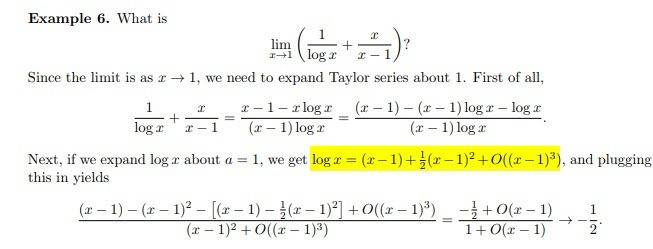
I was trying to solve the following problem myself but couldn't figure out how the given Taylor series for log(x) is found.
?hash=bd0a599335ca11df42aea03e1955cda2.jpg


Taylor series for a function f(x) is given as follows.

?hash=bd0a599335ca11df42aea03e1955cda2.jpg


Question 1:
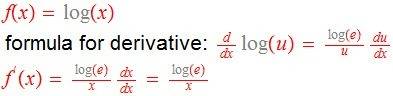
I was trying to find the derivative of log(x).
?hash=fec28be32c6920fd38d0c29f7bb45c83.jpg


My calculator gives it as d{log(x)}/dx=1/In(x)*x.

How do I convert log(e)/x to 1/In(x)*x? Logarithm base change formula isn't working for me. Thank you for your help!
 

Attachments

  • taylor_logx.jpg
    taylor_logx.jpg
    19.5 KB · Views: 2,354
  • taylor_fx.jpg
    taylor_fx.jpg
    4.5 KB · Views: 695
  • derivative_log.jpg
    derivative_log.jpg
    6.8 KB · Views: 713
Last edited:
Physics news on Phys.org
The log function in the example is the natural log, so log(e) = 1.
 
  • Like
Likes   Reactions: PainterGuy
Thank you!

Question 1:
vela said:
The log function in the example is the natural log, so log(e) = 1.

I believe that you are referring to Example 6 shown below.

taylor_logx-jpg.jpg


You can see that the Taylor series in Example 6 doesn't have "x" and "x²" in denominator for the first two terms. But the Taylor series found by me has "x" and "x²" in denominator as shown below. Where am I going wrong?

?hash=9dbb0151b0b8b6721b0e6e6da4430946.jpg
Question 2:

?hash=9dbb0151b0b8b6721b0e6e6da4430946.jpg


Thank you for your help.
 

Attachments

  • taylor_logx1.jpg
    taylor_logx1.jpg
    26.4 KB · Views: 1,200
  • derivative_log1.jpg
    derivative_log1.jpg
    21.5 KB · Views: 723
PainterGuy said:
Thank you!

Question 1:I believe that you are referring to Example 6 shown below.

View attachment 245372

You can see that the Taylor series in Example 6 doesn't have "x" and "x²" in denominator for the first two terms. But the Taylor series found by me has "x" and "x²" in denominator as shown below. Where am I going wrong?

View attachment 245373

I think you've calculated f'(x) = 1/x and f''(x) = -1/x^2, but forgot that these derivatives are evaluated at x = a, and should therefore be 1/a = 1 and -1/a^2 = -1.
 
  • Like
Likes   Reactions: PainterGuy
On your calculator, "log" means ##\log_{10}## whereas in the example "log" means ##\log_e## or what on your calculator is called ##\ln##. It's pretty common in mathematics to dispense with the ##\ln## notation and use ##\log## to refer to the natural logarithm.
 
  • Like
Likes   Reactions: PainterGuy
Thanks a lot!

I understand it now.

The following is a related example with a=2.

?hash=606c3838b1a7170a296b83086b9a1955.jpg


Also:

?hash=606c3838b1a7170a296b83086b9a1955.jpg
 

Attachments

  • related_example.jpg
    related_example.jpg
    31.3 KB · Views: 579
  • LOG_TAYLOR.jpg
    LOG_TAYLOR.jpg
    2.4 KB · Views: 567

Similar threads

  • · Replies 2 ·
Replies
2
Views
2K
  • · Replies 3 ·
Replies
3
Views
2K
  • · Replies 2 ·
Replies
2
Views
2K
  • · Replies 3 ·
Replies
3
Views
2K
  • · Replies 3 ·
Replies
3
Views
2K
  • · Replies 17 ·
Replies
17
Views
4K
  • · Replies 3 ·
Replies
3
Views
2K
  • · Replies 9 ·
Replies
9
Views
3K
  • · Replies 5 ·
Replies
5
Views
2K
  • · Replies 19 ·
Replies
19
Views
4K