Discussion Overview
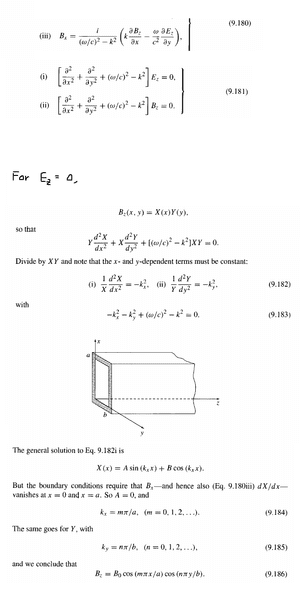
The discussion revolves around the boundary conditions for magnetic fields in a rectangular waveguide, specifically addressing why the magnetic field component Bx must equal zero at the boundaries x = 0 and x = a. Participants explore the implications of these conditions in the context of electromagnetic theory.
Discussion Character
- Technical explanation
- Conceptual clarification
- Debate/contested
Main Points Raised
- One participant questions the necessity of the condition dX/dx = 0 and why Bx must equal zero at the boundaries.
- Another participant states that the magnetic field B_n is continuous at a boundary and equals zero inside a perfect conductor, leading to B_n = 0 just outside the conductor.
- A participant suggests that the continuity of the normal component of the magnetic field can be derived from the absence of magnetic monopoles, referencing a potential derivation method involving a small pillbox at the boundary.
- There is a correction regarding the terminology used, with one participant clarifying that "monopole" was intended instead of "dipole."
- Some participants express confusion about the implications of B_n being zero, questioning whether this leads to Bx and By also being zero along the respective axes.
- It is clarified that only the normal component of the magnetic field is continuous, suggesting that the magnetic field can be parallel to the surface at the boundary.
Areas of Agreement / Disagreement
Participants exhibit some agreement on the continuity of the magnetic field components at the boundary, but there remains uncertainty and differing interpretations regarding the implications of these conditions on the components Bx and By.
Contextual Notes
There are unresolved assumptions regarding the definitions of magnetic field components and the conditions under which they are considered zero. The discussion does not reach a consensus on the implications of the boundary conditions.