Temperature change (first law of thermodynamics)

Click For Summary

Discussion Overview

The discussion revolves around the application of the first law of thermodynamics to the diurnal variation of air temperature, specifically addressing the relationship between heat flow and temperature change over time. Participants explore how temperature can continue to rise despite net heat loss during certain periods of the day.

Discussion Character

  • Exploratory
  • Technical explanation
  • Debate/contested

Main Points Raised

  • One participant presents a formula derived from the first law of thermodynamics, suggesting that temperature increases as long as the rate of heat flow (dQ/dt) is positive.
  • Another participant points out that the sun heats the ground rather than the air directly, implying a distinction in heat transfer processes.
  • A participant reiterates the initial formula and questions the reasoning behind temperature increases despite net heat loss, seeking clarification on the relationship between Q and dQ/dt.
  • It is noted that dQ/dt represents the current rate of solar heat flow, which remains positive throughout the day, and that the graph referenced indicates energy rate rather than cumulative energy.
  • A participant acknowledges the distinction between Eulerian temperature change (local change at a fixed position) and Lagrangian energy flux density (which varies along its path), suggesting a nuanced understanding of the concepts involved.

Areas of Agreement / Disagreement

Participants express differing views on the relationship between heat flow and temperature change, with some agreeing on the definitions of dQ/dt and its implications, while others question the reasoning behind the observed temperature patterns. The discussion remains unresolved regarding the implications of these concepts.

Contextual Notes

Participants reference specific conditions and assumptions related to the diurnal cycle and the nature of heat transfer, which may not be universally applicable or fully explored in the discussion.

jones123
Messages
10
Reaction score
0
Hi,

From the first law of thermodynamics it follows:

Cp * (δT/δt) = (δQ/δt)
where Cp = specific heat capacity, T = temperature, Q = heat, t = time

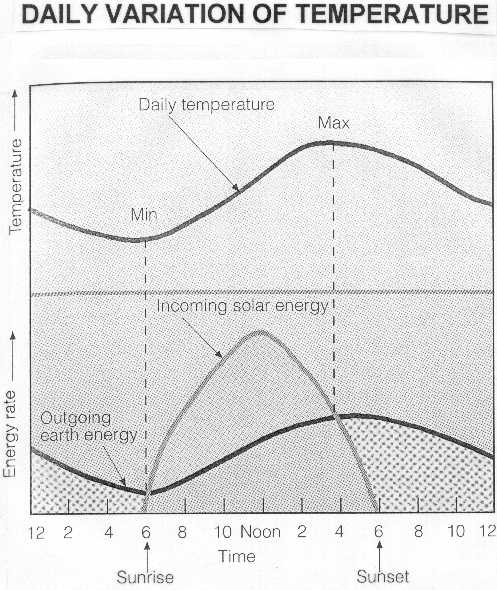
From this formula, you would derive that temperature keeps on increasing as long as dQ/dt > 0. But if you, for example, look at the idealized diurnal evolution of air temperature, it can be seen that the temperature keeps on increasing until its maximum value, despite the fact that there is net heat loss (dQ/dt < 0 for example between noon and 4h where the area between both curves becomes smaller)...

It seems that on the figure here the temperature keeps on rising as long as the value of Q itself > 0 but that doesn't necessarily mean that dQ/dt has to be > 0, right? Is my reasoning wrong or how can this correctly be explained with formulas?

Thanks already!
DailyT.jpg
 
Science news on Phys.org
The sun doesn't heat the air, it heats the ground.
 
jones123 said:
Hi,

From the first law of thermodynamics it follows:

Cp * (δT/δt) = (δQ/δt)
where Cp = specific heat capacity, T = temperature, Q = heat, t = time

From this formula, you would derive that temperature keeps on increasing as long as dQ/dt > 0. But if you, for example, look at the idealized diurnal evolution of air temperature, it can be seen that the temperature keeps on increasing until its maximum value, despite the fact that there is net heat loss (dQ/dt < 0 for example between noon and 4h where the area between both curves becomes smaller)...

It seems that on the figure here the temperature keeps on rising as long as the value of Q itself > 0 but that doesn't necessarily mean that dQ/dt has to be > 0, right? Is my reasoning wrong or how can this correctly be explained with formulas?

Thanks already!

View attachment 205308
dQ/dt is the current rate of solar heat flow. So throughout the day, current rate of solar heat flow is positive. The graph says Energy Rate, not cumulative amount of energy.
 
  • Like
Likes   Reactions: russ_watters
Chestermiller said:
dQ/dt is the current rate of solar heat flow. So throughout the day, current rate of solar heat flow is positive. The graph says Energy Rate, not cumulative amount of energy.
Oh I get it,

it's just that the temperature change is Eulerian (a local change at a fixed position) whereas the energy flux density is Lagrangian (it crosses the air on its path while having a negative or positive value).
 
jones123 said:
Oh I get it,

it's just that the temperature change is Eulerian (a local change at a fixed position) whereas the energy flux density is Lagrangian (it crosses the air on its path while having a negative or positive value).
Both are as reckoned by a "stationary" observer on the surface of the earth.
 

Similar threads

  • · Replies 3 ·
Replies
3
Views
2K
  • · Replies 5 ·
Replies
5
Views
2K
  • · Replies 1 ·
Replies
1
Views
2K
  • · Replies 46 ·
2
Replies
46
Views
6K
  • · Replies 8 ·
Replies
8
Views
3K
  • · Replies 2 ·
Replies
2
Views
3K
  • · Replies 15 ·
Replies
15
Views
3K
  • · Replies 4 ·
Replies
4
Views
2K
  • · Replies 1 ·
Replies
1
Views
3K
  • · Replies 2 ·
Replies
2
Views
2K