Tension Question with One Mass and Two Pulleys

Click For Summary
SUMMARY

The discussion clarifies the behavior of tension in a system involving two pulleys and a mass. It establishes that tension is not a force but rather a pair of equal and opposite forces along the rope. Specifically, tension always points away from the mass and the pulley, which can lead to confusion when analyzing the forces in a Free Body Diagram (FBD). The tension at one end of the rope may point upwards while at the other end it points downwards due to the constraints of Newton's 3rd law, which dictates that the force exerted by a rope is always attractive.

PREREQUISITES
  • Understanding of Newton's 3rd Law of Motion
  • Familiarity with Free Body Diagrams (FBD)
  • Basic knowledge of tension in ropes and pulleys
  • Concept of forces acting on fixed points in a mechanical system
NEXT STEPS
  • Study the principles of tension in mechanical systems
  • Learn how to construct and analyze Free Body Diagrams (FBD) for complex pulley systems
  • Explore the implications of Newton's 3rd Law in various mechanical contexts
  • Investigate the role of fixed supports in pulley systems and their effect on tension
USEFUL FOR

Physics students, mechanical engineers, and anyone interested in understanding the dynamics of tension in pulley systems.

singh101
Messages
14
Reaction score
4
Homework Statement
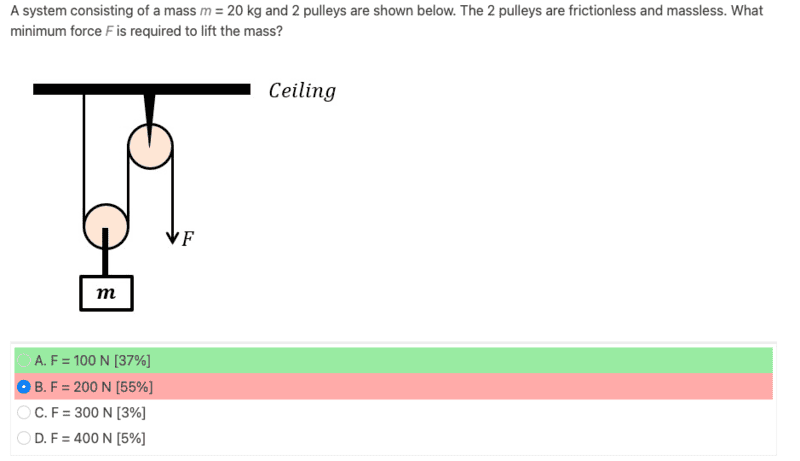
Hello, with this question I understand how to setup and get the answer. However, I was confused by a few points which led me to getting the wrong answer.
Relevant Equations
F=ma
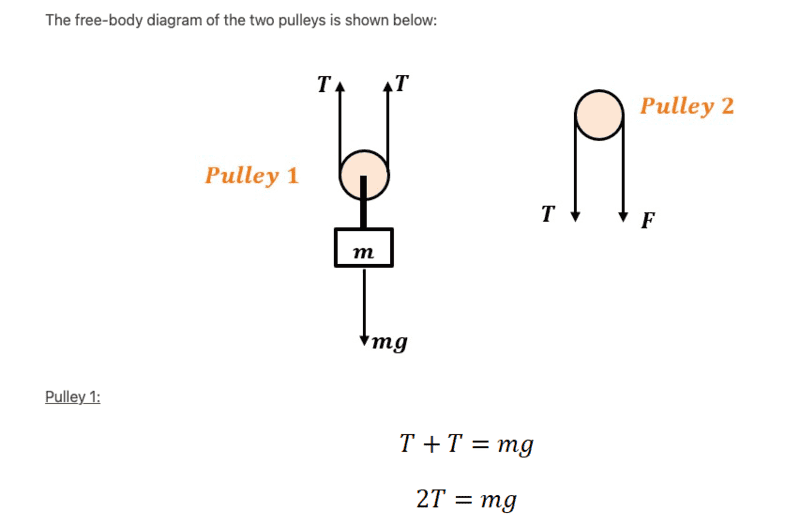
My question is how come the tension in pulley 2 is pointing downwards. I was under the impression that tension always points away from the mass.
Screen Shot 2024-01-18 at 6.37.26 PM.png
Screen Shot 2024-01-18 at 6.37.36 PM.png
 
Physics news on Phys.org
singh101 said:
My question is how come the tension in pulley 2 is pointing downwards. I was under the impression that tension always points away from the mass.
Tension (likewise compression) is not a force; rather, it is pairs of equal and opposite forces all along a line through the body experiencing it (the rope, here).
At each end, the force a tension exerts on the adjacent body is away from that body. When drawing the FBD of the suspended mass, it points away from the mass; when drawing the FBD of the pulley above, it points away from the pulley.
 
  • Like
Likes   Reactions: Delta2
For a pulley the tension from the adjacent ropes always points away from the pulley, not towards the pulley.
Imagine you have a rope between two boxes, the tension at each of the points where the rope meets each of the boxes points away from the boxes.
 
So for a pulley the tension will always point away from the pulley.
 
  • Like
Likes   Reactions: Delta2
singh101 said:
So for a pulley the tension will always point away from the pulley.
Yes, let me guess, your question is like, "How come at one end of the middle rope (where it meets pulley 1) the tension is upward and at the other end of the rope where it meets pulley 2 the tension is downwards? What exactly is happening inside the rope??" Is that your hidden question?
 
yes that was the thing that confused me because when setting up the question I put all the tension pointing upwards, however when I got the solution one of the tensions was point downwards.
 
  • Like
Likes   Reactions: Delta2
Well the answer lies on Newton's 3rd law and that the force from a rope to an adjacent body can only be attractive and not repulsive.

Why the force from a rope can be only attractive is a question that can be answered only by going into the realm of microscopic world which I don't want to do.

What Newton's 3rd law got to do here? Well imagine the infinitesimal portion ##dx## of the rope that is next to a pulley. According to Newton's 3rd the force from this dx of rope to the body (which can only be attractive as I said because we have a rope, newtons 3rd by default doesn't set requirement for attractive forces) lies on the line that connects the two bodies that is the piece of rope and the body.
 
  • Like
Likes   Reactions: Lnewqban and singh101
singh101 said:
yes that was the thing that confused me because when setting up the question I put all the tension pointing upwards, however when I got the solution one of the tensions was point downwards.
Note that the shown FBD of pulley 2 is missing the force of the support (applied at the axis).
As that pulley is fixed to the ceiling, it can't accelerate or move vertically; therefore, a force must be acting in opposite direction respect to T and F, and with magnitude T+F.

If you consider that the only function of pulley 2 is to change the direction of the rope in such a way that the pulling effort is made more comfortable for a person standing on the ground, the tension still "points away from the mass".

Raising-2x1.png
 
  • Like
Likes   Reactions: Delta2

Similar threads

  • · Replies 18 ·
Replies
18
Views
4K
  • · Replies 27 ·
Replies
27
Views
3K
  • · Replies 10 ·
Replies
10
Views
5K
Replies
19
Views
1K
  • · Replies 12 ·
Replies
12
Views
1K
  • · Replies 18 ·
Replies
18
Views
1K
  • · Replies 102 ·
4
Replies
102
Views
8K
  • · Replies 22 ·
Replies
22
Views
1K
  • · Replies 10 ·
Replies
10
Views
2K
  • · Replies 15 ·
Replies
15
Views
6K