Tensor product theorem 6.10 in Knapp's Basic Algebra

3 replies · 2K views · last reply
Math Amateur
Gold Member
MHB
Messages
3,920
Reaction score
48
I am reading Anthony W. Knapp's book: Basic Algebra in order to understand tensor products ... ...

I need some help with a further aspect of the proof of Theorem 6.10 in Section 6 of Chapter VI: Multilinear Algebra ...

The text of Theorem 6.10 reads as follows:
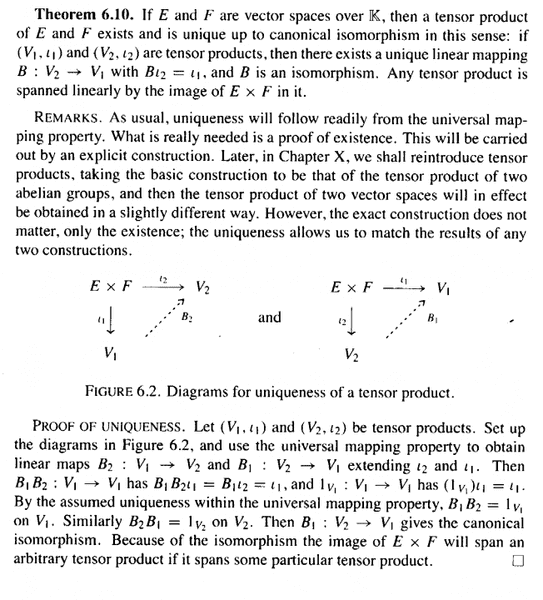
Printed page from a textbook showing Theorem 6.10 on tensor products and uniqueness up to canonical isomorphism, with Remarks, Figure 6.2 commutative diagrams for uniqueness, and the proof of uniqueness.

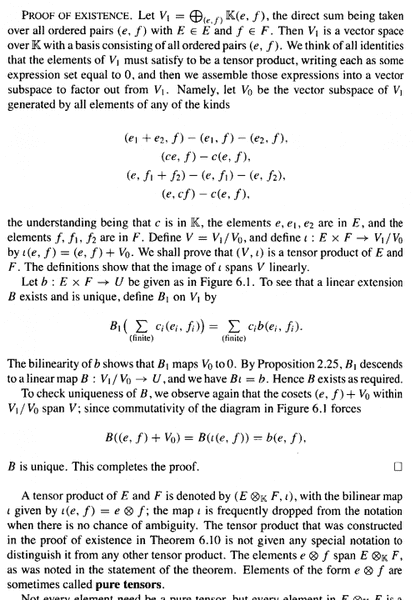
Printed proof from a algebra textbook: proof of existence of the tensor product, defining V1/V0, the map iota, and the induced linear map B, with equations in the direct sum over pairs (e, f).
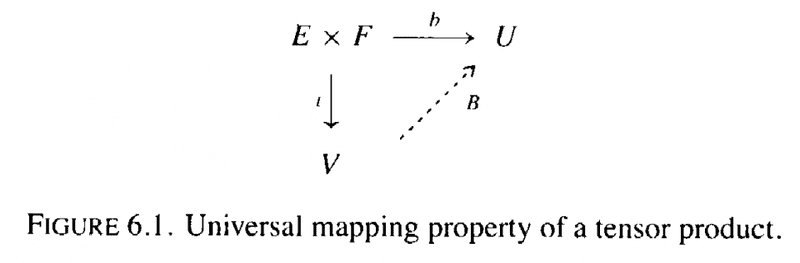
The above proof mentions Figure 6.1 which is provided below ... as follows:
Commutative diagram: E × F maps by b to U (top arrow), E × F maps by ι to V (left arrow), and a dashed arrow labeled B runs from V to U. Caption: Figure 6.1, universal mapping property of a tensor product.

In the above text, in the proof of Theorem 6.10 under "PROOF OF EXISTENCE" we read:

" ... ... The bilinearity of [itex]b[/itex] shows that [itex]B_1[/itex] maps [itex]V_0[/itex] to [itex]0[/itex]. By Proposition 2.25, [itex]B_1[/itex] descends to a linear map [itex]B \ : \ V_1/V_0 \longrightarrow U[/itex], and we have [itex]Bi = b[/itex]. "
My questions are as follows:Question 1

Can someone please give a detailed demonstration of how the bilinearity of [itex]b[/itex] shows that [itex]B_1[/itex] maps [itex]V_0[/itex] to [itex]0[/itex]?Question 2

Can someone please explain what is meant by "[itex]B_1[/itex] descends to a linear map [itex]B \ : \ V_1/V_0 \longrightarrow U[/itex]" and show why this is the case ... also showing why/how [itex]Bi = b[/itex] ... ... ?

Hope someone can help ...

Peter===========================================================*** EDIT ***

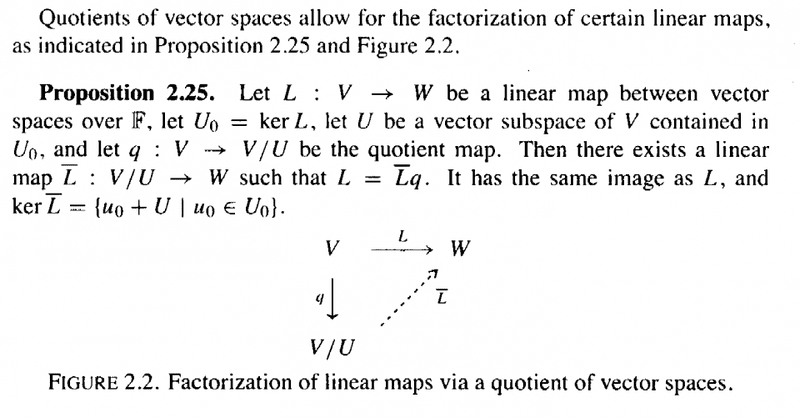
The above post mentions Proposition 2.25 so I am providing the text ... as follows:
Printed text of Proposition 2.25 on linear maps and quotients, with a commutative diagram: V maps to W by L, q goes down from V to V/U, and a dashed arrow labelled L-bar goes from V/U to W, with caption Figure 2.2.


============================================================*** EDIT 2 ***

After a little reflection it appears that the answer to my Question 2 above should "fall out" or result from matching the situation in Theorem 6.10 to that in Proposition 2.25 ... also I have noticed a remark of Knapp's following the statement of Proposition 2.25 which reads as follows:
Remark text reading: One says that L factors through V/U or descends to V/U.
So that explains the language: "[itex]B_1[/itex] descends to a linear map [itex]B \ : \ V_1/V_0 \longrightarrow U[/itex]" ... ...

BUT ... I remain perplexed over question 1 ...

Peter
 
Attachments
  • Theorem 6.10 from Knapp's Basic Algebra with its remarks and the proof of uniqueness of a tensor product, including Figure 6.2 showing two commutative diagrams with maps between E x F, V1 and V2.
    Knap - 1 - Theorem 6.10 - Part 1 ... ....png
    47 KB · Views: 665
  • Printed page of Knapp's Basic Algebra containing the proof of existence for the tensor product, defining the map B1 on V1 and the induced map B from V1/V0 to U.
    Knap - 2 - Theorem 6.10 - Part 2 ... ....png
    40.2 KB · Views: 634
  • Commutative diagram: E × F maps by b to U, E × F maps by ι down to V, and a dashed arrow labeled B runs from V to U. Caption: Figure 6.1, universal mapping property of a tensor product.
    Knapp - Figure 6.1 ....png
    11.7 KB · Views: 646
  • Printed text of Proposition 2.25 and Figure 2.2 from a linear algebra text: a linear map L from V to W factors through the quotient V/U via q and a map L-bar, with L = L-bar composed with q.
    Knapp - Proposition 2.25 ....png
    68.5 KB · Views: 649
  • Remark text reading: One says that L factors through V/U or descends to V/U.
    Knapp - 2 - Proposition 2.25 - PART 2 ....png
    4.1 KB · Views: 607
Last edited:
Math Amateur said:
I am reading Anthony W. Knapp's book: Basic Algebra in order to understand tensor products ... ...

I need some help with a further aspect of the proof of Theorem 6.10 in Section 6 of Chapter VI: Multilinear Algebra ...

The text of Theorem 6.10 reads as follows:
Printed page from a textbook showing Theorem 6.10 on uniqueness of tensor products, a remarks paragraph, two commutative diagrams labelled Figure 6.2 and a proof of uniqueness ending in a QED box.

Printed page from a textbook giving the proof of existence of the tensor product, Theorem 6.10, with the construction of V = V1/V0 and the bilinear map to the quotient, followed by a uniqueness argument using a commutative diagram.
The above proof mentions Figure 6.1 which is provided below ... as follows:
Commutative diagram for the universal mapping property of a tensor product: E x F maps to U by b, E x F maps down to V by i, and a dashed arrow labelled B runs from V to U.

In the above text, in the proof of Theorem 6.10 under "PROOF OF EXISTENCE" we read:

" ... ... The bilinearity of [itex]b[/itex] shows that [itex]B_1[/itex] maps [itex]V_0[/itex] to [itex]0[/itex]. By Proposition 2.25, [itex]B_1[/itex] descends to a linear map [itex]B \ : \ V_1/V_0 \longrightarrow U[/itex], and we have [itex]Bi = b[/itex]. "
My questions are as follows:Question 1

Can someone please give a detailed demonstration of how the bilinearity of [itex]b[/itex] shows that [itex]B_1[/itex] maps [itex]V_0[/itex] to [itex]0[/itex]?Question 2

Can someone please explain what is meant by "[itex]B_1[/itex] descends to a linear map [itex]B \ : \ V_1/V_0 \longrightarrow U[/itex]" and show why this is the case ... also showing why/how [itex]Bi = b[/itex] ... ... ?

Hope someone can help ...

Peter===========================================================*** EDIT ***

The above post mentions Proposition 2.25 so I am providing the text ... as follows:
Text from Figure 2.2: a commutative triangle diagram with V at top left, W at top right, and V/U at bottom left; arrow L from V to W, arrow q down from V to V/U, and dashed arrow L-bar from V/U to W, with the caption factorization of linear maps via a quotient of vector spaces.


============================================================*** EDIT 2 ***

After a little reflection it appears that the answer to my Question 2 above should "fall out" or result from matching the situation in Theorem 6.10 to that in Proposition 2.25 ... also I have noticed a remark of Knapp's following the statement of Proposition 2.25 which reads as follows:

Printed text reading: REMARK. One says that L factors through V/U or descends to V/U. The words factors through and descends are in bold.
So that explains the language: "[itex]B_1[/itex] descends to a linear map [itex]B \ : \ V_1/V_0 \longrightarrow U[/itex]" ... ...

BUT ... I remain perplexed over question 1 ...

Peter
... ... BUT NOTE ... after further reflection and work ...

I am having trouble applying Proposition 2.25 to Theorem 6.10 ... SO ... Question 2 remains a problem ... hope someone can help ...AND ... I remain perplexed over question 1 ...

Peter
 
Here is a way of thinking that may help with tensor products.

When one multiplies two numbers ##xy## ,for instance real or complex numbers, then the rules of ordinary multiplication and addition say that

##(ax)y = a(xy) = x(ay)##, ##(x_1 + x_2)y = x_1y + x_2y## and ##x(y_1 + y_2) = xy_1 + xy_2##

One would like to have exactly the same rules apply when ##x## and ##y## are vectors in two(usually different) vector spaces and ##a## is a scalar. Since it makes no sense to multiply vectors one needs to decide what a multiplication would mean. Your book defines the tensor product as the solution to a universal mapping problem. andrewkirk defines it in another way.

Whatever the construction one gets "products" ##x⊗y## in a new vector space, ##V⊗W##, that satisfy the rules of multiplication and addition. That is:

* ##a(x⊗y) = (ax)⊗y = x⊗(ay)##, ##(x_1+x_2)⊗y = x_1⊗y + x_2⊗y## and ##x⊗(y_1+y_2) = x⊗y_1+x⊗y_2##

This new vector space will be all linear combinations ##Σ_{i}a_{i}x_{i}⊗y_{i}## subject to the required rules of multiplication and addition. That is: the tensor product is just the vectors space of all symbols ##Σ_{i}a_{i}x_{i}⊗y_{i}## subject to the equivalence relations *

One can think of the tensor product of two vector spaces completely formally in this way. You tell yourself, " However it was constructed, this is what is must look like."

It is easy to check that a linear map from ##V⊗W## into another vector space,##U##, determines a bilinear map from ##V##x##W## into ##U## and visa versa.

Here is an exercise: Let ##V## be a vector space over the real numbers and view the complex numbers ##C## as a vectors space over the real numbers as well. What is the space ##V⊗C##? Is it a complex vector space?
 
Last edited:
  • Like
Likes   Reactions: Math Amateur
Inner products can also be defined on free abelian groups. ##g(x,y)## is a symmetric positive definite bilinear form that takes values in the integers. There is the additional condition that for every linear map ##L## of ##V## into the integers there is a unique ##v_0## such that
##L(w) = g(w,v_0)## for all ##w## in ##L##.

- Show that there is only one inner product on the integers.
 
Last edited: