Tensor - the indicial notation, beginners problem

Click For Summary
The discussion revolves around evaluating a matrix S_ij and a vector a_i through various problems labeled a) to e). For part a), the use of Einstein's convention is confirmed, identifying the result as the trace of the matrix. In part b), discrepancies arise in the sum of terms, with one participant obtaining 24 and another 28. The interchangeability of dummy indices in parts d) and e) is clarified, emphasizing that while changing indices is permissible, the problems themselves differ significantly. The conversation concludes with a suggestion to explore the Kronecker delta to understand the transition from E_ij to E_kk.
Dafe
Messages
144
Reaction score
0
1. The problem statement and attempt at solution

Given the matrix S_ij and a_i evaluate a),b),c),d) and e)
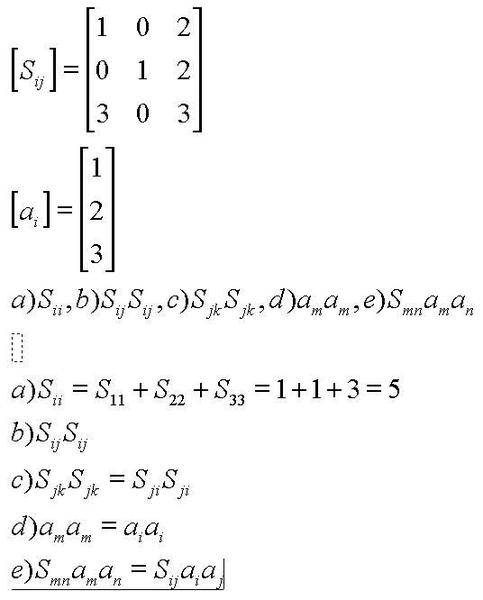
2A1.jpg


For a) I think i use Einsteins convention.
b) I just first sum on i, and then on j giving me 9 terms. The answer I get is 24.

d) can i change m with i since they are both dummy indexes?

e) the same problem as d I guess, is this allowed?

I'm trying to learn continuum mechanics by my self, and this is the first step.

Thank you.
 
Physics news on Phys.org
Dafe said:
1. The problem statement and attempt at solution

Given the matrix S_ij and a_i evaluate a),b),c),d) and e)

2A1.jpg


For a) I think i use Einsteins convention.
Yes, that is the sum of numbers on the main diagonal, also called the "trace".

b) I just first sum on i, and then on j giving me 9 terms. The answer I get is 24
?? I get 28, the sum of the squares of all terms. And, of course, (c) is exactly the same as (b).

d) can i change m with i since they are both dummy indexes?
Yes, but why would you want to? In any case this is the sum of the squares of the elements of a, 1+ 4+ 9.

e) the same problem as d I guess, is this allowed?
No, this is not at all the same problem as (d)! (d) was amam which is, as I said, the sum of the squares of the elements of a: the same as the 'dot product' of a with itself. In particular, there is no "S" in (d). (e) is Smnaman. Multiply the "matrix" S with the column vector a, then take the dot product of that with a.

I'm trying to learn continuum mechanics by my self, and this is the first step.

Thank you.[/QUOTE]
 
I didn't mean that e) was the same problem as d), I just wondered if I could change the indices from m to i and so on... You've answered that though, thank you very much!
 
I'll post some more questions here so I don't spam the forums, hope that's alright.

1. The problem statement and attempt at solution:

2A4-1.jpg


As I see it E_kk is a first order tensor and E_ij is a second order one. How do I go from E_ij to E_kk?

Thank you.
 
Try to find out what kronecker delta is! Then you will get the answer.
 
Question: A clock's minute hand has length 4 and its hour hand has length 3. What is the distance between the tips at the moment when it is increasing most rapidly?(Putnam Exam Question) Answer: Making assumption that both the hands moves at constant angular velocities, the answer is ## \sqrt{7} .## But don't you think this assumption is somewhat doubtful and wrong?

Similar threads

  • · Replies 2 ·
Replies
2
Views
3K
Replies
6
Views
1K
  • · Replies 1 ·
Replies
1
Views
2K
Replies
1
Views
1K
  • · Replies 5 ·
Replies
5
Views
1K
  • · Replies 7 ·
Replies
7
Views
744
  • · Replies 7 ·
Replies
7
Views
2K
  • · Replies 5 ·
Replies
5
Views
2K
  • · Replies 10 ·
Replies
10
Views
3K
  • · Replies 5 ·
Replies
5
Views
2K